
Fernando Stefani
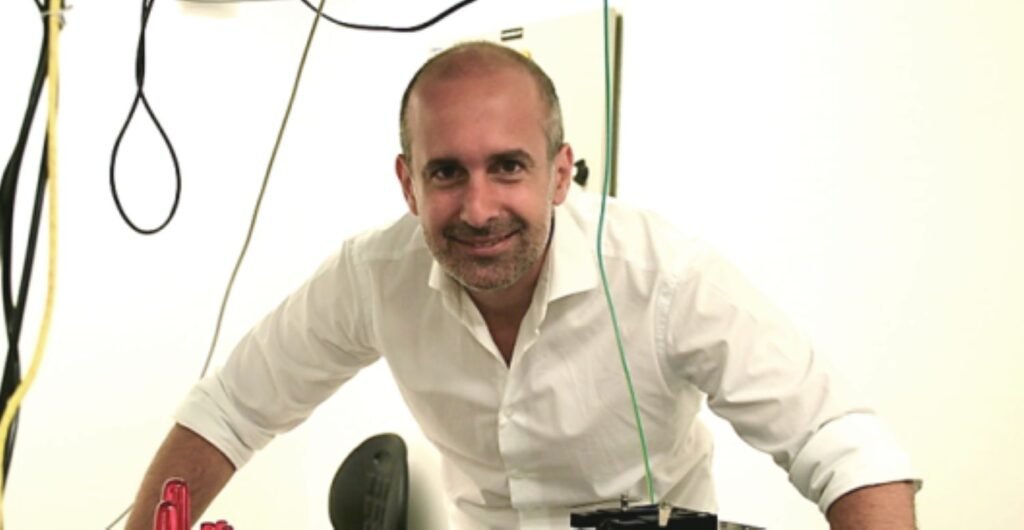
A human hair is between twenty thousand and one hundred and eighty thousand nanometers wide. A bacterium measures around two thousand. Fernando Stefani works several orders of magnitude below that: his laboratory can follow in real time as a DNA structure moves a tiny component between two positions separated by barely ten nanometers.
That is the scale where much of biology’s most interesting activity takes place, and also the scale that optics was unable to reach for more than a century. A large part of this Argentine physicist’s professional life has been devoted to pushing that limit, first in Germany and later, by his own choice, in Buenos Aires. His passion has two sides: a fascination with what cannot be seen and the determination to pursue it from Argentina.
An engineer who ended up among physicists
He began in 1997 at the Sábato Institute of Argentina’s National Atomic Energy Commission, studying Materials Engineering, a discipline he describes as applied solid-state physics. When the time came to work on his undergraduate thesis, he wanted to go abroad. He later recalled that he idealized foreign research institutes as if they belonged to another world and applied to many of them. In the end, two options remained: Manchester and the Max Planck Institute for Polymer Research in Mainz. He chose Germany and left in September 2000.
The first lesson was not scientific but one of perspective. He discovered that the corridors of those institutions were not filled with geniuses. They were filled with people who worked well and had enormous resources, and his own Argentine training held up perfectly well by comparison. He performed so well that he was invited back for a doctorate, which he completed in 2004 with the highest distinction.
Barcelona came next, working with Niek van Hulst at ICFO, followed by Munich in Jochen Feldmann’s group. Altogether, he spent eight years in Europe.
Returning for reasons that had nothing to do with work
This is where one of the traits that best defines him appears. When asked why he decided to return, Stefani did not talk about opportunities or laboratories. He said he has three siblings whose company he enjoys and that he wanted to be close to them. Then he added a sentence that explains much of his biography: he likes working, but work is not what determines where he lives.
He returned in October 2009. He joined the Physics Department at Exactas and CONICET. The office he was assigned was in terrible condition, and he began cleaning it himself until the department eventually sent painters. He estimated that setting up the laboratory properly would require between half a million and three-quarters of a million dollars in equipment, money he did not have. With a quarter of that amount, he said at the time, he could at least get started.
The laboratory that was built from scratch
Fifteen years later, that laboratory has become a regional reference in nanophotonics and super-resolution microscopy. Between 2011 and 2016, Stefani co-led a Max Planck Partner Group with Stefan W. Hell —winner of the 2014 Nobel Prize in Chemistry. That collaboration contributed to MINFLUX, a technique that can locate fluorescent molecules with unprecedented precision and was presented in Science in late 2016.
Another step followed: interleaved-pulsed MINFLUX, or pMINFLUX, developed with Philip Tinnefeld’s team in Munich. The microscope operating at CIBION, with hardware and software built at the institute itself, can track two molecules simultaneously with nanometer precision and can even locate molecules that absorb light without emitting it.
What comes next is even more ambitious. His group is adapting the technique for living cells and, together with IBIOBA, aims to observe axonal transport —the internal distribution system of neurons— with one-nanometer spatial resolution and microsecond timescales. The goal is to compare healthy neurons with others carrying mutations associated with neurodegenerative diseases. These are processes that can take decades to become visible, while the mechanisms behind them are too subtle for other methods to capture.
Training people, the other half of the job
There is one figure on his résumé that usually attracts less attention than his papers: more than twenty young researchers began their careers in his laboratory and later moved on to academia or high-technology companies. Two of the five best experimental physics theses in the country also came from his group, according to the biennial award of the Argentine Physical Association.
For someone who returned to a run-down office with no equipment, that may be the hardest thing he has built: not the microscope itself, but the people capable of using it and building the next one.
When passion forces you to speak
In recent years, Stefani has found himself in a less comfortable position. He has become one of the most frequently cited voices in Argentina’s debate over science policy, often delivering harsh assessments. He argues that the country is not going through a period of development but accumulating setbacks in science and technology, and he has spoken about how painful it is to see researchers once again being pushed to leave. He has also participated in congressional Science and Technology committee hearings.
Coming from someone who left, could comfortably have stayed abroad and deliberately chose to return, that concern carries particular weight. It is not an abstract complaint about budgets. It is a defense of the concrete possibility that someone else might be able to do here what he did.
What holds it all together
The image that best captures his passion is not an award or a magazine cover. It is a piece of DNA origami moving an arm by ten nanometers while someone watches it happen live through a microscope built in Buenos Aires.
Stefani has spent twenty-five years pushing the boundary of what can be observed. What is unusual is that he chose to do it from the place where he wanted to live, rather than from the place where it would have been easiest.