
Milo Lockett
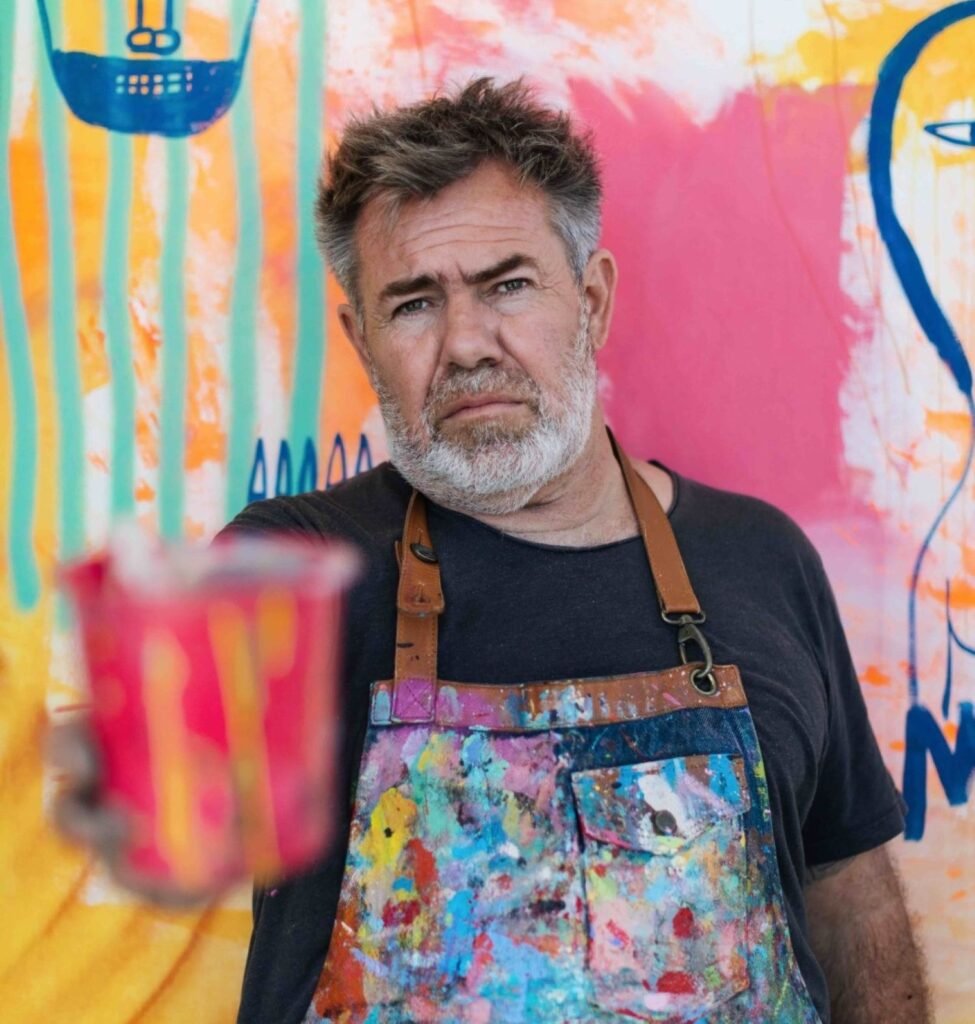
Some artists pursue posterity. Others pursue something harder: getting art into ordinary people’s homes, schools and hospitals. Milo Lockett, the artist from Chaco whose colorful faces have become part of Argentina’s visual identity, belongs to the second group. His story is one of a passion he came to late and embraced completely. He owned a textile factory in Resistencia until the 2001 crisis swept it away. Rather than rebuild the business, he decided to devote himself to the one thing he had always wanted to do. Twenty-five years later, his work hangs in museums and galleries in Argentina and abroad, and he still paints the way he did when he started: every day.
2001: The Bankruptcy That Brought Him Back to Painting
His career began almost by chance, when the economic collapse of 2001 forced him to close the textile factory he ran in Chaco. With no formal training in art, he made do with what he had. He painted on kraft paper he could roll up and carry, hanging his work with wire and clips wherever someone would give him space. That makeshift setup was a statement in itself. What mattered was painting and showing the work, without waiting for recognition.
Recognition came quickly anyway. In 2005, he held his first exhibition in Buenos Aires and painted the elevators at Galerías Pacífico, in the Centro Cultural Borges, putting his work in front of thousands of people every day. That same year, he won an OSDE award. He made his ArteBA debut in 2006 with gallery owner Teresa Anchorena and, by his own account, had his best year in 2008, when he won several national awards. The self-taught painter had become a hit with the public.
Art for Everyone: A Passion with a Purpose
What sets Lockett apart is as much about who he paints for as what he paints. His belief fits into a line he has repeated for two decades and that the BADA art fair has taken to heart: “Art has to be affordable.” When he parted ways with his representative, he opened his own gallery and organized group exhibitions of small-format works with a hundred artists. He was convinced the art world could expand from the ground up.
That conviction found a natural home at BADA, the fair founded by Ana Spinetto where artists sell directly to the public. Lockett is one of its most recognizable faces. The edition held at La Rural from August 27 to 30, 2026, brought together about 350 artists, following an earlier edition that drew more than 100,000 visitors. Something happens there, he says, that traditional galleries don’t allow: “The artist can put their work into words,” with no one in between.
Color Where It’s Needed Most
His belief that art belongs beyond gallery walls has taken concrete form in years of projects with UNICEF, the Garrahan Foundation and INADI, and in works conceived for schools, hospitals and public spaces ahead of collectors’ living rooms. His simple lines and saturated colors bring faces, fantastical animals and stray words into pediatric wards and classrooms across Argentina, where they have become a familiar presence.
Working with children is part of how he makes art. Lockett paints in public, lets children watch him work and turns each exhibition into an open-air workshop. That practice of meeting people directly helps explain a rare distinction in Argentine contemporary art: people who have never set foot in a gallery know his name.
Clay, Water and What Comes Next
Lockett has lived in Buenos Aires for years. “I’ve lived near Patio Bullrich for sixteen years,” he says. The shopping center’s PATIOarts space has become a regular venue for his work. There he presented Irupé, a free exhibition inspired by the Guaraní legend of a flower from Argentina’s Litoral region, a story that has moved him since childhood. In a white gallery, his familiar creatures took on a mythic form. He has already hinted at where his work will go next: “I’m going back to working with clay and water.”
Chaco, where he lived until 2011 and which he describes as a province with “a rich culture,” remains the source of the imagery that runs through his work. A quarter of a century after his factory closed, the same idea that carried him through 2001 still guides him. Painting is his way of being in the world, and sharing what he paints is his way of giving back. The next fair, the next hospital or the next white gallery is already waiting for him.