
Ronnie Wood
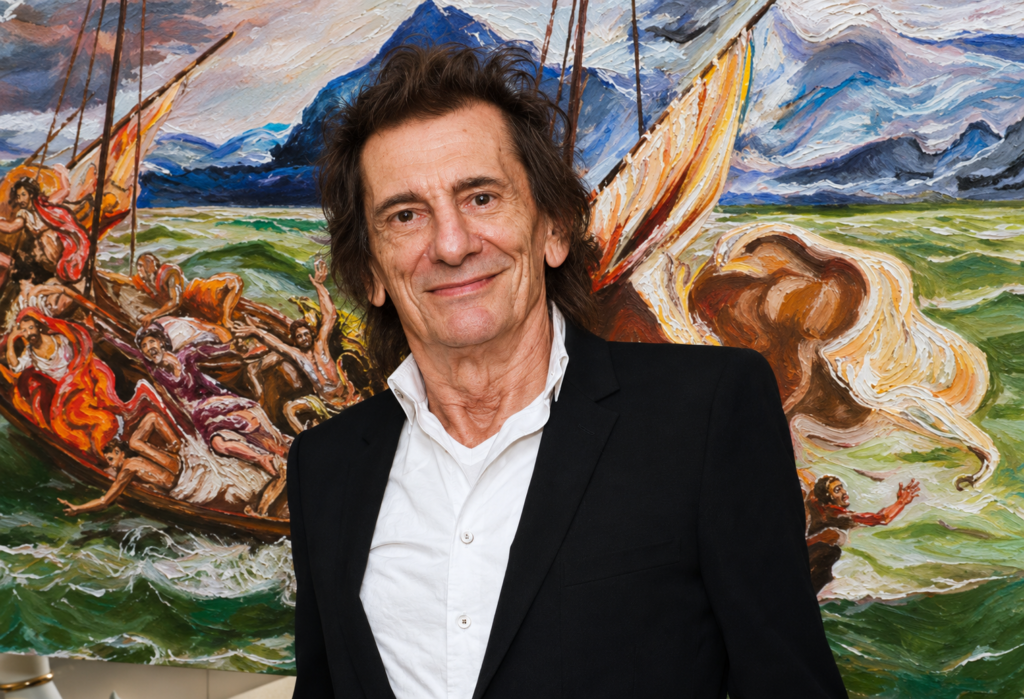
At 79, Ronnie Wood still divides his time between guitar and painting. In November 2026, he returns to South America for his own shows, with Buenos Aires, Rosario and Santiago listed on his official schedule. An interview with Mario Pergolini on El Trece’s Otro día perdido was also announced for November 4.
The visit comes more than six decades into a career that includes two inductions into the Rock and Roll Hall of Fame and ongoing work both within and outside the Rolling Stones. Alongside records and tours, he has built a career involving exhibitions, books and solo recordings that began before he joined the band.
A childhood between drawing and guitar
Wood was born on June 1, 1947, in Hillingdon, west London, into a family of river boatmen. His older brothers, Art and Ted, were involved in music and visual art. Ronnie grew up interested in both and maintained that connection throughout his life.
In 1964, he joined The Birds as a guitarist. He also played with The Creation before joining the Jeff Beck Group in 1967, playing bass on Truth and Beck-Ola.
In 1969, he formed Faces with Rod Stewart, Ronnie Lane, Ian McLagan and Kenney Jones. The band brought together musicians from the Jeff Beck Group and Small Faces, allowing Wood to focus on guitar again.
Alongside his work with Faces, he contributed to Stewart’s early solo albums. That period established musical relationships that continued after the band split.
More than half a century with the Rolling Stones
Wood began playing with the Rolling Stones in 1975, following Mick Taylor’s departure. He initially joined them on tour and was invited to become a permanent member in early 1976.
With Keith Richards, he developed an approach based on constant interaction between their guitars. Richards describes it as “the ancient art of weaving”: their parts overlap, blurring the distinction between rhythm and lead. Wood also contributed slide and pedal steel guitar.
He entered the Rock and Roll Hall of Fame with the Stones in 1989 and received the honor again with Small Faces/Faces in 2012.
His recent work includes Hackney Diamonds (2023) and Foreign Tongues, released on July 10, 2026. Describing the new album as a recording still awaiting release would therefore leave the account out of date.
His solo career
Before becoming a permanent Stone, Wood had already released I’ve Got My Own Album to Do (1974). His solo discography continued with albums including Gimme Some Neck, Slide on This and I Feel Like Playing.
In 2025, he released Fearless: Anthology 1965–2025, a collection covering his different bands and solo work, alongside new recordings.
That history forms the basis of his 2026 tour. The repertoire draws on The Birds, The Creation, the Jeff Beck Group, Faces, the Rolling Stones and his solo albums. The announced South American dates include Buenos Aires’ Movistar Arena on November 6, Rosario’s Teatro Metropolitano on November 8 and Santiago’s Teatro Caupolicán on November 10.
The musician who also paints
Painting has accompanied Wood since before his recognition as a musician. His work includes portraits, concert scenes and compositions featuring bandmates and other cultural figures.
Over time, that activity developed through exhibitions and relationships with galleries. Music frequently appears in his paintings, but his visual work also covers other subjects.
His career brings together two practices requiring different settings and rhythms: the collective work of a band and the concentration of working at a canvas. Neither has been confined to an earlier chapter of his life.
He also published the autobiography Ronnie (2007) and the art book Ronnie Wood: Artist (2017). The latter offers an overview of his visual work and relationship with drawing rather than serving as a conventional second autobiography.
Health, family and continuing to work
Wood has spoken publicly about alcohol problems and rehabilitation. In 2025, he celebrated fifteen years of sobriety.
He has also faced two cancer diagnoses. He underwent surgery for lung cancer in 2017 and, following a second diagnosis in 2020, announced in 2021 that he was cancer-free.
He has been married to Sally Humphreys since 2012. Their twin daughters, Gracie Jane and Alice Rose, were born in 2016, joining his four other children.
Those experiences belong to a long biography, but they do not alone explain his continued artistic activity. That continuity is visible in the work: recording, preparing set lists, rehearsing, painting and performing again.
In 2026, Wood continues all those activities. His South American visit brings several stages of his career into one repertoire, while the Rolling Stones keep adding records to a history he has been part of for more than fifty years.
Ronnie Wood: una vida entre la guitarra y la pintura
Ronnie Wood tenía diecisiete años cuando empezó a tocar con The Birds. A los 79 sigue subiendo a los escenarios, aunque su carrera nunca se limitó a la música. Entre giras y grabaciones encontró tiempo para pintar, exponer y publicar libros. La guitarra y el pincel lo acompañan desde antes de que se convirtiera en un Rolling Stone.
En noviembre de 2026 vuelve a Sudamérica con una gira propia que incluye Buenos Aires, Rosario y Santiago de Chile. El repertorio recorre las bandas por las que pasó y sus discos solistas. Es una oportunidad para escuchar una parte de su historia que suele quedar detrás de los grandes éxitos de los Stones.
Antes de los Rolling Stones
Nació el 1 de junio de 1947 en Hillingdon, al oeste de Londres, en una familia de barqueros fluviales. Sus hermanos mayores, Art y Ted, estaban vinculados con la música y las artes visuales. Ronnie creció dibujando y tocando la guitarra, sin pensar que debía elegir una sola actividad.
En 1964 se incorporó a The Birds, una banda británica de rhythm and blues. Después pasó por The Creation y llegó al Jeff Beck Group, donde cambió de instrumento: tocó el bajo en Truth y Beck-Ola. Allí compartió escenario con Rod Stewart.
Cuando esa formación se disolvió, Wood y Stewart se unieron a Ronnie Lane, Ian McLagan y Kenney Jones para formar Faces en 1969. Wood volvió a la guitarra y participó en canciones como “Stay With Me” y “Ooh La La”. También colaboró en los primeros álbumes solistas de Stewart.
Faces combinaba canciones cuidadas con actuaciones que podían parecer a punto de desbordarse. Esa manera de tocar, apoyada en la complicidad entre los músicos, fue parte de la experiencia que Wood llevó después a los Stones.
La guitarra que se cruza con Keith Richards
La salida de Mick Taylor abrió un lugar en los Rolling Stones. Wood empezó a tocar con ellos en la gira de 1975 y se incorporó de manera permanente a comienzos de 1976.
Con Keith Richards desarrolló un intercambio en el que resulta difícil separar quién acompaña y quién lleva la melodía. Richards lo llama «el antiguo arte de tejer»: una guitarra deja espacio y la otra lo ocupa; las frases se responden y las funciones cambian durante la canción.
Wood también sumó slide y pedal steel. Su participación se extendió por discos, giras y distintas etapas de la banda, hasta trabajos recientes como Hackney Diamonds, de 2023, y Foreign Tongues, publicado en julio de 2026.
El Rock and Roll Hall of Fame lo incorporó dos veces: con los Rolling Stones en 1989 y con Small Faces/Faces en 2012.
Los discos que llevan su nombre
Su carrera solista había empezado antes de entrar definitivamente a los Stones. En 1974 publicó I’ve Got My Own Album to Do. Después llegaron, entre otros, Gimme Some Neck, Slide on This e I Feel Like Playing.
Esos discos le dieron un espacio para cantar, componer y trabajar con músicos fuera de la estructura de su banda principal. También permitieron escuchar sus intereses en el blues, el soul y el rock desde otro lugar.
En 2025 publicó Fearless: Anthology 1965–2025, una recopilación que reúne distintas etapas de su recorrido e incorpora nuevas grabaciones. Ese material sirve de punto de partida para las presentaciones de 2026.
Frente al caballete
Wood pintaba antes de tener una carrera musical. Con el tiempo, sus dibujos y cuadros empezaron a circular en galerías y exposiciones.
En muchas obras aparecen músicos que conoce de cerca: sus compañeros de los Stones, artistas con los que compartió escenario y figuras que admira. Hay retratos, escenas de conciertos y composiciones donde intenta registrar el movimiento de una actuación.
La pintura tiene, además, un ritmo distinto del de las giras. Puede trabajar solo, detenerse en un detalle y volver sobre una imagen. Su libro Ronnie Wood: Artist, publicado en 2017, reúne esa parte de su producción. Diez años antes había contado episodios de su vida en la autobiografía Ronnie.
Seguir después de los problemas de salud
Wood habló públicamente de su consumo de alcohol y de sus tratamientos de rehabilitación. En 2025 celebró quince años de sobriedad.
También atravesó dos diagnósticos de cáncer. En 2017 fue operado por un cáncer de pulmón. Después de un segundo diagnóstico en 2020, anunció en 2021 que estaba libre de la enfermedad.
Desde 2012 está casado con Sally Humphreys. En 2016 nacieron sus mellizas, Gracie Jane y Alice Rose, que se sumaron a sus otros cuatro hijos.
La familia, la recuperación y el trabajo conviven en esta etapa de su vida. Wood continúa preparando conciertos y grabaciones, y conserva un lugar para pintar entre esas obligaciones.
Su carrera ya supera las seis décadas, pero el repertorio que lleva a Sudamérica evita reducirla a una sola banda. Antes de los Stones estuvieron The Birds, Jeff Beck y Faces; después llegaron más discos, colaboraciones y cuadros. En cada escenario vuelve a encontrarse con algo de todo ese recorrido.