
Claudio Bertonatti
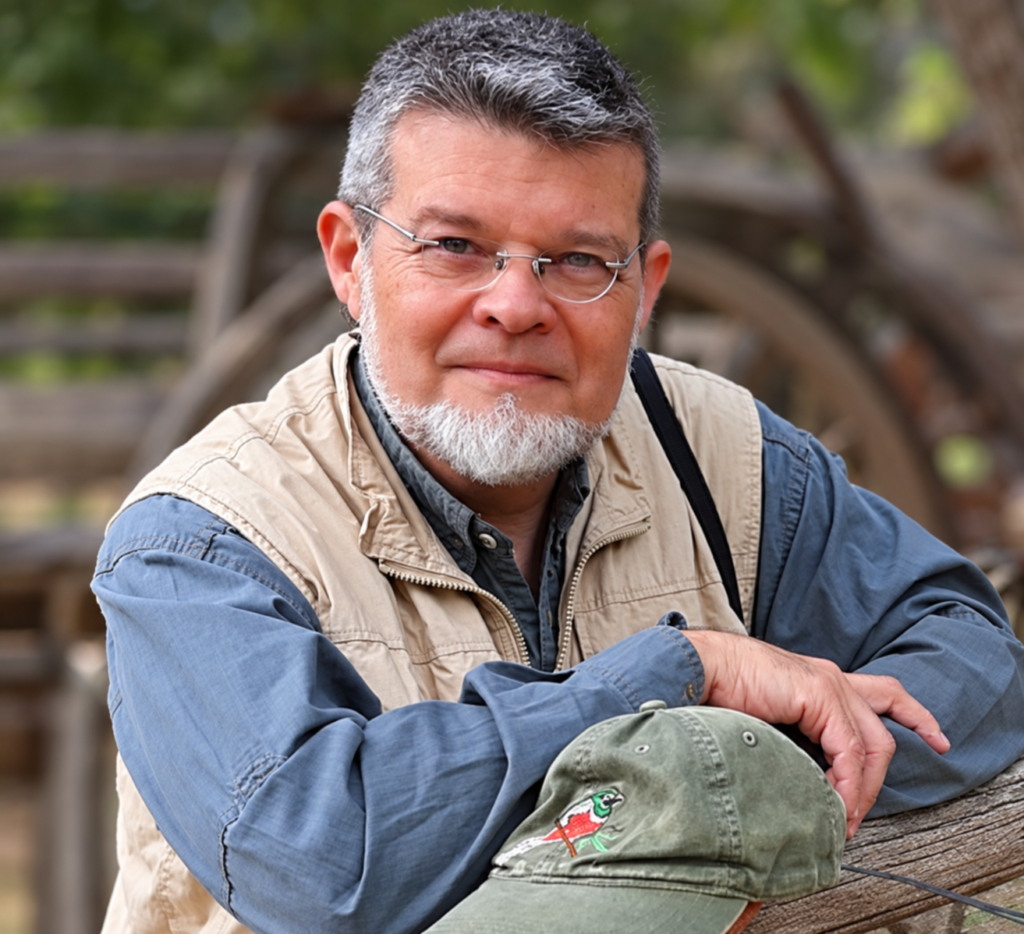
Claudio Bertonatti never studied biology at university. He taught himself to observe birds, identify plants, and understand ecosystems through books, binoculars, and field trips, alongside a friend who would later become one of the leading figures in Argentine conservation. With that self-built education, he went on to lead Fundación Vida Silvestre, the Costanera Sur Ecological Reserve, and the Buenos Aires Zoo, publish dozens of books, and become one of the country’s most respected voices on nature. In 2025, an international organization recognized him for his work defending rural life.
Two Kids and a Pair of Binoculars
Bertonatti was born in the city of Buenos Aires in 1963. His biological education began without classrooms or formal study programs: he pursued it on his own, together with his friend and colleague Juan Carlos Chébez, who would later become one of Argentina’s most influential naturalists and the author of a major reference work on the country’s threatened wildlife.
That pair of young learners turned curiosity into a method. Bertonatti began working professionally in conservation in 1983, when he was just 19 years old. Since then, his subject has never really changed: over more than four decades, he has worked with organizations, museums, reserves, and universities, always around the same central idea.
From the Field to the Museum
Over time, he added another discipline to biology that would ultimately define much of his work: museology. He studied the field and completed two postgraduate programs, one in Environmental Management and another in Historic Botanical Gardens.
That combination made him an unusual professional. He not only understands which species inhabit an ecosystem, but also how to explain them to the public. He participated in the creation of interpretation centers at tourist destinations and in the design of anthropology and natural science museums. He often insists on an idea that runs throughout his work: what is unknown cannot be protected, and for that reason inventories of species and ecosystems are the first step in conservation.
Vida Silvestre, Costanera Sur and the Zoo
His institutional career includes three very different places. He worked for nearly three decades at Fundación Vida Silvestre Argentina, where he held management positions. He also directed the Costanera Sur Ecological Reserve, a recovered natural area along the river just meters from downtown Buenos Aires.
He also briefly headed the Buenos Aires Zoo. His plan was to transform it into a center for the conservation of Argentine wildlife, scientific research, and environmental education. When he realized that he would not be able to carry out that project, he left. The decision says a great deal about the way he works: he changed jobs many times, but never his convictions.
Sixty Books and Six Hundred Articles
Bertonatti is also a prolific science communicator. As an author, collaborator, or writer of forewords, he has contributed to around 60 books and more than 600 scientific and popular articles. His titles include La naturaleza de la patria (2009), the guide ¿Cómo descubrir, reconocer y disfrutar de las aves en 5 pasos? (2014), written with Claudia Nardini, a volume on Perito Moreno National Park co-edited with Tom Butler, and a network of museological terms developed with other specialists.
He also teaches. He has been a professor at the UNESCO Chair in Cultural Tourism, the University of Buenos Aires, the Catholic University of Salta, and the Instituto Superior Perito Moreno. Together with museologist Carlos Fernández Balboa, he taught courses on natural and cultural heritage in places as varied as the National Museum of Fine Arts, the Anthropology Museum of Córdoba, the End of the World Museum in Tierra del Fuego, the National University of La Pampa, the Teatro Argentino de La Plata, and a nature reserve in Misiones.
Today, he is a researcher at the center for natural, environmental, and anthropological sciences at Universidad Maimónides, which awarded him an honorary doctorate. He also directs its degree program in Tourism and Heritage Conservation and serves as a scientific adviser to Fundación Azara. At Aves Argentinas, he participates in the ornithological records committee.
The Distance That Concerns Him
In March 2025, the Inter-American Institute for Cooperation on Agriculture recognized him in San José, Costa Rica, as one of the Leaders of Rurality of the Americas, an award honoring people who work on behalf of the continent’s rural world.
On that occasion, he summarized the concern that guides his current work. More than half of the world’s population lives in cities, far from wild and rural landscapes, and for him that distance is not only geographical: it is also intellectual and emotional. Someone who grows up far from the countryside may never fully understand the functions ecosystems perform or where oxygen and drinking water come from.
That explains his defense of rural producers. He gives an example that often surprises people: some beekeepers earn more by renting out their hives to pollinate crops than by selling honey, a sign of the value of natural services that most people never see. He argues that change should begin with everyday decisions, in schools and at home, by showing the advantages of consuming local, seasonal, and responsibly produced goods.
A Vocation Without an Initial Diploma
Bertonatti’s story has particular appeal in a country where people are often judged by their formal qualifications. A teenager with no credentials who heads into the field with a friend can end up leading institutions, writing dozens of books, and teaching at universities, as long as curiosity remains alive.
He puts it another way when discussing the relationship between people and nature: people protect what they know, and they know what someone has taken the time to show them. He has devoted more than four decades to doing exactly that.