
Miguel San Martín
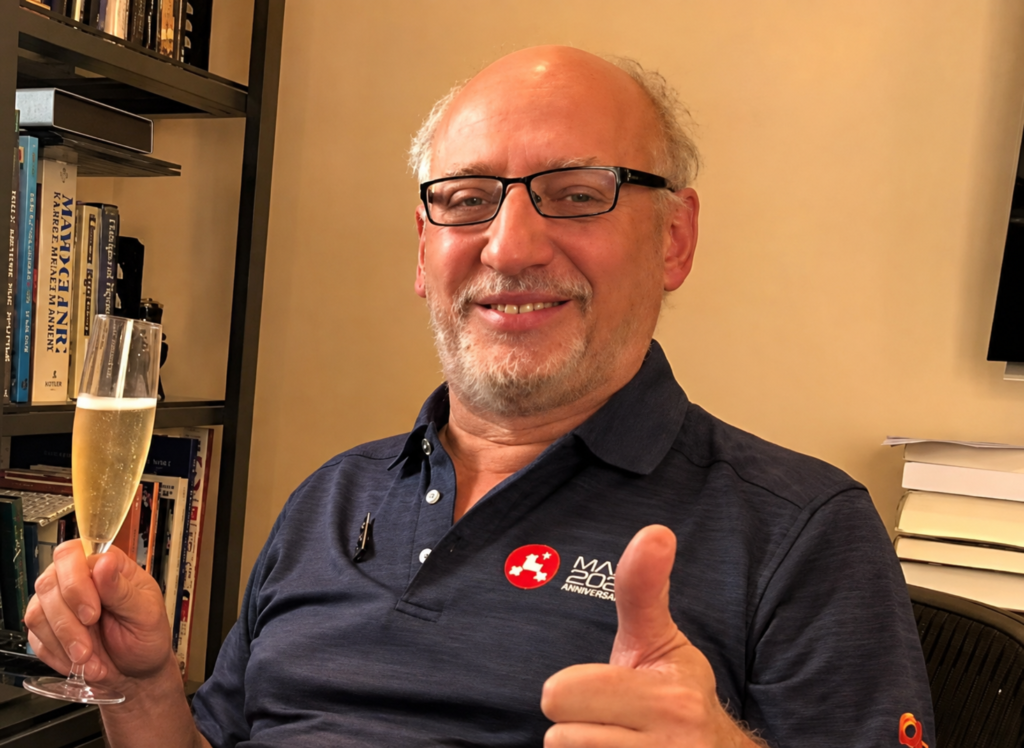
During a winter vacation in the mid-1970s, a teenager from Villa Regina went to the town newsstand to do the morning shopping. The front page of the newspaper Río Negro showed a photograph of the Viking probe’s leg resting on the surface of Mars. At that moment, as he tells it, he thought: this is what I want to do.
Five decades later, Miguel San Martín is chief engineer for Guidance, Navigation and Control at NASA’s Jet Propulsion Laboratory and has participated in every successful U.S. vehicle landing on the red planet.
A dark sky and a father who read the stars
His fascination did not begin with that newspaper. It started earlier, at the gate of the family farm beside Route 22. His father was a civil engineer who laid out roads and bridges across Patagonia in an era before GPS, using the stars to orient himself. He knew the constellations and taught them to his son.
San Martín sums it up with an observation that applies to almost any city child: in Buenos Aires, people do not look up, they look down. It was during those dark, moonless nights that his interest in space began.
The rest of the family pushed him in the same direction. One uncle built power and telephone stations. His maternal grandfather was an Italian sailor, Captain Cánepa, a recognized oceanographer whose name was given to several islands and geographic features. Much of maritime geometry, San Martín points out, is the same geometry used to navigate through space.
His toys ran on batteries and came with chemistry or electronics kits. His first achievements were radios and alarms. He also had remote-controlled boats that fascinated him for a very specific reason: he found it strange that someone could guide an object from a distance. That strangeness eventually became his profession.
A one-way ticket in January
He finished high school at the Pío IX technical school in Buenos Aires in December 1978. By January he was already in the United States. He was alone, with no family there, no concrete plan and English that he describes as poor: he knew all the grammar taught at school, but could neither speak nor understand spoken English.
In every other respect, he felt well prepared. Technical school had given him a solid foundation in mathematics, physics and electronics. And he had something he himself describes as luck: a father who could afford to pay for his education.
His first attempt failed. Cornell rejected him and, for a while, it looked as though the entire adventure might not last even a year. He found a way into Syracuse University, where he studied electronic engineering and earned such good grades that he was named Engineering Student of the Year.
With that record, he applied to several universities and was accepted by MIT, Stanford and Carnegie Mellon. He chose MIT for one very specific reason: the guidance, navigation and control system for the Apollo program had been developed there, and he wanted to study with those professors. He graduated with a master’s degree in Aeronautics and Astronautics in 1985.
The only job he has ever had
NASA centers recruit at MIT. When JPL came to campus, San Martín put on a suit and tie. Nobody wears a suit and tie at JPL, but he did not know that. They interviewed him, paid for a flight, interviewed him again and offered him the job.
He has been there since 1985 and, in his own words, it is the only job he has ever had.
JPL is unusual within NASA: it is operated through a contract with Caltech, so the environment feels more like a university than a government office. Informal but efficient, as San Martín describes it.
His first assignments were the Magellan mission to Venus and Cassini to Saturn, where he designed the spacecraft’s star-based attitude determination system, the same basic technique his father had used in Patagonia with different tools. Then came Mars, and he never really left: Pathfinder in 1997 as chief engineer, Spirit and Opportunity in 2004, Curiosity in 2012, and Perseverance, where he participated as a consultant and member of review panels.
SkyCrane and the seven minutes of terror
The technical contribution for which he is best known is SkyCrane, a system he co-invented. Curiosity was a rover about the size of a small car, and the traditional approach —a legged platform landing first, followed by a ramp for the rover to drive down— would not work at that scale. The mechanical engineers’ idea was to turn the entire concept upside down and put the propulsion system above, with the rover hanging underneath it.
When San Martín was asked whether something like that could actually be controlled, he said yes and requested a couple of changes to the system’s geometry. He insists that it was a team effort involving contributions from many people.
Curiosity also produced the NASA video that popularized the phrase “seven minutes of terror,” in which San Martín is one of the engineers explaining what happens between the moment the spacecraft reaches the upper Martian atmosphere, 125 kilometers above the surface and traveling at 20,000 kilometers per hour, and the moment it arrives safely on the ground. The vehicle has to slow down, separate components and survive an unforgiving sequence: a 0.01% failure ruins everything. His comparison is both Argentine and precise: it is like missing a penalty in a World Cup final.
The pleasure of finding the root of the problem
He was once asked to name his three hobbies. He replied, while admitting that it sounded bad, that his work was hobby number one because he genuinely enjoyed it and spent so much time doing it. The other two are listening to music —especially jazz— and eating, like a good Argentine. He is also fascinated by the history of the Apollo program and says many books about it read like science fiction.
But his most precise description of what drives him has to do with problems. He says he is never simultaneously as happy and as miserable as when he has one to solve: happy because he enjoys it, miserable because it means work, sometimes spending entire nights staring at the ceiling.
What he enjoys most is not finding the solution but reaching the root of the problem. He observes that young engineers often jump to solutions before they fully understand what is happening, and end up treating symptoms. Once you reach the underlying cause, he says, the solution often appears by itself and is usually much simpler.
He is also unusually candid about the less glamorous side of the profession. There are moments of enormous frustration because these adventures are carried out by human beings who do not always agree, amid budget problems and constant difficulties. His way of recharging, he says, is to remember what they are actually doing: putting a spacecraft on the surface of Mars.
What he is looking for on Mars
His explanation of why all of this matters is strikingly clear. The Viking missions of the 1970s looked for life that existed in the present and found nothing; that negative result caused interest and funding to decline. Later missions changed the question: not whether life exists there now, but whether the conditions for life ever existed.
Curiosity made the answer considerably clearer. Three or four billion years ago, Mars was a warm and wet planet resembling Earth, with rivers, an atmosphere and water with a pH compatible with life. Organic compounds were also found. San Martín puts it plainly: it was almost impossible for life not to have existed there.
Perseverance took the next step. It searches for biosignatures, mineral traces that may have been deposited through biological activity, and collects samples that it seals and leaves on the surface. To land in Jezero Crater, an area of slopes and cliffs around eighty meters high, the rover uses a system called Terrain-Relative Navigation: during descent it photographs the ground and compares those images with a map stored onboard, reducing the landing uncertainty from roughly three kilometers to less than fifty meters.
His current work is the logical continuation: Mars Sample Return, the mission intended to retrieve those samples and bring them back to Earth. It is several missions rolled into one, involving a spacecraft and a rocket that will launch from the Martian surface. San Martín calls it the finishing touch on his career and jokes that once that is done, he can finally hang up his boots.
Coming back, telling the story, sitting on juries
Despite living in California, San Martín returns regularly to Argentina to give talks at universities and scientific institutions. He participated in TEDx Río de la Plata in 2012 and Fundación Balseiro’s Migración de Ideas meeting in Bariloche in 2022, where he toured the Instituto Balseiro campus. He also served as a judge for Invap’s first Engineering Thesis Competition, a role he described as a responsibility to be fair to young people whose lives might be changed by that recognition.
His view of opportunities in Argentina is optimistic and concrete. He points out that CONAE and Invap already participate in scientific missions with NASA and highlights the rise of newspace, with companies such as Satellogic operating at much lower costs. His conclusion is personal: if he were young today, he would not have had to leave the country the way he did.
Guiding things from a distance
He was asked whether he would travel to the Moon. He said yes, aboard SpaceX’s Starship, because it would be comfortable. In an Apollo capsule, honestly, no. And Mars? Even less.
What he said next explains his entire career better than any résumé. He is not fascinated by the journey itself. He is fascinated by designing the machines that make the journey possible. The fact that a machine can guide itself through space using the stars is what has kept him interested from the remote-controlled boats of his childhood all the way to the system that placed Curiosity on the Martian surface.
And he has one line about the moment all of that becomes real: watching a vehicle land on Mars knowing that you had something to do with it is an experience you never forget, and one that keeps you going until the next time.