
Francis Halzen
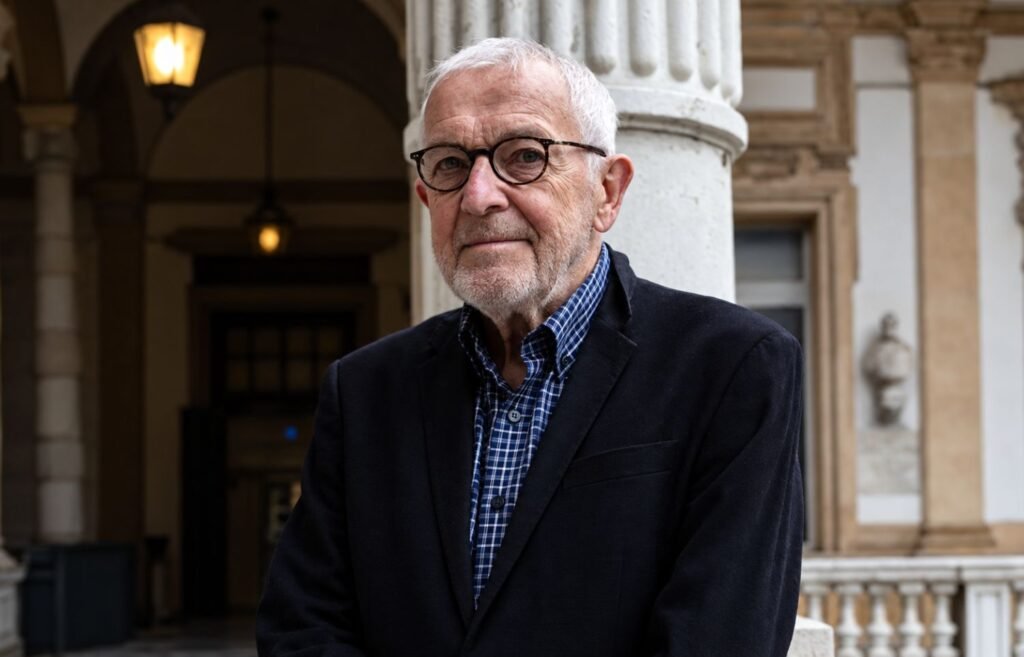
He proposed turning the Antarctic ice sheet into a telescope. He was told it was a nice idea that would never work. He kept going anyway for almost four decades, until a detector encompassing a cubic kilometer of ice began recording particles arriving from the most violent phenomena in the universe. On October 6, 2026, at 82, he received a call from Stockholm. He was writing a proposal to request funding for his next project.
“I Just Had to Live Long Enough”
Since 2013, people had been telling him he was among the Nobel contenders. He did the calculation and brought it down to earth: one chance in twenty each year.
Thirteen years of that arithmetic ended on Tuesday, October 6, 2026, when the Royal Swedish Academy of Sciences announced him as a winner of the Nobel Prize in Physics. His reaction, recounted to AP, was anything but solemn. He said he just had to live long enough, and here he was.
The detail that best describes him is what he was doing at that moment. When the call came, Halzen was working on a new research proposal. He remarked that he hoped the prize would help get it approved.
The committee honored him for his contributions to the IceCube Neutrino Observatory and for the discovery of high-energy neutrinos of astrophysical origin.
A Boy From Tienen Who Ended Up in Wisconsin
He was born on March 23, 1944, in Tienen, a small city in Belgium. He studied at the University of Leuven, where he earned his master’s degree in 1966 and his doctorate in 1969, and then spent time at CERN as a research associate.
From there, he went to the University of Wisconsin–Madison, the institution with which he would be identified for the rest of his life. Today, he holds two named professorships there and directs the Institute for Elementary Particle Physics.
In 1983, he published a textbook with Alan Martin, Quarks and Leptons, which educated several generations of particle physics students. For many physicists, Halzen was the author of that textbook for years before becoming the man of the ice.
He defines himself more modestly than his biography suggests: a theoretical physicist working at the intersection of particle physics, astrophysics and cosmology.
The Problem of Particles That Do Not Collide With Anything
To understand the obsession, it helps to understand the obstacle.
Neutrinos are tiny particles with no electric charge and an extremely small mass. They pass through our bodies all the time, every second, without leaving a trace. That indifference to matter is precisely what makes them valuable: they travel in straight lines from where they originated, without being deflected or absorbed, bringing direct information from places that light cannot penetrate.
The problem is that, for the same reason, they are almost impossible to detect. If a particle does not interact with anything, it leaves no signal.
The only way forward is statistical: build a detector so large that, through sheer numbers, one of those particles eventually collides inside it. And that was where the idea Halzen began advocating in 1987 emerged.
Using Antarctica as an Instrument
Instead of building the detector, use one that already existed.
The Antarctic ice sheet is deep, transparent and free from interference. When a neutrino interacts with that ice, it produces a flash of light. If enough optical sensors are buried deep enough, they can capture those flashes.
Halzen proposed exactly that. In 1991, he co-authored a paper in Nature on observing muons using the ice sheet as a Cherenkov detector. Then came AMANDA, the first-generation neutrino telescope installed at the South Pole, which served as a proof of concept and produced its own paper in Nature in 2001.
And then IceCube: a cubic kilometer of instrumented Antarctic ice, with sensors buried at around 2,500 meters, where the ice protects them from radiation and cosmic rays. It is funded by the U.S. National Science Foundation and operated by Wisconsin–Madison, with a collaboration of more than 400 scientists from fourteen countries.
Halzen describes it as a great eye of ice that looks at the universe through neutrinos instead of light.
What They Told Him While He Was Building It
The less frequently told part of this story is the skepticism.
He himself summed it up with a phrase not often heard from a Nobel laureate: people thought it was a nice idea, but that it would never work. And he added that the biggest surprise was that it did.
The numbers explain why it was hard to believe. The detector records around three thousand charged particles per second, but the overwhelming majority are neutrinos produced in Earth’s atmosphere, not the cosmic ones they were seeking. Separating the noise from the signal meant retaining just one particle identified with certainty each month.
Three thousand per second to retain one per month. That was the work, for years.
Confirmation came in 2013, with two publications: one in Science, on evidence of high-energy extraterrestrial neutrinos in the detector, and another in Physical Review Letters, on the first observation of neutrinos with energies on the order of a petaelectronvolt. Physics World selected it as the breakthrough of the year. What those papers demonstrated was not merely an isolated discovery: they demonstrated that neutrino astronomy was possible.
Recognition followed. The Smithsonian American Ingenuity Award in 2014. The Balzan Prize for astroparticle physics and the European Physical Society prize in 2015. Earlier, he had received the International Helmholtz Award from the Alexander von Humboldt Foundation in 2006, and honorary doctorates in Uppsala and Ghent.
Forty Years, a Single Question
Measured by the dates, the arc spans thirty-nine years: he began working on neutrinos in 1987 and received the Nobel in 2026. The first solid evidence that his approach worked did not appear until 2013, twenty-six years after he began.
Few scientific careers can withstand such a timeframe. Most academic funding systems are not designed for ideas that take a quarter of a century to deliver results, and most researchers would have pivoted toward something publishable much earlier.
What makes Halzen’s case distinctive is not the intelligence of the proposal, which was elegant from the beginning. It is that he sustained it while the community treated it as an appealing curiosity, and that at 82, with the call from Stockholm still fresh, what he had on his computer screen was a funding request for what comes next.