
Santiago Lange
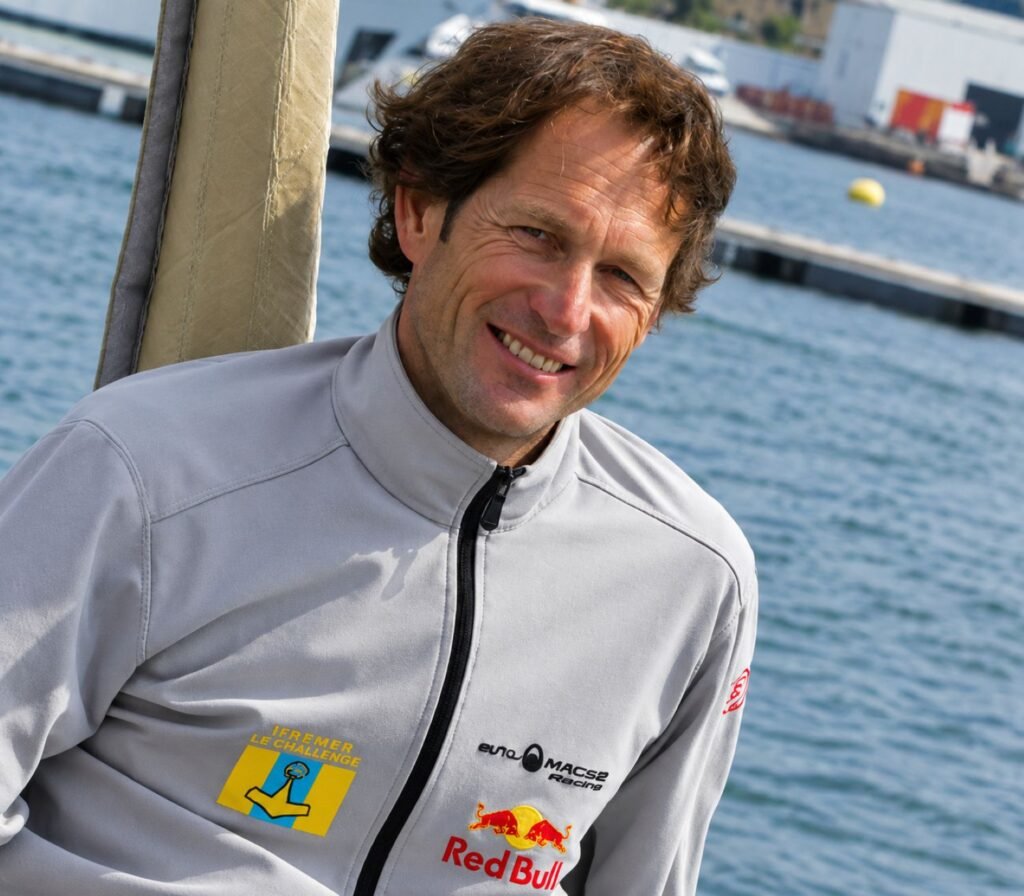
Santiago Lange first stepped onto a boat at the age of six, following his father. Sixty years later, the sea remains the place where he feels most like himself. In between came seven Olympic appearances, three medals, a World Sailor of the Year title and a story told in many languages: that of a 54-year-old man who had part of a lung removed and eleven months later won Olympic gold in Rio de Janeiro. There were also four years spent living aboard a borrowed boat because he had no money. His passion was never negotiable.
A Boy Following His Father
Lange was born in Buenos Aires in 1961 and began sailing at six, following the example of his father, who was also a sailor. That family inheritance defined everything that followed.
He trained as a naval architect, a choice that says a great deal about him: sailing boats was not enough; he wanted to understand how they worked and how they could be improved. From that combination of sport and engineering came a model of the Optimist, the small dinghy used by children around the world to learn how to sail, which bears his surname and was used for years in Argentina.
His Olympic debut came at Seoul 1988, when he was 26. It was the first of seven Olympic Games as a competitor, a number very few athletes achieve in any discipline. His final appearance came at Tokyo 2020.
Living on a Borrowed Boat
The road was not always filled with podiums. During a difficult period in his life, after separating from his wife, Lange ran out of money. A friend lent him a boat, and he ended up living aboard it for four years.
It is a difficult image to reconcile with the life of an elite athlete, yet he tells the story without drama. That ability to sustain his vocation even when material conditions worked against him explains much of what came later.
His first major results came alongside Carlos “Camau” Espínola in the Tornado class: bronze at Athens 2004 and another bronze at Beijing 2008. Yet those two medals left him with what he called a thorn in his side: the gold medal.
March 2015
The diagnosis came in March 2015, just over a year before the Rio Games. Lung cancer. Lange underwent surgery on September 22 of that year, his 54th birthday, at a clinic in Barcelona. Doctors removed part of his left lung.
His teammate Cecilia Carranza Saroli, who took him to the hospital when he became ill, later said she never imagined he could recover. Lange processed it differently. He admitted struggling with the question of why it had happened to him, but said that sinking into despair was never an option: it was the reality he had been given, and he had to live it.
Returning to the water was brutal. He had lost a significant amount of lung capacity in a sport that pushes the body to its limits. He later described the nine months leading up to Rio as the greatest effort of his entire sporting career.
August 16, 2016
In Rio de Janeiro, Lange was the oldest sailor in the entire competition. Together with Carranza Saroli, he entered the Medal Race, the decisive race in the Nacra 17 class, at the top of the standings.
The finish was extraordinarily close: they won gold by just one point over the Australian crew. It was Lange’s third Olympic medal and his first gold. The thorn was finally gone.
That same year, World Sailing named him Rolex World Sailor of the Year, one of sailing’s highest international honors.
Keep Going, Always Keep Going
What many would have considered a perfect ending, Lange treated as another stop along the way. He kept competing. At Tokyo 2020, he carried the Argentine flag alongside Carranza Saroli and competed in his seventh Olympic Games. They finished seventh overall and won the final Medal Race.
He then began another campaign toward Paris 2024 with Victoria Travascio. The goal was to reach an eighth Olympic Games, but the pair did not secure Argentina’s berth. In August 2023, at 61, Lange announced that those would be his final races on the Olympic circuit.
In his farewell, he wrote that he considered himself privileged to have sailed at the highest level for so long and that he intended to enjoy every wave, every tack and every wind shift of that final day. He wanted to be fully present in every remaining minute and imprint that feeling of fulfillment permanently in his memory.
The Lung Again
In July 2026, eleven years after his first diagnosis, a routine medical examination detected a nodule in one of his lungs. Lange underwent surgery in Barcelona, the city where he lives. The procedure was successful: doctors removed the affected cells and the prognosis was encouraging. At 64, he began recovering with his family while remaining under medical supervision.
The Argentine Olympic Committee announced the news and emphasized that throughout his life Lange had shown that greatness is measured not only in medals, but also in strength, courage and the ability to overcome adversity.
His relationship with sailing did not end with his Olympic retirement. In a different role, he became involved with the team of Mateo Majdalani and Eugenia Bosco, silver medalists at Paris 2024, looking ahead to the Olympic cycle toward Los Angeles 2028.
The Sea as a Way of Being Himself
Lange once said that he does not measure things by age, but by the way he experiences them. That may explain his career better than any medal table.
He did not sail despite illness or to prove anything. He sailed because it is what he has done since he was six, and because giving it up would have meant giving up a part of himself. When doctors removed part of his lung, he returned to the water. When he turned sixty, he kept competing. When his Olympic cycle ended, he found another way to remain close to boats.
For him, the answer to adversity was always in the same place: on the water.