
Fabricio Ballarini
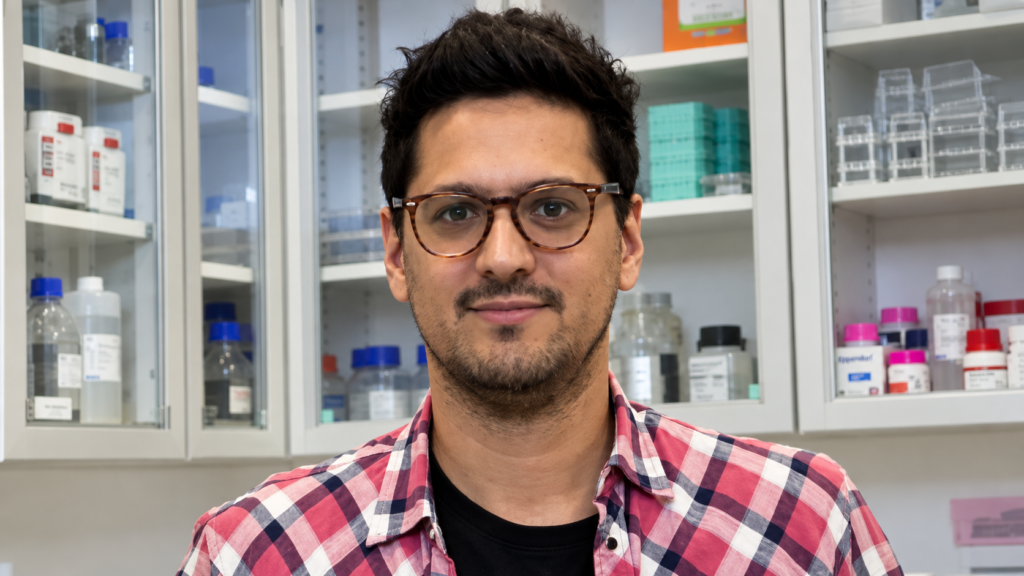
He wanted to become an architect like his father. He enrolled, completed his first year and did poorly. Angry with his own decision, he crossed over to the faculty building opposite it at Ciudad Universitaria and enrolled in Biology, mainly because he liked animal documentaries. He made it through third year, then fourth, and only then understood what a scientist actually did. The conclusion he drew from that late discovery ended up defining his entire career: if an advanced biology student does not know what kind of work is available to them, the problem is not the student but the way scientists explain what they do. Today, Fabricio Ballarini researches memory at CONICET, heads a university department, has written several books and is one of the most recognizable faces of science communication in Argentina.
Six students, a Tuesday morning
There is one moment he identifies as the one that changed his direction, and it was not an experiment.
It was a class.
At university, one of his lecturers was Adrián Paenza, at a time when Paenza was known mainly as a sports journalist. Ballarini did not know who he was until he saw him walk into the classroom. There were six students, on a Tuesday morning.
What caught his attention was not the content but the way it was delivered. He says Paenza gave everything he had and structured his classes in a completely different way from everyone else. Ballarini was fascinated from the first day.
Even so, he makes clear that it never crossed his mind at the time that he would eventually end up communicating science himself.
From mice to a classroom in Avellaneda
In 2009, while still a doctoral fellow, Ballarini did something that had never been done in his laboratory: he went to a primary school in Avellaneda.
Until then, all the findings from the Memory Laboratory had come from studying animal behavior. Humans had never been the subjects of the research.
What he went there to test later became his trademark. In simple terms, the idea is that when something breaks a routine and surprises the brain, the brain gets to work: it synthesizes proteins and stores the information from that moment more strongly.
What makes the effect useful in a classroom is its time span. According to Ballarini, it does not apply only to the moment of surprise itself: it extends from roughly one hour before to one hour afterward. It is as if the brain pressed a record button both backward and forward.
Translated into a school setting: if children have a brief, novel experience before or after a history lesson —an unexpected music class, something that breaks the expected routine— they remember the history lesson better.
Ballarini eventually tested the strategy with thousands of students at every educational level.
Educando al Cerebro, or why publishing was not enough
Those school visits produced a discomfort that he describes in almost ethical terms.
Teachers welcomed the team openly, lending them their classrooms, students and time. In return, science took the data, published a paper and disappeared. Ballarini felt it was unfair to use the educational system as an instrument without giving anything back.
The response was to invite other researchers working in education, request the main hall of the Colegio Nacional de Buenos Aires and organize an open event for teachers. They called it Educando al Cerebro.
It worked so well that they received support from CONICET to take the program around the country.
The series later became the basis for one of his books, and the underlying logic is the same one that runs through everything he does: knowledge produced in a laboratory financed by the state has to return to people in a form they can actually use.
REC and what happens when a scientist writes for everyone
His first book was published in 2014 and was titled REC: Por qué recordamos lo que recordamos y olvidamos lo que olvidamos.
Nearly two hundred pages dealing with routine, novelty, surprise, forgetting and false memories, written for readers with no scientific background. The premise is straightforward: memory can be trained through experiments at home, without the need for a laboratory.
When describing how he wrote it, he gives a detail that says a great deal about his relationship with work. For two years, he put in extra hours at home, including weekends. And he makes clear that he did not experience it as a punishment, but as something enormously motivating.
He also admits that none of this had been part of the plan. Neither while writing his undergraduate thesis nor during his doctorate had he planned to write a book, give talks for teachers or work on the radio.
His most recent book, No sos vos, soy yo, was written with linguist Juan Eduardo Bonnin and applies scientific rigor to a subject not often treated in those terms: romantic love.
How a memory works, according to him
When asked where memory is stored, Ballarini first dismantles the popular image.
For a long time, people thought memories were deposited somewhere in the brain, almost like objects inside a small box. The current consensus is different: they exist in the connections between neurons. The brain creates connections, stores information and disconnects them constantly, without us noticing.
His way of illustrating it is elegant: the brain with which someone begins a conversation is not the same brain with which they finish it.
The second idea he likes to emphasize is that memory works like a time machine. It allows someone to close their eyes and return to a beach from their teenage years, or hear a song and suddenly recover faces, smells and sensations. Without those memories, people cannot plan, decide or fall in love.
The third idea is the most uncomfortable: we should not completely trust our own memories.
His explanation is that every time someone recalls something, they are not accessing the original event but the last time they remembered it. And because the memory is stored again at that moment, it is modified. That is why memories are malleable and can be manipulated both by the environment and by ourselves.
When asked whether that is disturbing, he says yes, because who we are depends on our memory. But he still argues that we should preserve some room for doubt.
The memory we leave on our phones
There is one concept that particularly fascinates him: transactive memory.
It means that we do not store everything in our own heads. We deposit memories in the people around us. It happens with coworkers, family and partners. Because storing information is energetically expensive, the brain outsources whatever it can.
From that he draws an observation with something almost heartbreaking about it: one of the greatest pains of bereavement or separation is that the other person does not only leave physically; they also take part of our memories with them.
The problem, he says, is that we now practice transactive memory with our phones. And what can be lost in that transfer is our ability to preserve our own milestones.
The question he asks out loud does not receive an optimistic answer: whether technology will make us more stupid or free up time to explore other things. His current impression leans toward the first possibility, which he illustrates mercilessly: nobody says they use artificial intelligence to save time so they can study Chinese; generally, they use that extra time to watch cat videos.
The research that worries him
Together with his team, he spent two or three years measuring self-perceived anxiety and depression in schools across the Buenos Aires metropolitan area, initially in relation to the pandemic.
They began because school administrators and teachers themselves were warning them that something different was happening: more self-harm, more suicides and attempts, more children crying.
When they compared those data with social media use, physical activity, sleep and motivation, a pattern emerged. Students begin secondary school with a certain amount of screen time and, on average, add another hour with each passing year. Some reach peaks of eleven, twelve or thirteen hours per day.
Ballarini makes clear that this is a correlation, not a demonstrated causal relationship, but says the correlation is clear: more hours on the phone, greater self-perceived anxiety, greater self-perceived depression and more sleep problems.
To put it into perspective, he uses a calculation that works better than almost any statistic. Five hours of screen time per day is equivalent to three or four months of life each year.
Fighting myths
A large part of his public work consists of dismantling things people assume are true.
The claim that we use only 10% of our brains is false, although he admits that the number is appealing. The idea that some people are left-brained and others right-brained is also false. The claim that male and female brains are wired differently is false as well, originated within science itself and can be explained by flawed calculations and by the sexism that also exists within the scientific world.
Sudoku does not prevent neurodegenerative diseases, however much he might wish it did. Learning a language or a musical instrument, on the other hand, helps. Sleeping after studying improves retention, and a nap counts too.
What irritates him most are unsupported viral posts. He has described his frustration with a post claiming that spending two hours a day in silence generates new neurons: the research was more than a decade old, conducted in mice, never verified in humans, and yet the post had millions of views.
His greatest concern is misinformation about vaccines, particularly when it is spread by someone working within the healthcare system. That, he says, makes it much more dangerous.
Curiosity before intelligence
He was asked whether curiosity matters more than intelligence. He said yes, while making clear that it was his personal opinion: someone can be extremely intelligent, but without curiosity they will not go looking for anything.
It is probably the most accurate summary of his own biography. A boy who did not know what a scientist was, who failed at the degree he had chosen because of family tradition and who ended up devoting himself to studying how memories are formed, almost because of his curiosity about animal documentaries.
The question that keeps him awake today is no longer about the brain itself, but about what comes next: what technology is going to do to our cognitive functions. He says he has a fairly clear idea of what he can do with technology.
What keeps him awake is the other side of the question.