
Martha Argerich
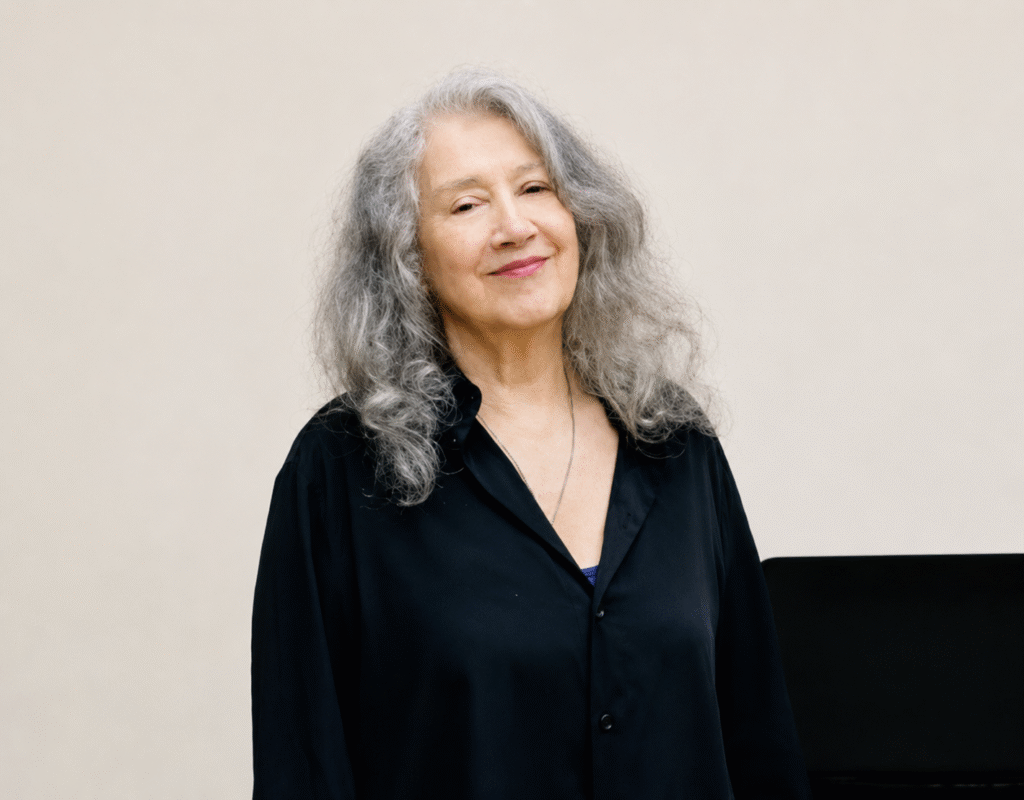
Martha Argerich was three years old when, at kindergarten, she played back by ear a melody she had just heard. At four, she gave her first public recital. At seven, she performed Mozart with an orchestra. At sixteen, she won two of Europe’s most demanding competitions within three weeks. And at twenty-three, when everyone was waiting for her next concert, she shut herself inside a New York apartment and stopped playing.
That contradiction —an extraordinary gift and the burden of carrying it— is one of the keys to understanding her story. Eighty years after that first stage appearance, the Argentine pianist is still performing, but largely on terms she set for herself: almost never alone, almost never out of obligation and almost always surrounded by other musicians. It is the story of a passion that survived because it learned how to change shape.
Four years old and already onstage
Some vocations are discovered. Others appear before there is even a chance to choose them. Martha Argerich belongs to the second group. In 1945, at four, she gave her first public recital at the Teatro Astral in Buenos Aires. At seven, she returned to the same stage to perform Mozart’s Piano Concerto No. 20 in D minor, a work many pianists do not approach until adulthood.
Her training was entrusted to Vicente Scaramuzza, the Italian-born teacher based in Buenos Aires who also trained Bruno Gelber and helped establish an Argentine piano school recognized around the world. Those years of daily work provided the technical foundation that would later allow her to do almost anything at the keyboard.
A presidential meeting and a ticket to Vienna
The episode that opened Europe to her has something of a national anecdote about it. At twelve, after performing at the Teatro Colón, she was received by Juan Domingo Perón at the presidential residence. When the president asked where she wanted to study, she did not hesitate: Vienna, with Friedrich Gulda.
Perón solved the problem by arranging a diplomatic appointment for her father as an economic attaché in the Austrian capital and a position for her mother at the embassy.
The family moved in 1954, and Argerich spent eighteen months studying with Gulda, whom she has always described as her most influential teacher. Geneva followed, along with Nikita Magaloff, Madeleine Lipatti, Stefan Askenase, Maria Curcio and, in 1960, Arturo Benedetti Michelangeli. She has lived in Europe ever since.
Talent as a problem
What is told less often is how heavily that extraordinary ease weighed on her. In 1957, at sixteen, she won two of the most demanding competitions on the circuit —the Busoni Competition in Bolzano and the Geneva International Music Competition— only three weeks apart. Her career suddenly opened up.
And not long afterward, it stopped. In the early 1960s, while living in New York, she went through a very brief marriage, the birth of her eldest daughter and a personal crisis that kept her away from the piano for roughly two years. She suffered from stage fright and found the life of a soloist suffocating. Because she spoke several languages, she seriously considered becoming a secretary; with her technique, she joked, she would make an excellent typist.
Her mother eventually insisted that she visit Stefan Askenase, a professor at the Brussels Conservatory. He and his wife helped her regain her balance and encouraged her to enter the competition in Warsaw.
In 1965, Argerich won first prize at the International Frédéric Chopin Piano Competition. That became the real point of no return: from then on, the world’s leading orchestras and concert halls competed for space on her calendar.
There is an uncomfortable lesson in that pause. Genuine passion does not always coexist easily with the obligation to perform. Argerich had to find her way back to the piano outside the expectation that she constantly behave like a phenomenon.
Playing with others
One decision defines her career as much as any award. In several interviews, Argerich has said that she feels lonely onstage during solo recitals, and from around 1980 she virtually stopped giving them. She chose orchestral concerts, chamber music, sonatas with other instrumentalists and piano duos instead.
That shift was not a retreat. It was the way she found to preserve the pleasure of playing. Her recordings with Mischa Maisky, Gidon Kremer, Mikhail Pletnev and Stephen Kovacevich, and especially her lifelong bond with Brazilian pianist Nelson Freire, reveal a performer who seems to need someone across from her to ignite the musical conversation.
The same logic explains what she built later. In 2002, she founded the Martha Argerich Project in Lugano, while in Buenos Aires both a festival and an international piano competition at the Teatro Colón bear her name, and she often serves as president of the jury. They are structures designed to bring musicians together rather than simply display a star.
A life without a script
Her personal life followed a similar logic of freedom. She has three daughters by three different fathers: Lyda Chen, a violist and daughter of Chinese-Swiss conductor Chen Liang Sheng; Annie, daughter of conductor Charles Dutoit; and Stéphanie, daughter of pianist Stephen Kovacevich, who made the documentary Bloody Daughter about her mother. Argerich raised all three while traveling around the world, without drawing a firm line between home and work.
She also faced a serious illness. In 1990, she was diagnosed with malignant melanoma. Treatment worked, but in 1995 the cancer returned and spread to her lungs and lymph nodes. She underwent aggressive treatment at the John Wayne Cancer Institute in Santa Monica, including the removal of part of a lung and an experimental vaccine.
She returned to the stage and, in gratitude, gave a Carnegie Hall recital to benefit the institute. She never turned the episode into the center of her public story. She simply kept playing.
Her connection with her origins has remained intermittent but alive. On her father’s side, she descends from Catalans who arrived in the Río de la Plata in the eighteenth century; on her mother’s side, from a Ukrainian Jewish family that settled in the colony of Villa Clara in Entre Ríos. In 2015, she received the Baron Hirsch Award from Fundación Judaica and the Jewish Museum of Buenos Aires. At the ceremony, she remembered her mother, Juana Heller, and said that her mother had everything to do with who she became.
What eighty years of sustained passion can teach
At 85, she is still performing, still creating festivals and still surrounding herself with younger musicians. Her career has brought her three Grammy Awards, Japan’s Praemium Imperiale, the Kennedy Center Honors presented by Barack Obama, Italy’s Order of Merit and France’s Legion of Honour, among many other distinctions. In Argentina, the Konex Foundation named her the greatest pianist in the country’s history.
But none of those awards explains why she continues. What seems to sustain her is something simpler: she found a way to keep playing the piano as a source of pleasure rather than an obligation, even when the entire world expected exactly the opposite.