
Demian Reidel
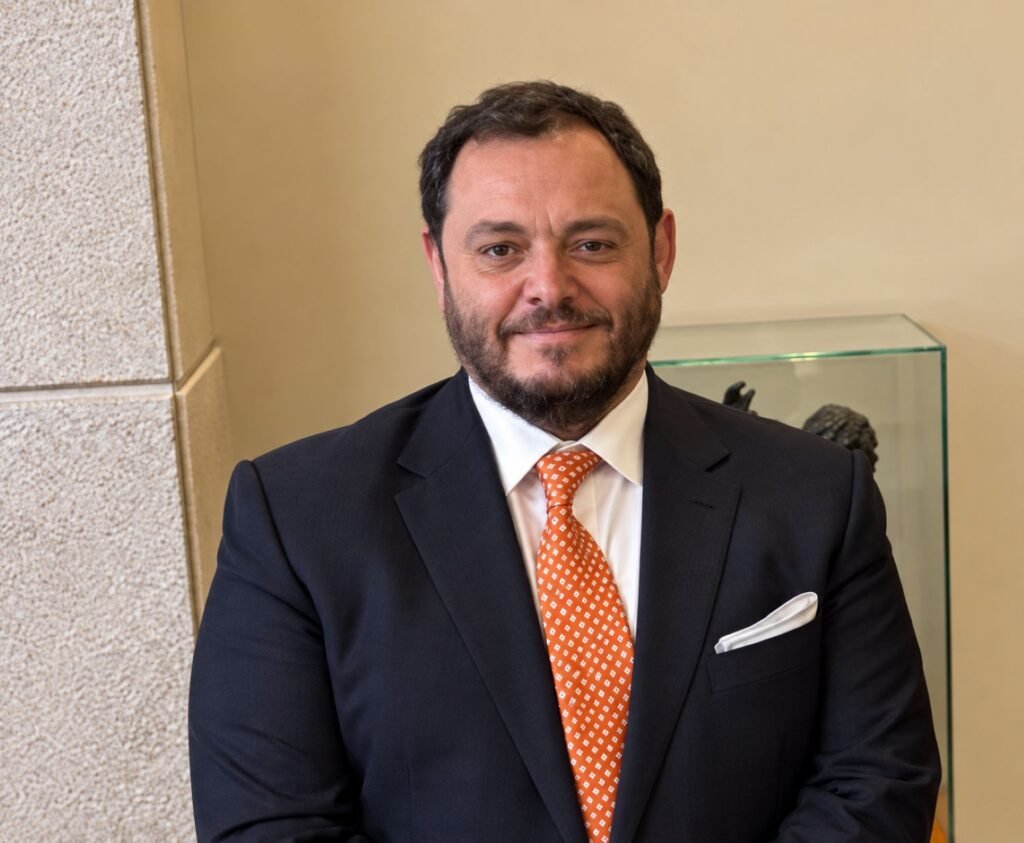
Demian Reidel’s passion takes the shape of an atom. He trained as a physicist at the Balseiro Institute, spent twenty years on a detour through Wall Street—Goldman Sachs, JPMorgan and his own fund—and even served on the board of Argentina’s Central Bank. But he eventually returned to a field he had never entirely left behind: today, he chairs Nucleoeléctrica Argentina and leads a Nuclear Plan that envisions modular reactors, uranium and artificial intelligence data centers. This profile follows that journey out and back, and how a calling rooted in the laboratory can shape an entire career.
A physicist on Wall Street
Reidel was born on January 8, 1971, and his education followed an unusual progression: a degree in Physics from the Balseiro Institute in Bariloche, a master’s in Mathematics from the University of Chicago and a doctorate in Economics from Harvard. With that background, he joined the emerging markets desks at Goldman Sachs and JPMorgan, co-founded QFR Capital Management in New York and taught in the master’s program in Finance at Torcuato Di Tella University.
The Balseiro brotherhood
Balseiro is more than a decorative detail in his biography. The Bariloche institute, managed by Argentina’s National Atomic Energy Commission, has historically trained generations of Argentine physicists. Admission requires an entrance examination, and graduates leave with a shared identity. Reidel belongs to that community. When, years later, he was called upon to defend Argentina’s nuclear capabilities, he spoke less like a government official than someone returning to the subject of his youth.
His first role in public office came during Mauricio Macri’s administration. Appointed in December 2015, he served on the Central Bank’s board alongside Federico Sturzenegger and was one of the architects of the financial arrangements that enabled the lifting of currency controls on December 16, 2015. He resigned shortly after Sturzenegger’s departure in 2018 and returned to academia as a senior researcher at the Harvard Kennedy School.
From currency controls to the Council of Advisors
His return came through the front door of the libertarian administration: on March 8, 2024, Javier Milei appointed him to lead the Presidential Council of Advisors. In December of that year, he also joined the Nuclear Council tasked with designing the country’s new nuclear policy, alongside Guillermo Francos and Luis Petri.
In retrospect, the financial detour never took him entirely away from physics. He built a career modeling markets, a field where the equations learned at Balseiro can be as useful as they are in a laboratory. His move back to the atom was less a change of direction than a return.
The man linking nuclear energy and AI
On April 23, 2025, he became chairman of Nucleoeléctrica Argentina, the state-owned operator of the Atucha and Embalse nuclear power plants. In July, he left the Council of Advisors to focus entirely on the Argentine Nuclear Plan. The plan has three phases. The first is to design and build a privately financed, 300-megawatt modular reactor at the Atucha complex, a move that involved abandoning the Atucha III project that China was to finance. He explains the second phase with a retail analogy: “We’re going to sell the reactors, and we’re going to sell the fuel,” like razors and replacement blades, with the ambition of replacing Russia’s Rosatom as a supplier to the United States. The third is to attract investment in technology powered by reactors, with artificial intelligence clusters as the leading prospective customer.
Along the way, he made difficult decisions, including discontinuing the commercial development of CAREM, the domestically designed modular reactor that the National Atomic Energy Commission had been building, citing a lack of commercial viability. He also promotes uranium mining and the creation of YPF Nuclear. In remarks to La Nación, he summed up Argentina’s opportunity with a phrase: “Our country won the geological lottery.” For readers who remember Reidel from the Central Bank, the shift is less surprising than it might seem: the physicist who applied equations to the removal of currency controls is now trying to establish an export price for Argentina’s nuclear technology.
Four reactors in five years
The goals he announced come with figures and deadlines: four modules totaling 1.2 gigawatts, operating within five years and capable of supplying around 10% of Argentina’s current electricity consumption. He also wants the country to become one of the first in the world to sell small modular reactors. Uranium is the other part of the plan. Argentina has three nuclear power plants but has never exploited its reserves of the mineral, a paradox Reidel wants to resolve so the country can supply future reactor buyers. “When a country is looking to install a data center, it will be attracted by this infrastructure,” he explains of the third phase. He envisions computing hubs powered by nuclear energy, with Patagonia’s cold climate offering an advantage for cooling.
The atom before political power
His international agenda reflects that enthusiasm. In May 2025, he led a visit to France and returned with agreements with the Paris-based accelerator Station F, cooperation with the European SMR Alliance and scientific exchanges with French nuclear agencies. In July 2025, he made the decision that further defined his direction: he stepped down as chair of the Council of Advisors—a position that placed him close to Milei—to focus exclusively on Nucleoeléctrica. Between political power and the atom, he chose the atom.
When announcing his departure, he outlined the scope of the plan: building Argentina’s first modular reactor, extending the operating lives of existing nuclear power plants, promoting uranium mining and creating YPF Nuclear. He described it as a state policy aimed at restoring energy sovereignty and strengthening scientific development. That final word—scientific—reveals the student from Bariloche he never stopped being: a country that sells reactors is also a country where physicists do not have to choose between their calling and their careers. Returning to that calling took Reidel thirty years and two careers in other fields. Today, he pursues it from the company that operates the country’s three nuclear power plants.