
Daniel Barenboim
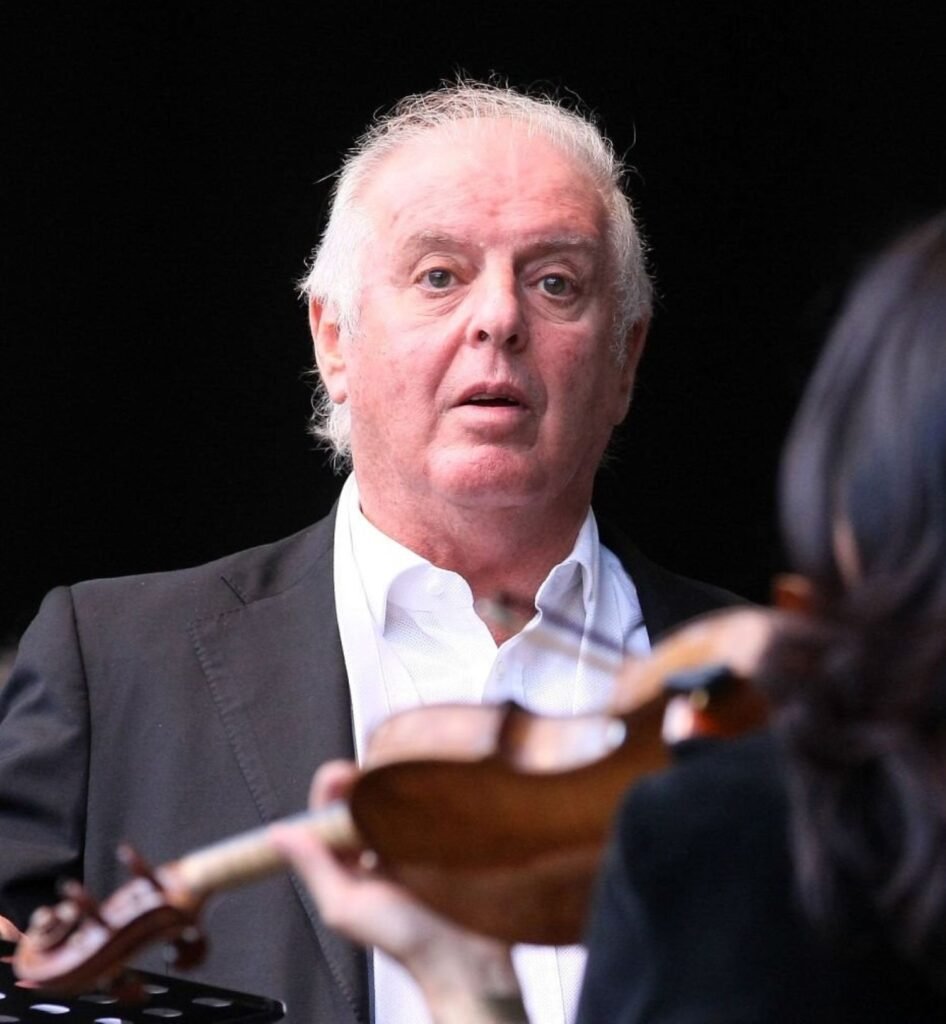
He gave his first concert in Buenos Aires at the age of seven and, more than seven decades later, was still sitting down at the piano, by then diagnosed with Parkinson’s disease. Between those two points lies a life in which everything —love, passports, public battles, the school he founded— ultimately revolved around the same thing: listening to music and making it sound.
A home where the piano was the family language
He was born in Buenos Aires into a Jewish family in which both parents were professional pianists. He began taking lessons from his mother at five and continued with his father, who became his only piano teacher and never gave up that role. There was no conservatory or succession of famous teachers: there was a home where music was part of everyday conversation.
On August 19, 1950, at seven, he gave his first formal concert in Buenos Aires. In 1952, the family emigrated to Israel, and that same year, at ten, he performed in Vienna and Rome. Paris and London followed, and in 1957 he appeared in New York under Leopold Stokowski. From then on, tours across Europe, the United States, South America, Australia and Asia became routine.
The summer that shaped his ear forever
In 1954, his parents took him to Salzburg to attend Igor Markevitch’s conducting classes. He was eleven. That summer he played for Wilhelm Furtwängler, who described him as a phenomenon and invited him to perform Beethoven’s First Piano Concerto with the Berlin Philharmonic.
His father said no. He believed it was too soon, only nine years after the war, for a Jewish boy to perform in Germany. Barenboim missed that debut, but Furtwängler became his lifelong musical ideal, and decades later he would write about why the conductor still moved him.
In 1955, he studied harmony and composition with Nadia Boulanger in Paris. He was never simply a child prodigy devoted to displaying his talent: while building a career as a concert pianist, he was also acquiring the tools he would eventually need as a conductor.
Two professions instead of one
In 1966, he made his conducting debut with the English Chamber Orchestra at Abbey Road Studios. From then on, he maintained a dual professional life that would be impossible for most musicians: he remained a repertory pianist while taking on some of the most demanding conducting positions in classical music.
He led the Orchestre de Paris from 1975 to 1989. He succeeded Georg Solti in Chicago and conducted that orchestra for fifteen years. In 1992, he arrived at the Berlin Staatsoper, where he remained for three decades and fought to preserve both the theater’s independence and the traditional sound of its orchestra. In 2000, the Staatskapelle Berlin named him conductor for life, a distinction granted not simply for a résumé but for a relationship.
He made his operatic debut in the pit in 1973 with Don Giovanni in Edinburgh, and from 1981 returned to Bayreuth almost every summer for two decades. In 2011, he became music director of La Scala.
His recording catalogue gives some sense of his appetite: complete cycles of Mozart and Beethoven sonatas, Beethoven’s concertos performed and conducted from the keyboard, complete symphony cycles of Beethoven, Brahms, Bruckner, Schubert and Schumann, Mozart’s Da Ponte operas and Wagner’s complete Ring cycle. For his 75th birthday, one label released a 39-disc box devoted solely to his solo recordings, while another issued 43 discs of orchestral recordings.
Jacqueline
The relationship that most deeply marked his private life began in 1967, when he married British cellist Jacqueline du Pré in a ceremony in Jerusalem. Zubin Mehta, his lifelong friend, had to be temporarily renamed in order to serve as a legally valid witness.
With du Pré, he recorded sonatas by Beethoven and Brahms, trios with Zukerman and the celebrated Trout Quintet, filmed in 1969 with Perlman, Zukerman and Mehta, a film that captured a group of young musicians in a state of exhilaration. Passion and work were the same thing.
In 1973, du Pré withdrew from music after being diagnosed with multiple sclerosis. Their marriage continued until her death in 1987. It is the part of Barenboim’s biography he rarely explains in public, and the one that makes clear that his story is not simply one of uninterrupted professional ascent.
Music as a place where conflict sits down to talk
In 1999, together with Palestinian-American intellectual Edward Said, he founded the West-Eastern Divan Orchestra, which each summer brings together young musicians from Israel, Palestine and other countries in the Middle East and North Africa. The premise is simple and difficult: playing together requires listening to one another.
In 2002, they received the Prince of Asturias Award for Concord for that work, and their public conversations at Carnegie Hall became the book Parallels and Paradoxes.
The project grew into something more ambitious. The Barenboim-Said Akademie opened in Berlin in 2016, in a former Staatsoper storage building, offering a four-year program combining music and the humanities for students primarily from the Middle East. Its public concert hall, the Pierre Boulez Saal, opened in 2017, with an elliptical design by Frank Gehry and acoustics by Yasuhisa Toyota.
His commitment took him to places musicians rarely go. He performed in Bir Zeit and several times in Ramallah. In 2011, he brought an orchestra of volunteers from the Berlin Philharmonic, the Staatskapelle, La Scala, the Vienna Philharmonic and the Orchestre de Paris to Gaza, secretly coordinating their entry with the United Nations and flying from Berlin to El Arish. They performed Mozart for schoolchildren and NGO workers.
Four years earlier, a Baroque concert in Gaza had been abandoned after a Palestinian musician was stopped at the border and the ensemble decided to cancel in solidarity after seven hours of waiting.
The price of his convictions
His relationship with Wagner’s music condenses much of what sustaining his beliefs has cost him. In July 2001, after agreeing to change the program at the Israel Festival, he proposed performing Wagner as an encore at the end of the concert, asked the audience for permission and offered anyone who wished to leave the opportunity to do so.
A half-hour debate followed in the hall. Someone called him a fascist, a few people left, and most remained to hear the prelude to Tristan und Isolde.
The episode led to calls in the Knesset to declare him persona non grata, delayed his Wolf Prize until he clarified his remarks and triggered a storm of criticism. His position was never to deny Wagner’s antisemitism, which he described as monstrous, but to separate the man from the work.
When he eventually received the Wolf Prize in 2004, he used his speech to ask aloud whether the occupation was compatible with Israel’s Declaration of Independence and donated the prize money to music education for young Israelis and Palestinians.
In 2008, he accepted honorary Palestinian citizenship as a public gesture of peace, becoming the first Israeli to receive it.
Explaining without lowering the level
Barenboim devoted a considerable part of his energy to explaining why music matters, convinced that classical music is not inherently elitist.
In 2006, he delivered the BBC’s Reith Lectures under the title In the Beginning Was Sound, recorded in London, Chicago, Berlin and Jerusalem, and that same autumn delivered the Charles Eliot Norton Lectures at Harvard. He wrote an autobiography, essays on the power of music and books of conversations.
His interpretive stubbornness follows the same logic. He rejects the idea of finding tempo in metronome markings or historical evidence and argues that it has to be found inside the music itself, in the harmony. He plays Bach with pedal and highlighted voices, things impossible on a harpsichord, because he is more interested in a living tradition spanning two and a half centuries than in reconstructing an ancient sound.
That curiosity took him into jazz, Argentine folklore and tango, which he conducted at a year-end concert in Buenos Aires in 2006. And in 2015, he introduced a new concert grand piano built by Chris Maene with support from Steinway, using straight, parallel strings instead of cross-stringing and inspired by Liszt’s Érard, in search of greater clarity and control of tone color.
Not letting go
In July 2020, in the middle of the pandemic, he returned to the Palace of Charles V at the Granada Festival for a benefit recital for the Spanish Red Cross, performing the Diabelli Variations, the same work with which he had made his debut there forty years earlier.
That year, together with flutist Emmanuel Pahud, he also curated a digital festival of new music in which composers and performers waived their fees.
In October 2022, he announced that he was reducing his commitments for health reasons, and in January 2023 he stepped down as music director of the Staatsoper after thirty years. In February 2025, he announced himself on social media that he had Parkinson’s disease.
An asteroid has carried his name since its discovery in 1984. But the clearest trace of his legacy lies elsewhere: in an orchestra where Israelis and Palestinians tune their instruments together every summer, in a Berlin school that teaches music and the humanities to young people from the Middle East, and in the habit, sustained for more than seven decades, of sitting down at a keyboard to discover what a score has to say.