
Mauro Colagreco
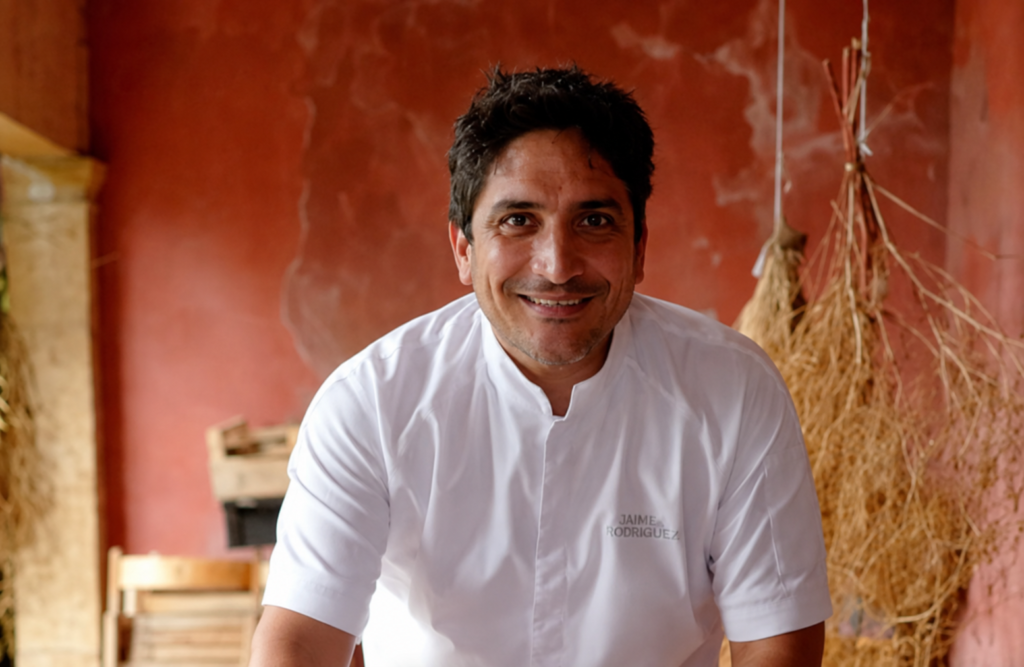
He left La Plata for France without speaking the language, and his first job consisted of peeling garlic for hours in Bernard Loiseau’s kitchen. He did it without complaining because, as he tells it, that task was part of the dream. Twenty years later, his restaurant was the best in the world and he was the only Argentine chef with three Michelin stars.
The boy from La Plata who played rugby
Before cooking, there were rugby fields and a middle-class childhood in La Plata. There was also a grandfather who, at lunchtime, would pour his grandchildren a few drops of red wine and fill the rest of the glass with soda water, Colagreco’s first contact with something that would later become an obsession of his own: for years, he personally built his restaurant’s wine lists alongside his sommelier.
He trained in Buenos Aires at Gato Dumas’s cooking school and learned from Beatriz Chomnalez. From that period he retains one precise memory: salmon wrapped in puff pastry with spinach and a mango and grapefruit vinaigrette that she taught him in 1998, his first French dish.
He says that if he is where he is today, it is because he met people who helped him along the way, and that detailed memory of a recipe from more than two decades ago says quite a lot about the way his mind works.
Garlic, châteaux and a new language
When he arrived in France, he used his first few months, while learning the language, to travel through the Bordeaux châteaux for tastings. His first job was at Bernard Loiseau’s restaurant in the heart of Burgundy, where he discovered the wines that remain among his favorites.
There, he spent hour after hour peeling garlic. The way he looks back on that period explains his character better than almost anything else: he knew he had not traveled all that way to peel garlic, but being in that kitchen was part of the dream, so he did it.
When asked what quality someone absolutely needs to work with him, he gives two answers: passion and knowing what you want.
Menton, or how to start without knowing anyone
He arrived in Menton in March 2006 and opened Mirazur in April. He knew no one, had never been to the French Riviera, had not tasted the local cuisine and had no relationships with its producers. That initial ignorance, he says, gave him enormous freedom to create dishes because there was no local template he felt obliged to respect.
The first Michelin star came just nine months after opening. It was so unexpected that he remembers it more as a surprise than an achievement. The second took five years, and that one he was expecting. When it finally arrived in 2012, he understood why it had taken so long. The number of customers rose by 30 percent almost immediately, and he realized they would not have been ready before. On the Sunday they found out, everyone hugged and cried; by the following Wednesday, every table in the restaurant was booked.
In 2019 came the third star and first place in The World’s 50 Best, a double achievement no Argentine chef had reached before.
The garden at the center of the method
What makes Mirazur distinctive is not so much its technique as its reversed logistics: instead of deciding on a menu and then looking for the ingredients, the restaurant cooks whatever the land provides that day. There is no fixed menu; there is a new one every day, based on what comes from the garden and what the fisherman brings.
Over time, that idea became a system. The restaurant’s own garden covers five hectares, three cultivated and two in rotation, and provides around 60 percent of its vegetables. It uses permaculture and biodynamic principles, and even carries lunar influence onto the plate: menus are organized around the phases of the moon, one day focused on leaves, another on fruit, another on roots. Changing everything every two or three days creates an enormous amount of work, and he chose it deliberately.
The remaining 40 percent comes from regional producers whom he asked to follow the same lunar calendar. To serve forty-five guests, the restaurant employs sixty-eight people.
His commitment to ingredients takes him to places that are not particularly photogenic. He may be found wearing rubber boots and a helmet inside a meat-processing facility in La Plata, talking to a spice merchant in China or searching in the mountains for a goat-milk producer. He does not wait for an official to solve those problems for him: he does it because buying from a supermarket, even if it is easier and cheaper, is not enough.
Throwing everything away after reaching the top
The gesture that best captures his relationship with the profession came after the pandemic. The expected response when a restaurant reaches three stars is to freeze the concept so as not to lose them. Colagreco did the opposite: he changed everything. He reopened with four tasting menus in which, apart from one or two dishes, almost nothing remained from what had earned him the highest distinction.
His argument is that what was best yesterday is not necessarily best today, and that perfection, precisely because it can never be reached, is what makes continued progress possible. He says he is not afraid of making mistakes along that path, and that excellence is not about stars or rankings but a way of approaching work from which there is no turning back.
He also turned Mirazur into the first certified plastic-free restaurant, after three years of work that began following a trip to Asia. The hardest obstacle was not technical but cultural: changing habits proved difficult even among young, environmentally conscious employees. The final challenge was kitchen film, of which the restaurant used around ten thousand kilometers a year, eventually replaced with compostable bioplastic.
The same standards for a hamburger
Carne, his burger restaurant, was born in La Plata with the same logic. Colagreco quotes Paul Bocuse: there are two kinds of cooking, good and bad.
With his sister Carolina, he researched local producers; with his head chef, he tested until they found the exact preparation for the meat; the ketchup is made with organic tomatoes from La Plata, and the bread took almost a year to adapt to Argentine ingredients.
Even the fries have their own story. Because the potato variety commonly used in Argentina is not ideal for frying, they decided to work seasonally with three different types, including one developed by INTA with a low starch content. The potatoes are first steamed, then confited and finally fried, with the oil temperature adjusted according to the variety.
What makes him proud of the project is having demonstrated that the idea that it is impossible to feed large numbers of people well at a reasonable price is false. The brand has already expanded to Brussels, Saudi Arabia and several airports around the world.
Cooking with others
He has devoted a considerable amount of energy to collaborative dinners. He has prepared four-, six- and ten-handed meals with Massimo Bottura, Quique Dacosta and Sasu Laukkonen, and, in Argentina, with Darío Gualtieri, Narda Lepes, Germán Martitegui and Fernando Trocca, deliberately using his international position to showcase the cuisine of his country.
For Mirazur’s tenth anniversary, he invited ten colleagues, one each month, to take over his kitchen.
Together with Jorge Vallejo and Virgilio Martínez, he promotes Orígenes, a platform dedicated to rescuing ingredients and producers at risk of disappearing, with the idea of bringing products considered humble into haute cuisine while giving their growers access to fair trade. His argument is that cooking needs to become an agent of social change.
In Argentina, he chairs the jury of the Prix Baron B, an award designed from the beginning not to recognize a dish or technique but a project and its socioeconomic impact, an idea that took some time to be understood during its early years.
What he does not want to become
Colagreco is explicit in rejecting the transformation of chefs into personalities. He argues that the celebrity-chef figure emerged from a historical need, when cooks had to be brought out of coal-fired kitchens and given social recognition, but that today it largely responds to a business logic that has ended up pulling chefs away from the stove.
He does not want the constructed persona to become more important than the craft.
When asked to introduce himself in a video, he simply says that he has a small restaurant in the south of France.
The most expensive luxury
Despite seventeen-hour working days, he says his most valuable luxury is time. He walks through the garden every morning and tries to spend time with his children because he needs to give part of each day to his private life in order to continue enjoying what he does.
His favorite project today is not another opening in a major capital, but a twenty-hectare farm in the mountains, half an hour from Mirazur, where he plans to create a few rooms and a twenty-seat restaurant in which everything served will come directly from the property.
It is the same movement as always, reduced to its purest form: the land first, the plate second.