
Leandro Ciappina
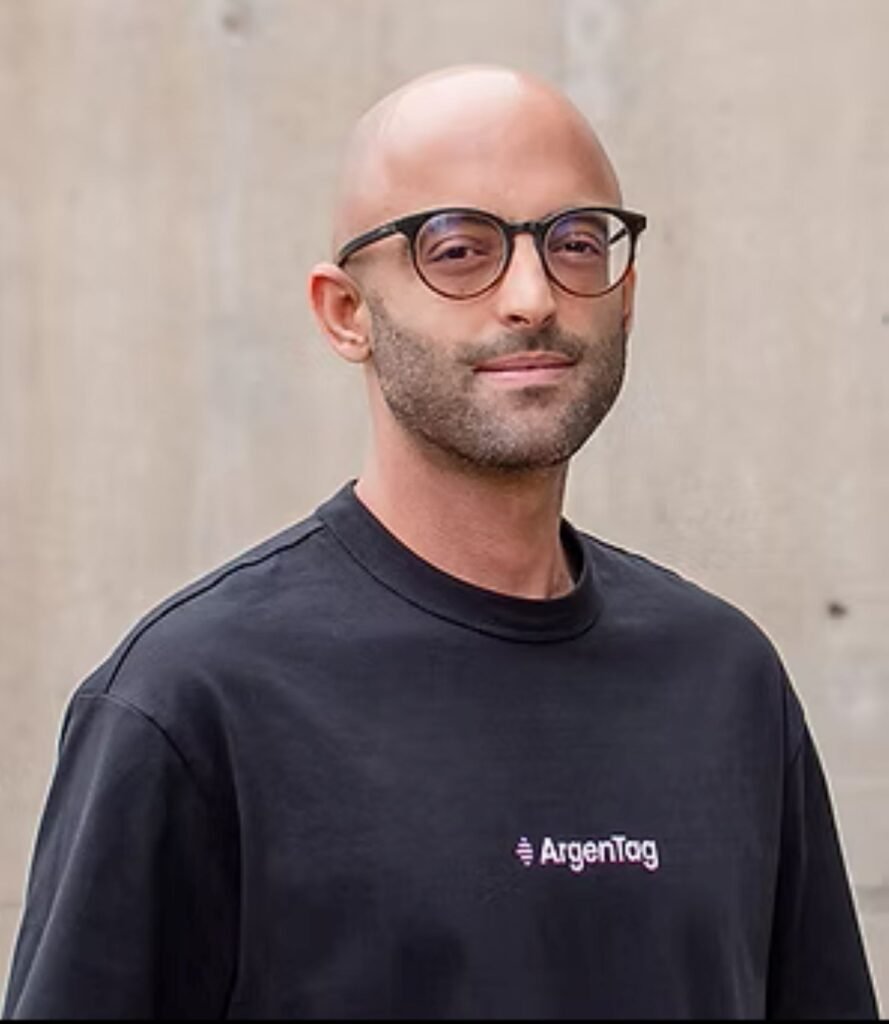
Born in Mar del Plata, with a background in business and no laboratory coat. He partnered with two scientists from Rosario, became obsessed with a problem that was not originally his own, and ended up manufacturing in Argentina a kit now used by Stanford, New York University, and St. Jude. This is the story of that persistence.
Someone else’s problem became his own
Ciappina is not a biologist. He comes from the business world and holds an MBA from IAE. When he tells his story, he begins by making it clear that he does not consider himself a genius: he describes himself as a kid from Instituto Carlos Tejedor who became hooked on a problem and put everything he had into solving it. That self-description says a lot about him. His contribution was not the scientific discovery itself, but the persistence to see that university research could become a product and refusing to let go of the idea.
The starting point was 2020. Ciappina partnered with two researchers from Rosario, Elizabeth Tapia and Pilar Bulacio, to take a development born at the university beyond the academic environment. He brought the commercial perspective; they brought mathematics and molecular biology. The three remain at the core of ArgenTag: Tapia as Chief Scientific Officer, Bulacio as Chief Technology Officer, and Ciappina as CEO.
What ArgenTag does, without the dictionary
The idea is simpler than it sounds. To understand what is happening inside a tissue, scientists need to read genetic material cell by cell, because each cell may be doing something different. The problem is that processing them individually is extremely expensive, while processing them all together makes it impossible to know which information came from which cell.
ArgenTag’s solution is to give each cell a kind of molecular barcode. This makes it possible to analyze all of them simultaneously without losing the identity of any individual cell. Ciappina compares it to moving from reading the credits of a movie to actually watching the scenes. He also gives a figure that helps put the scale into perspective: the DNA inside a single cell, if stretched out, measures about two meters; the DNA from all the cells in a human body would circle the Earth.
What is striking about the development is where its technical advantage comes from. It did not emerge from testing thousands of combinations until one happened to work. Instead, it came from applying mathematical models and error-correcting codes —the same family of tools used in telecommunications to ensure that a message arrives intact through a noisy channel— to the preservation of biological information. The final product is a kit scientists can use with equipment they already have.
From COVID to single cells
The path was not a straight line. They began by testing the technology with COVID samples, then moved into metagenomics, and only later focused on single-cell analysis, with applications in oncology, neuroscience, and immunology. That kind of zigzag is common in scientific startups and is often what kills them: every pivot consumes money and patience.
Today, ArgenTag works with institutions including Stanford, New York University, St. Jude, Mount Sinai Hospital, and European genomics centers, and is in an early adoption stage with laboratories using long-read sequencing. The team consists of around 12 people, most of them scientists trained within Argentina’s public research system. The company has a corporate address in New York, but the development work is done in Argentina.
Five attempts before getting in
The least glamorous part of the story is also one of the most revealing. Ciappina applied to an accelerator five times before finally being accepted. That stubbornness is probably his greatest professional asset.
The results came later. The project was selected by MIT and received investment from the Draper fund, with acceleration through Draper Cygnus. Ciappina describes that as positive pressure: when someone like Tim Draper bets on you, you can no longer afford to slow down.
In 2022, MIT Technology Review included him among its 35 Innovators Under 35 in Latin America, in the biotechnology and medicine category, for helping democratize a technique that had previously been limited by its cost.
Recognition accelerated in 2025. On July 2, he received the INTECMAR Network Innovation Award in the Business category at an event held at Espacio Chauvin in Mar del Plata. In June, ArgenTag had been selected for the BioTools Innovator accelerator: 31 companies chosen from more than 400 applicants across 43 countries, roughly 7% of those that applied.
In November, the team was at Cold Spring Harbor Laboratory, where Sofía Lavista Llanos presented comparative results from the kit to the single-cell research community. The year ended with the company’s logo displayed on the Nasdaq screen in Times Square.
Data with a purpose
There is another layer to what ArgenTag does, and Ciappina points it out whenever he can. Artificial intelligence applied to healthcare requires high-quality biological data, and single-cell sequencing generates terabytes of information at extremely high resolution.
His argument is that the goal is not to generate data simply for the sake of generating it, but to produce the kind of information that can improve diagnoses, help researchers understand complex diseases, and open new lines of investigation.
That is where the project stops being merely a local startup and enters a global conversation. Detecting malignant cells that a broader genomic analysis might miss changes the way a tumor can be understood and monitored over time.
Mardel Valley: the other obsession
Before ArgenTag became international news, Ciappina was already building something in his hometown. Together with his cousin Federico Ciappina, he created Mardel Valley, a technology and entrepreneurship event born after the two visited Silicon Valley and asked themselves why something similar could not exist in Mar del Plata.
Its seventh edition, held in 2023 at the Estadio Polideportivo Islas Malvinas, brought together nearly 20,000 people over two days of gaming, robotics, home automation, artificial intelligence, and virtual reality.
That project and ArgenTag share the same premise, and it may be the idea that best defines Ciappina: the belief that pushing the frontier of knowledge does not require moving to California. Capital can be raised from Mar del Plata, science can be developed with a Rosario accent, and a company can compete on equal terms in the global genomics ecosystem.
What holds everything together
When asked what made progress possible, he does not talk about a brilliant idea. He talks about surrounding himself with different profiles —engineering, molecular biology, data analysis, business— and refusing to give up. It is an unglamorous formula, which is precisely what makes it believable.
What drives this entrepreneur is not genetics in the abstract. It is the concrete possibility of getting a diagnosis sooner. Every labeled cell represents information that, until recently, would have been lost. And hidden inside that information may be treatments that do not yet exist.