
Adrián Villar Rojas
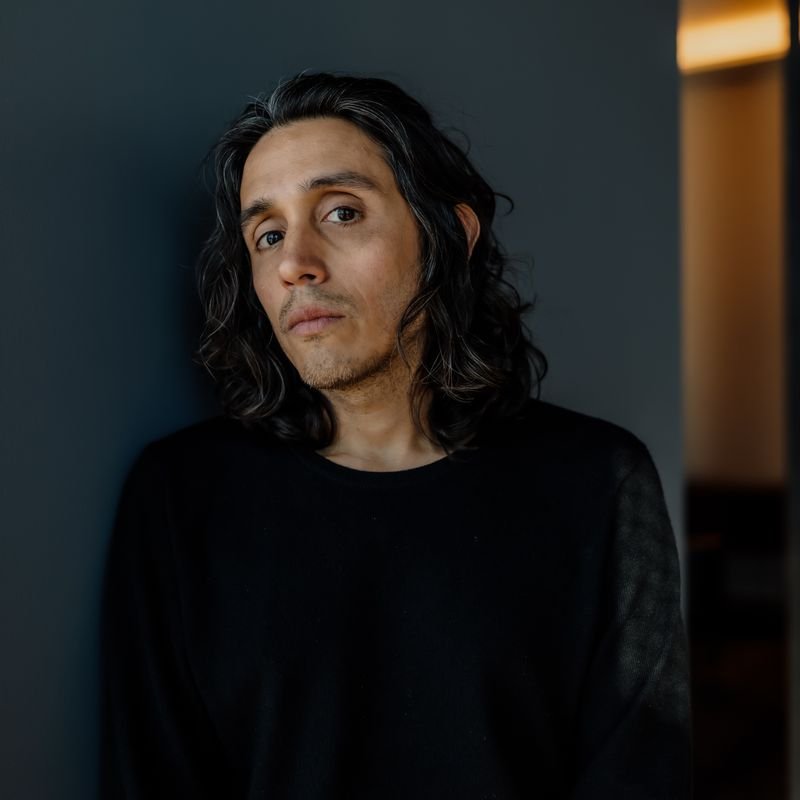
He won a competition for artists with no résumé in 2003, and nine years later he was driving clay sculptures into the terraces of a vineyard in Kassel for documenta. Adrián Villar Rojas works with materials that crack, rot and fall apart: clay, soil, bread, fish, plants, cement and electronic waste. His works look simultaneously like relics of a lost civilization and remains from a future that has not yet arrived. And they are made to disappear, something that complicates their sale, conservation and transportation. Born in Rosario in 1980, he is one of the Argentine artists with the widest international reach: he has exhibited at the Met, the Serpentine, MoMA PS1, Moderna Museet and the High Line, and represented Argentina at the Venice Biennale at the age of 31.
Rosario, a competition and a blank résumé
He trained at the School of Fine Arts of the National University of Rosario, in the city where he was born. His entry into the Buenos Aires art circuit came through Ruth Benzacar gallery’s Currículum Cero competition, created specifically for artists with no previous track record, which he won in 2003. The following year he held his first solo exhibition there, Incendio, followed by Un mar.
Local recognition came quickly: first prize at the National Art Biennial of Bahía Blanca in 2005 and a fellowship for young artists the following year. Between 2006 and 2007, he exhibited at the Ricardo Rojas Cultural Center, Belleza y Felicidad and the Borges Cultural Center, with titles that already anticipated his tone: Estas son las probabilidades de que te pase algo and 15.000 años nuevos.
What the fire brought me
The exhibition that established him as a distinctive figure was Lo que el fuego me trajo, at Ruth Benzacar. There he mixed objects separated by tens of thousands of years: Paleolithic arrowheads alongside busts of his own relatives, his sneakers and an iPod. The floor was covered with rubble, so visitors literally walked over ruins.
Critic María Gainza wrote in Artforum that through this operation the artist had turned ruins into icons and created a style of loss: not the loss of wealth or knowledge, but the loss of the very materiality of civilization. That formula still describes much of what followed.
Then came Mi familia muerta, at the II Biennial of the End of the World in Ushuaia, and Mi abuelo muerto, at Berlin’s Akademie der Künste. The titles function almost like a saga: mourning, inheritance and what remains when no one is left.
Venice, the Tuileries and the Kassel vineyard
In 2011, two appearances put him on the global map. He represented Argentina at the 54th Venice Biennale with El asesino de tu herencia, a participation for which he received the ninth Benesse Prize. That same year, he installed Poems for Earthlings in the Tuileries Garden in Paris.
The following year came dOCUMENTA (13), one of contemporary art’s most demanding events. For Return the World, he occupied the different levels of the Weinberg, an old vineyard in Kassel with underground vaults that had served as a bunker during the war. There he spread clay and cement sculptures across the outdoor terraces, alternating geometric, organic, naturalistic and openly surreal forms. That same year, the Konex Foundation also recognized him in Argentina.
The pace of the following years was relentless: Today We Reboot the Planet at London’s Serpentine —where the British press focused on a clay figure of Kurt Cobain—, La inocencia de los animales at MoMA PS1, the Zurich Art Prize for his project at Museum Haus Konstruktiv, The Evolution of God on New York’s High Line, Los Teatros de Saturno at kurimanzutto, the beginning of the Real DMZ Project in Korea, Fantasma at Moderna Museet in Stockholm and an award at the Sharjah Biennial.
In 2017, he presented The Theater of Disappearance simultaneously at five locations: the rooftop of the Metropolitan Museum of Art in New York, the Geffen Contemporary at MOCA in Los Angeles, Kunsthaus Bregenz, the National Observatory of Athens and Marian Goodman Gallery in London.
A method that looks more like moving house than installing an exhibition
What distinguishes Villar Rojas from most of his peers is not a style but a procedure. His work is site-specific in a radical sense: for each project, he and his studio settle for months in the place where they will exhibit and study its social, cultural, geographical and institutional environment. The exhibition is the residue of that experience, not its goal.
This itinerant residency model makes him a nomadic artist. It also makes him a collective one: the projects are produced as a team. For The Language of the Enemy in Seoul, eleven collaborators and six weeks of work inside the building were required.
The most uncomfortable consequence of the method is material. By using organic, perishable and constantly transforming components, the work is condemned to disappear. That means it cannot be fully preserved, reproduced, commercialized or transported, placing pressure on the basic rules of the art market and on the museum’s role as an institution devoted to preservation.
From the Moon as monument to a hive in Seoul
Between late 2022 and May 2023, The Bass Museum in Miami Beach presented The End of Imagination, a large-scale installation created with fellow Argentine artist Mariana Tellería. It began with an unusual question: what will happen to monumentality and commemoration when interplanetary conquest reaches the Moon or Mars?
The argument unfolds in a chain. If the social meaning of monuments to Columbus, Cortés or Pizarro shifted from glorification to rejection, will there come a day when the oppressed of the future reinterpret the monuments of space conquest? Then comes a second, more unsettling idea: because the Moon has no atmosphere, every footprint, every rover mark, every flagpole and every crashed satellite will remain there frozen in its current state. In that reading, the Moon is already a museum of human exploration, the ultimate anti-entropic archive of the solar system.
Out of that project came The End of Imagination, the sculptural series begun in 2022 and still ongoing: hybrid and supernatural forms, defeated cyborgs awaiting an irreversible end, impossible combinations of plants and metals.
That series formed the core of The Language of the Enemy, his first solo exhibition in Korea, held at the Art Sonje Center in Seoul from September 2025 to February 2026. There, he transformed the institution into a futuristic hive inhabited by nonhuman, posthuman and synthetic beings, with organic matter invading the institutional space until the boundary between inside and outside dissolved. The exhibition closed a Korean cycle that had begun with the Real DMZ Project and continued through the 2018 and 2021 Gwangju Biennials.
Archaeology of the present
His entire body of work is sustained by the same tension: human against nonhuman, organic against inorganic, inheritance against extinction. His scenarios oscillate between archaeology and science fiction, with vanished civilizations, eroded machines and fossil creatures that still seem to have a pulse.
It is not gratuitous fantasy. This narrative appears at a moment when humanity is seriously debating its own continuity, amid climate change, the rise of the far right and the proliferation of conspiracy theories. His work positions itself precisely on that edge, between what is lost and what is passed on.
The question left hanging in every room is always the same, and it has no comfortable answer: what will remain of us when nothing else remains.