
Diego Pasjalidis
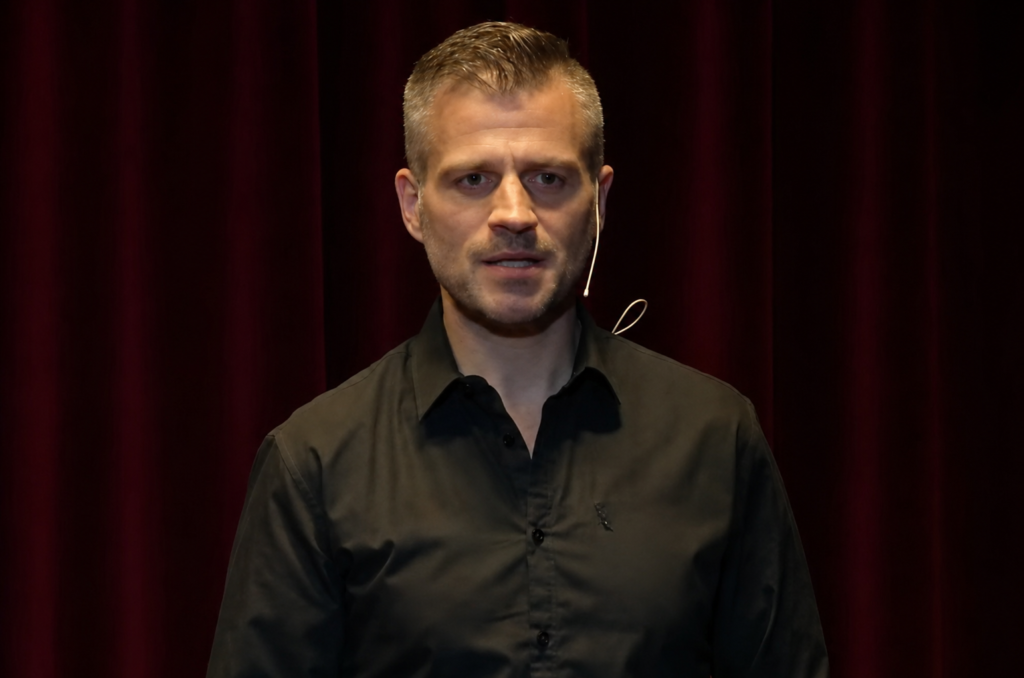
Two young men who lived on the tips they earned performing magic tricks on the street asked him for help building a strategy. They knew nothing about business. Translating business-school management models into language they could actually apply took him months. It worked, and from that experience came the book that turned him into one of Argentina’s most sought-after voices on innovation.
An engineer who stepped outside the mold
Pasjalidis has the background of a traditional technical professional: Industrial Engineering at UTN, followed by an MBA that he completed with the highest possible grade and a master’s degree in Business Management. None of that suggests someone who now explains innovation by quoting the Three Stooges.
His professional career has taken him through very different environments. He served as deputy manager of Technology Transfer at INTI, director of the Industrial Engineering program at UADE, commercial and innovation director at the Argentine subsidiary of a multinational technology company, and today leads the academic area of an educational technology company. That movement between government, university, industry and education helps explain why he can speak the language of all those worlds.
The case that changed his direction
The turning point was not a large company but two magicians. Julián and Marcos lived on tips and contacted him because they needed a strategy. The only thing they knew how to do was perform tricks.
Pasjalidis set himself the challenge of translating the strategy and innovation models taught at business schools into language they could use, breaking them down into steps that could be applied one at a time. The result exceeded all expectations: the magicians, known as Asombro Extremo, eventually won international recognition in the same professional circuit that has featured figures such as David Copperfield.
What Pasjalidis took from the experience was a practical conclusion: if the model had worked for two people with no business training and no resources, it could work for anyone. That is why he wrote the book, and why it has the title it does.
Inspiración Extrema, or how to cook up a strategy
The book was published by Editorial Conecta and became a management bestseller. It contains seventeen chapters and more than 250 pages of quotations, charts and examples, designed so that any entrepreneur or business owner can work through it gradually and build a sustainable business.
At its core is a tool he calls the inspirational cross: a two-axis diagnostic that places a business in one of four quadrants. The appropriate strategy and type of innovation differ depending on where the business falls, and that is the central idea. Pasjalidis compares it to going to the doctor: expecting the same medication to work for everyone is a mistake. It may harm some people while helping others.
Before designing anything, he proposes diagnosing where the problem lies, who the competitors are, what the customer values, what distinctive value will be offered, which resources are limiting and what the key success factors are. Only then, he says, can you stock the pantry from which the strategy will be cooked.
The book also includes a list of the ten main reasons ventures fail and addresses issues that rarely appear in manuals: how fear operates as an invisible barrier, why anyone can become an entrepreneur and how much an idea is actually worth.
His favorite definition
When asked what innovation is, he answers with two words: differential value. Then he breaks them apart. Everyone has creativity, the ability to generate ideas; innovation appears when those ideas are applied and produce something. Value means giving someone a real solution. Differential means that no one else is providing that same thing.
That explains his insistence on teamwork. An innovator needs the idea to be manufactured, produced, sold, distributed and communicated; alone, they cannot get there. Without that entire system, the idea simply floats.
For innovations connected to what a company already does, he proposes four paths summarized by the acronym ERIC: eliminate, reduce, increase and create. Bigger leaps, however, require breaking existing patterns and learning from mistakes.
Another of his recurring recommendations is technology scouting, the habit of constantly watching what is happening around you, especially in fast-moving industries. To explain why standing still is also a decision, he turns to a scene from the Three Stooges in the military: when a general asked for three volunteers and ordered them to step forward, they stayed still while everyone else stepped backward. They ended up going to war because they did nothing.
His commitment to those just getting started
Much of his energy has gone into less glamorous corners of the entrepreneurial ecosystem. He worked with CAME throughout Argentina, particularly with CAME Joven, after realizing that many entrepreneurs have nowhere to obtain both technical knowledge and practical experience in innovation at the same time.
In 2017, he was one of the speakers at Emprender San Luis at the National University of San Luis. The way he describes that experience says a great deal about his character: he made clear that he did not go to those events to talk about U.S. business schools, but about Argentina’s concrete reality, and that while interviewing local entrepreneurs he ended up learning things that he later turned into tools, models and articles.
He also brought the discussion into agriculture. In an interview on agribusiness, he argued that Argentina is good at innovating in the first links of the production chain but has shortcomings further along; that innovation means accepting risk and making frightening decisions; and that short-term thinking has to be abandoned in order to understand and build the future.
School, work and the right question
On education, he takes a position that departs from the usual technology script. He acknowledges that today’s teachers need very different skills from those they were originally trained for —himself included— and that their role has shifted from transmitting information to managing knowledge, with the responsibility of working with students who are all different. His recommendation is that teachers focus precisely on where each student shines, where a particular ability or passion becomes visible.
When asked whether teenagers should study programming, he did not give the obvious answer. He said the first thing he would ask a young person is what makes them happy, because once they understand where their passion lies, alternative careers emerge in which technology can also be applied. He pointed to graphic designers, who once felt threatened and returned strongly through design thinking, and to biologists and philosophers who now work in technology while doing what they enjoy.
His warning is clear: technology is a means, and behind it are many careers with a future. In the knowledge economy that is coming, he argues, the role of teachers will be fundamental.
What he did with lockdown
The most human portrait of his method appears in the way he lived through 2020. With work entirely remote and no possibility of going out to train, he exhausted the movies on cable television, added streaming platforms, began taking online courses and became absorbed in a single book. In January of that same year, he had joined the digital company where he wanted to grow in innovation, just before the pandemic accelerated many of the changes he had been anticipating.
He used the lockdown weekends to write. He envisioned his second book as something different from the first: practical, digital, free for readers and designed as a toolbox for virtually any business problem. By the end of the year, he had completed 70 percent of it.
His personal conclusion from that year was equally simple: no goal makes sense without health, relationships and peace of mind.
The phrase that sums it all up
There is one idea he repeats that functions as his underlying thesis: being good is not enough. In a market where products similar to yours will always appear, the only thing that sustains a business is difference.
He adds an optimistic observation about the starting point. It does not matter, he says, whether you are at the center of the world or in a remote city: thanks to technology and communications, everyone can compete on more equal terms. What remains is to build meaningful differentiation.
It is the same conviction that led him to sit down and explain strategy to two magicians who lived on tips.