
Mara Wilson
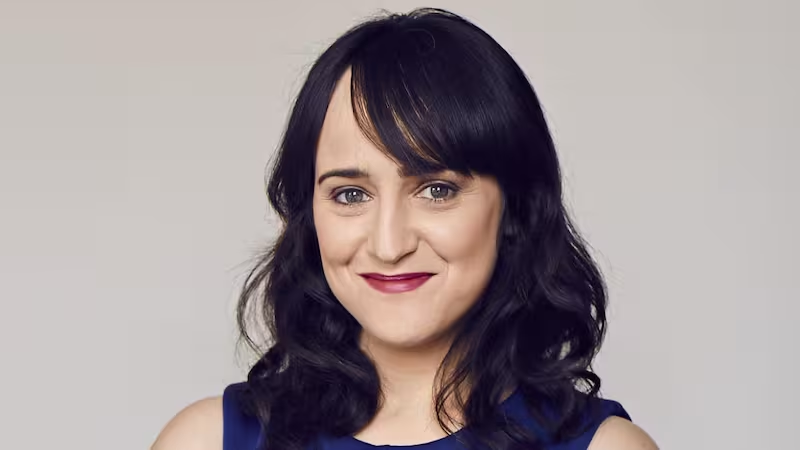
Mara Wilson became forever associated with Matilda, but her true passion was broader than childhood acting. Her path shows an artist who turned early fame into writing, voice, memory and reflection. Far from remaining confined within Hollywood, she built an adult career based on narration, literature, voice performance and an honest view of mental health.
A vocation stronger than fame
Mara Wilson cannot be understood only as a former child actress. Her career shows a sustained relationship with the act of telling stories, first through the screen and later through writing, voice and the stage. That passion allowed her to distance herself from early fame without abandoning creative work. Instead of being defined by the image of a child prodigy, she sought an adult form of expression, with greater control over her personal and professional narrative.
First steps in acting
Born on July 24, 1987, in Burbank, California, Mara Wilson entered the audiovisual world during childhood. Her career began with commercials and soon reached cinema with Mrs. Doubtfire, released in 1993. There, she played Natalie Hillard, the daughter of Robin Williams’ character. That role introduced her to a massive audience and revealed an uncommon ability to work naturally alongside adult figures with enormous stage presence.
The impact of Matilda
Her most remembered role came in 1996 with Matilda, directed by Danny DeVito and based on Roald Dahl’s novel. Wilson played a sensitive, intelligent young reader who found in books a form of resistance against a hostile environment. The film became established as a generational work. For the actress, that project was also marked by a painful personal experience: the death of her mother, Suzie Wilson, to whom the film was dedicated.
Moving away from Hollywood
After several years of exposure, Wilson decided to move away from film as the center of her professional life. Her departure did not mean a renunciation of art, but a choice in response to an industry that often demands continuity, public image and constant adaptation. Adolescence allowed her to look back on that stage with distance. Instead of sustaining a career imposed by fame, she chose to study, write and build a healthier relationship with creativity and private life.
Writing as her own territory
Writing became the space where Wilson could organize her experience. In 2016, she published Where Am I Now? Stories of Girlhood and Accidental Fame, a book of memoir and essays about childhood, fame, grief, anxiety and identity. There, she did not merely recall her time in Hollywood: she worked on how a person can recover their own voice after having been watched, interpreted and defined by others from a very early age.
Voice, narration and new formats
In adulthood, Wilson developed a career connected to narration, voice acting, audiobooks, podcasts and playwriting. These formats allowed her to continue performing without being subjected to the same visual exposure as film. Voice requires technical precision: rhythm, intention, breathing, tone and understanding of the text. In that field, Wilson found a natural continuity between acting and literature, with a more intimate and controlled presence.
Mental health and public perspective
Mara Wilson also spoke publicly about anxiety, OCD and depression. Her contribution was not built from spectacle, but from a willingness to put words to common experiences that are often silenced. That dimension broadened her public figure: she stopped being only an actress remembered for a children’s film and became an author capable of thinking about the effects of fame, social pressure and emotional care with a direct and developed voice.
A passion turned into autonomy
Mara Wilson’s story shows that passion does not always mean remaining where success first appeared. In her case, dedication meant changing form without abandoning the creative core. The girl who played Matilda became associated with imagination and reading; the adult who writes, narrates and reflects transformed that energy into a work of her own. Her career demonstrates that true artistic continuity can lie in choosing the right language for each stage.