
Erling Haaland
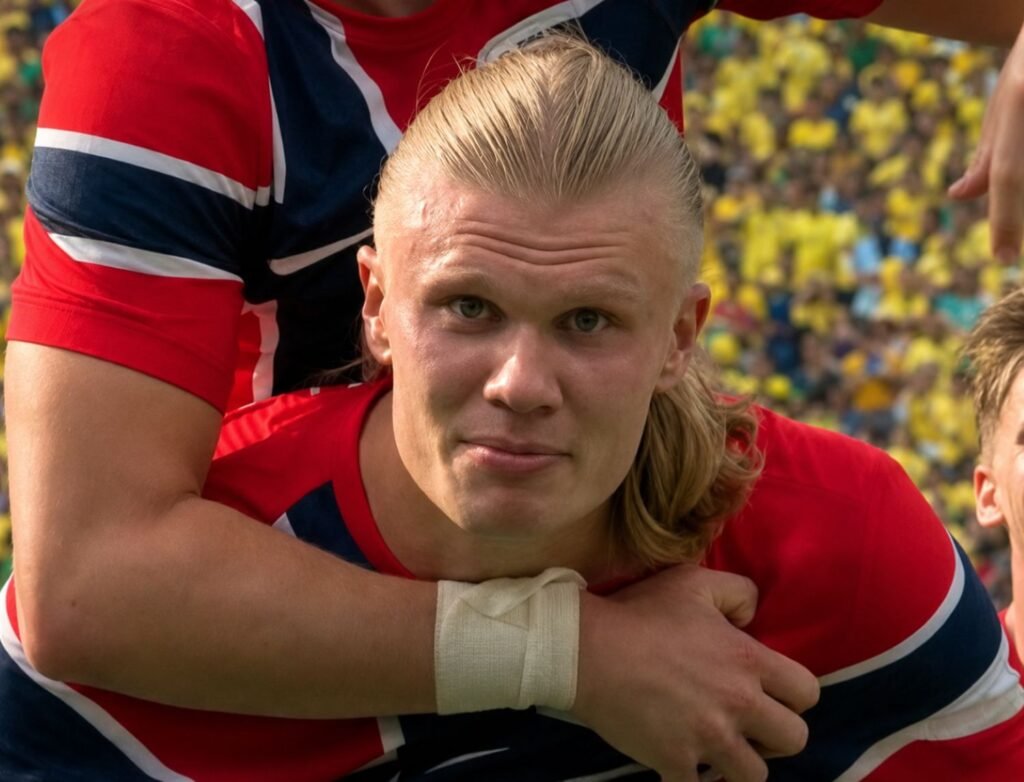
They call him “The Beast” and “The Android,” and both nicknames point to the same idea: the feeling that Erling Haaland was programmed to score. But behind that coldness in front of goal there is a trained mind, a childhood filled with many sports and an idol who taught him to want the goal above all else. Understanding that mentality helps explain why he breaks records that once seemed untouchable.
A boy who tried every sport
Before choosing football, Haaland was a complete athlete. As a child, he practiced handball, golf and athletics, and an unusual mark is still remembered: at just five years old, he set a record for his age group in standing long jump, with 1.63 meters. That physical base — inherited from a footballer father and a heptathlete mother — shaped the explosive striker he would later become. He did not reach the elite only through talent with the ball, but through a body trained from childhood to jump, run and collide without giving ground.
The idol who taught him to want the goal
When he was still dreaming of becoming a professional, he watched the Champions League while focusing on one detail: Cristiano Ronaldo’s face before scoring. He was fascinated by that conviction of feeling like the protagonist, the one who was going to decide the match, and he said he wanted to copy exactly that attitude. He also admired Zlatan Ibrahimović, another striker with an overwhelming personality. From those mirrors he drew an idea that now defines his game: the goal is not awaited, it is pursued with a determination that borders on obsession. He treats every cross into the box as an opportunity he has no intention of wasting, and that hunter’s mentality — more than any flashy technical gesture — is the trademark of his career. He prefers scoring ten ugly goals to one highlight-reel finish.
The mind of a scoring machine
Haaland’s numbers are frightening precisely because they seem laboratory-made. He was the fastest player to reach 100 goals in Europe’s five major leagues, surpassing a mark held by Ronaldo Nazário, and also the fastest to reach 50 goals in the Premier League. In his debut season in that league, he scored 36 goals, a record for a campaign, and led Manchester City’s treble of Premier League, FA Cup and Champions League, which established him as Europe’s best player. In the continent’s top competition, he also left his mark early: he was among the youngest in history to string together his first goals, with hat-tricks on his debuts for both Salzburg and Dortmund. And as a teenager he had already given notice: at the 2019 U-20 World Cup, he scored nine goals in a single match against Honduras, another record for the competition. Not even injuries stopped him: every time he returned from a layoff, he resumed his scoring rhythm as if nothing had happened.
To those who criticize him for “only scoring goals,” he answers with the scoreboard; that extreme specialization is, in fact, the hardest skill in football. A striker who guarantees thirty or forty goals per season is worth his weight in gold, and he knows it.
Clockwork discipline: how he takes care of his body
Such regularity is not sustained by talent alone. Haaland is known for an almost scientific care of his body: he pays obsessive attention to nutrition, controls the hours and quality of his sleep and organizes his routine around recovery. To that physical work he adds the mental side: he practices meditation, a tool that helps him slow down and arrive focused for every duel. The image of the “android” who feels nothing hides, deep down, a professional who plans every detail so that scoring does not depend on chance.
What he dreams of when he hangs up his boots
Far from the roar of stadiums, Haaland keeps a plan that surprises anyone. When asked about the future, he does not talk about coaching teams or living off marketing: he says he wants to be the best farmer, take care of animals and grow vegetables. Near Bryne, he has been seen driving a tractor or feeding cows, an image that contrasts with the millionaire goalscorer on magazine covers. That simple life, tied to the land where he grew up, works as a counterweight to a dizzying career and explains where he gets the calm to perform under pressure.
The same hunger that led him to break records in Europe appeared again at the 2026 World Cup, when his brace against Brazil took Norway to the quarterfinals for the first time in history and left him level with Messi and Mbappé at the top of the tournament’s scoring table. At 25, with his ambition intact and a life plan as down-to-earth as his finishing, “The Android” keeps doing the only thing he seems to do effortlessly: turning the ball into a goal.