
Florencia Benedicto
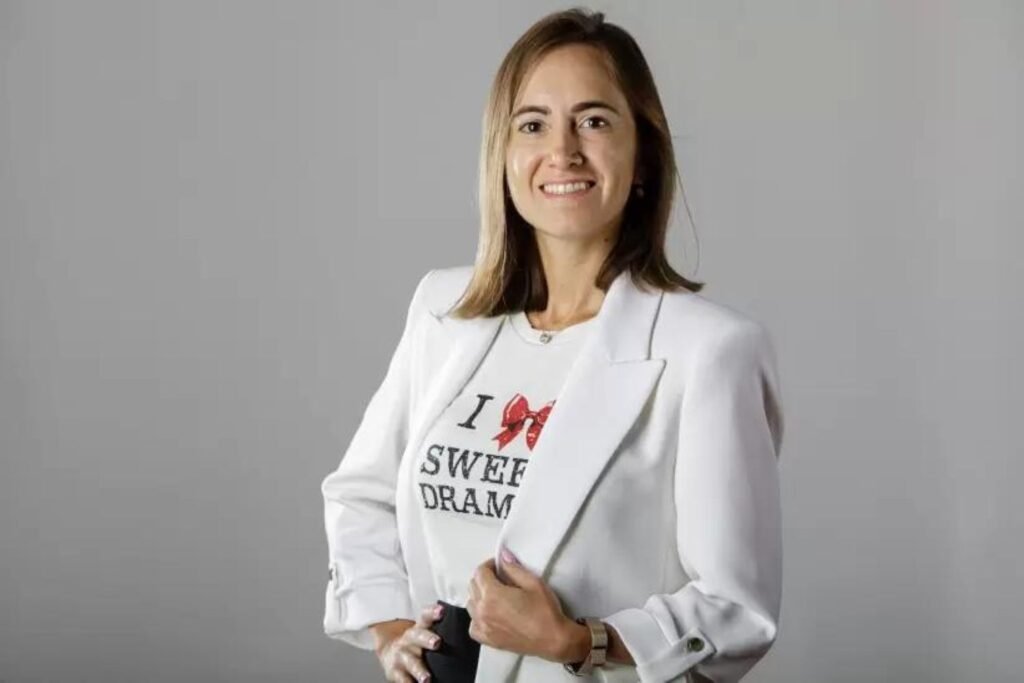
She grew up hearing conversations about casinos around the family table, but chose environmental law as her first profession. Florencia Benedicto is a lawyer specializing in environmental management and the co-founder of GEA Sustentable and KO Agua. Her career brings together two fields that rarely share the same agenda: the entertainment industry and the circular economy.
This profile traces how she came to work in both and why environmental impact became the connecting idea between them.
The noise of gaming halls and the silence of legal files
Benedicto was born in Comodoro Rivadavia, the Patagonian city where her father opened his first gaming establishment when she was five years old. The industry was always present in family conversations.
When the time came to choose her own path, however, she moved in another direction. She trained as a lawyer and devoted the first stage of her professional life to environmental law.
Her specialization in Environmental Direction and Management provided the technical framework. Professional practice then led her to a broader conclusion: the waste problem could not be solved through regulations alone. Someone also had to take responsibility for the materials after they were discarded.
GEA Sustentable: From an idea to an operating plant
In 2015, Benedicto founded GEA Sustentable with her cousin Ciro Panizo. They had identified a specific gap in the market: large companies and organizations generated significant volumes of recyclable waste but often lacked a reliable operator capable of managing it properly.
GEA was created as a B Corporation and developed a system that begins before the waste reaches a container. The company trains employees at client organizations, collects and sorts the materials at its own operating centers and sells the compacted recyclables back to industry.
One of the features it emphasizes is traceability. Client organizations receive reports showing how much material was recovered, the resources saved and estimates of the environmental impact avoided through recycling.
The company later expanded into composting, biodigestion, carbon-footprint measurement, energy efficiency and biogas. By 2021, it had operating centers in Buenos Aires and Rosario, more than thirty employees and over 120 client organizations.
GEA has since developed into a group of B Corporations working in waste management, renewable-energy generation, environmental education and the manufacture of products made from recycled materials. Its current network includes projects such as GEA Buenos Aires, GEA Rosario, GEA Mendoza, Buena Madera, GEA Bio and GEA Academia y Consultoría.
KO Agua was added to that entrepreneurial portfolio as a project intended to rethink plastic consumption from the packaging stage. The brand promotes containers made largely from renewable sources, placing the environmental discussion directly in the product rather than limiting it to the disposal process.
Returning to the family business through energy
Years after launching her environmental ventures, Benedicto joined Grupo Inverclub, the holding company associated with her family and its partners.
Her entry point was not a gaming table but renewable energy. She became involved with EFESA, a company created to generate photovoltaic solar power for some of the group’s largest operations.
The company developed 22 MW of generation capacity. That supply allowed facilities such as City Center Rosario to cover more than 70 percent of their electricity consumption with renewable energy at the time the figures were reported.
EFESA also developed the Los Llanos Solar Park in La Rioja. The project was certified as a B Corporation and obtained Gold Standard recognition for its environmental performance. Company estimates indicated annual generation of approximately 62,649 MWh and avoided emissions of more than 28,000 tonnes of carbon dioxide equivalent per year.
Benedicto later expanded her responsibilities within Inverclub, participating in the management of entertainment, digital, technology and energy businesses. Her professional biography indicates that she spent seven years as a corporate director within the group before moving on from that stage.
During that period, she also took part in the development of online gaming operations connected with Ondiss and BetWarrior. In a 2023 interview, she explained that the group had obtained its first Argentine online gaming licence in Neuquén in 2017 and subsequently expanded into other provincial markets.
Managing in order to set an example
When discussing women’s participation in a traditionally male-dominated industry, Benedicto tends to frame the issue through management rather than slogans. Her argument is that leadership must be demonstrated through results.
During her time at Inverclub, she highlighted that women represented approximately 40 percent of the group’s workforce and occupied positions across its different companies.
The group’s corporate sustainability strategy included responsible-gaming programs, scholarships for employees completing secondary education, breastfeeding rooms, workplace inclusion for people with disabilities, animal-care initiatives at the Palermo racetrack and volunteer programs with community organizations.
According to Benedicto, those initiatives were aligned with the United Nations Sustainable Development Goals and formed part of the companies’ strategic management rather than separate philanthropic activities.
What she says when invited to speak
Benedicto writes and speaks regularly about waste, recycling, responsible consumption and impact investment. Her articles have addressed subjects ranging from the five Rs of sustainability to Earth Overshoot Day and the kinds of materials that can be recycled.
Her argument remains consistent: the climate crisis is connected with the way societies produce, consume and live. Sustainability therefore cannot remain an appendix to corporate strategy. It must become part of the way companies design products, calculate costs and make investment decisions.
At the 2025 Forbes Sustainability Summit, she participated in a panel devoted to Argentine startups using science, technology and new business models to address environmental problems. She appeared there as co-founder of GEA Sustentable and KO Agua.
Her view of purpose-driven entrepreneurship includes a practical difficulty. Recycling costs money. Replacing conventional packaging with lower-impact alternatives can also increase immediate expenses. The challenge is to find organizations that recognize environmental and reputational returns rather than evaluating every decision only through its short-term cost.
For Benedicto, that difficulty also reveals the size of the opportunity. Waste that is currently buried or discarded can become raw material, energy or a new industrial product when companies, governments and impact ventures build the necessary systems together.
The connecting thread
Environmental law, a B Corporation founded with her cousin, solar panels supplying entertainment businesses, alternative packaging and experience in the online gaming industry can make Florencia Benedicto’s career appear scattered when viewed from a distance.
Seen more closely, each stage responds to the same idea: environmental impact should stop being treated as an external cost that companies try to avoid and become something they measure, manage and incorporate into the business itself.
That principle allowed her to move between two very different industries without entirely changing direction. The businesses changed. The question behind them remained the same.