
Néstor Sarmiento
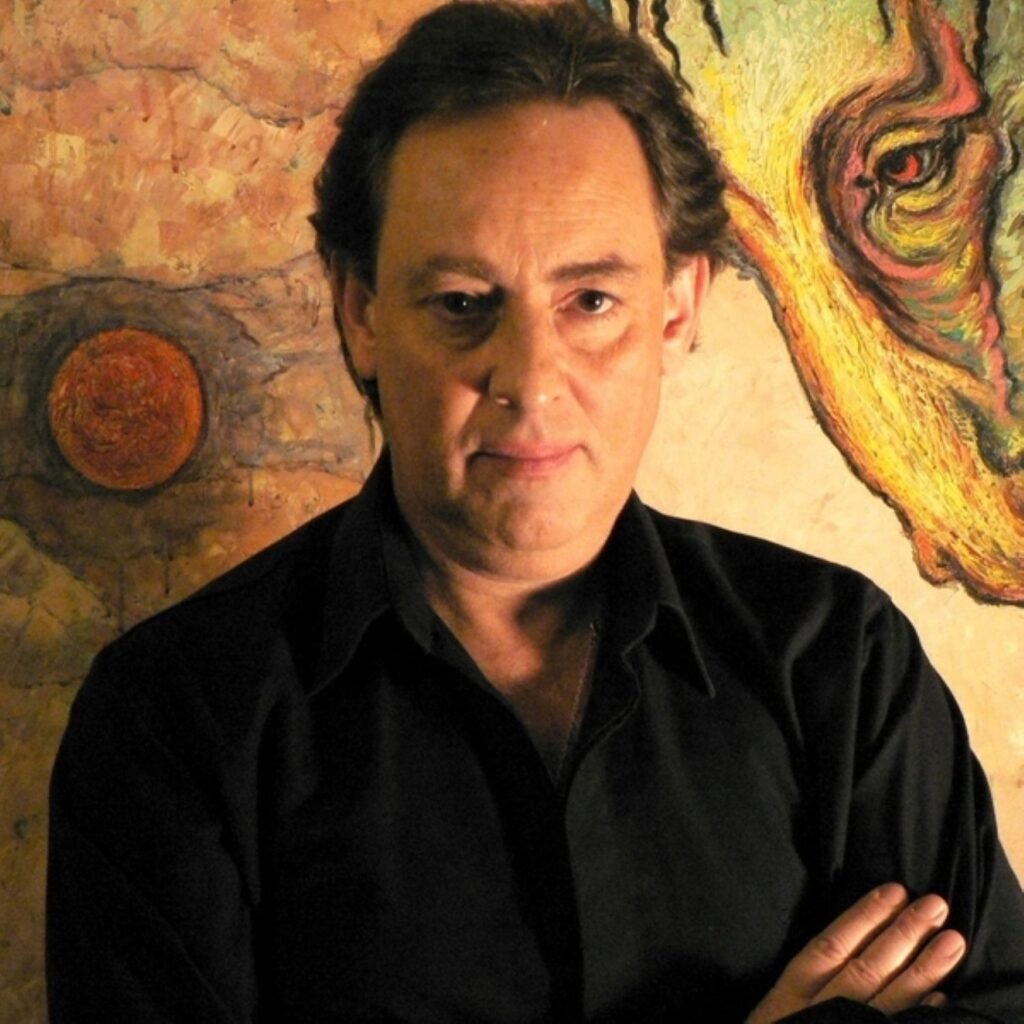
He learned to paint from his father. He later trained with the master Vito Campanella, settled in Brazil in 1983 and returned to Argentina in 1992. Since then, he has done two things simultaneously: painted in oils and taught oil painting. His Recoleta studio marked thirty years of uninterrupted activity in 2026, celebrating with an exhibition of work by seventy of his students at the University of Buenos Aires Faculty of Law. The phrase he uses to close his videos sums up what he has been doing since the nineties better than any résumé: “And don’t pretend to be an artist, because you can be one.”
His Father Was His First Teacher
This story begins in a home rather than an academy.
His first teacher was Roberto Sarmiento, his father, who introduced him to painting. That has a consequence running through his entire subsequent career: he learned the craft as one learns a family trade, watching someone work and copying their movements before any formal training.
Someone who undergoes that kind of training often retains an understanding of teaching different from that of someone educated in an institution. Knowledge is passed on person to person, over the painting, making corrections while the paint is still wet. Thirty years later, that is exactly what is replicated in his own studio.
Training with Campanella
He completed his subsequent training with the master Vito Campanella, accompanied by Domingo Onofrio and Félix González Mora.
That lineage matters because it defines the aesthetic territory in which he works. The work Sarmiento offers and exhibits moves between figurative, expressionist and surrealist modes, and his medium is oil paint, without detours into other materials. At a time in contemporary art when installations, video and objects occupy much of the exhibition space, devoting an entire career to oil on canvas is a decision rather than a limitation.
His own website organizes his work into five periods, indicating a body of work extensive enough to have distinct stages.
Brazil, 1983
In 1983, he settled in Brazil and remained there until 1992, when he returned to Argentina.
That was nine years abroad, in the region’s largest country and during the democratic transition on both sides of the border. Since returning, he has participated in national and international art salons and exhibitions, showing his work in Brazil, Italy, the United States and Mexico.
In Argentina, he was invited to present his work at three major venues: the Centro Cultural Borges, the Fine Arts Museum of the Province of Buenos Aires and the Salón de los Pasos Perdidos in the National Congress.
Florence, and the List of Awards
The recognition most often mentioned in his résumé comes from Italy.
He received the Lorenzo il Magnífico Gold Medal at the Florence International Biennial of Contemporary Art, the Italia per l’Arte award from the Vetrina Internazionale degli Artisti Latino, and the Grand Collar of Donatello, awarded by the Cosimo de’ Medici Academy, which also named him an honorary master.
In Buenos Aires, he accumulated distinctions from art salons and galleries: a special jury mention at Galería Donderte, a first honorable mention at Galería Núcleo de Arte, a third honorable mention at Galería El Portal and first prize at the Universidad Popular de La Boca Anniversary Salon. He also received recognition from the Buenos Aires City Legislature and Argentina’s Chamber of Deputies.
Thirty Years of the Studio
Here lies the part of his work that says the most about his dedication, and it has nothing to do with his own paintings.
His studio in Recoleta marked thirty years of uninterrupted activity. Around one hundred students attend in-person classes each month, while online classes reach different Argentine provinces and students living in Mexico, Bolivia, Brazil, Germany, Spain and England.
The studio’s structure says a great deal about how he understands teaching. He accepts students from age twelve and works with adult groups, both beginners and advanced students, with life-model sessions available. In other words, someone who has never touched a brush can share a room with someone who has been painting for years.
Maintaining that for three decades without interruption, in a country with Argentina’s economic instability, is a fact worth measuring. Private art classes are among the first expenses a family cuts when its income shrinks. Thirty years of continuity means having gone through 2001, the pandemic and every crisis in between while maintaining enrollment.
Seventy Students at the Faculty of Law
He celebrated the thirty years in the way most consistent with his craft: exhibiting his students rather than himself.
The exhibition was called “Expo 70 alumnos” and was presented at the University of Buenos Aires Faculty of Law from April 20 to May 4, 2026, in the faculty’s exhibition hall, as part of the institution’s visual arts exhibition program. Seventy of his students displayed work. According to the studio’s own account, the opening attracted more than twelve hundred people.
The choice deserves attention. A painter marking thirty years of teaching has earned the right to stage a retrospective of his own work in an institutional venue. He used that space for others.
“Don’t Pretend to Be an Artist, Because You Can Be One”
The phrase he uses to close his teaching videos is a statement of method, and it deserves to be unpacked because it is not a stock expression.
The first part, “don’t pretend to be an artist,” disarms the pose: the idea that to paint, one must first adopt an identity, an air or a way of presenting oneself. The second, “because you can be one,” says the opposite of what might seem likely to follow. He is not denying that the other person can be an artist; he is saying they can, and that precisely for that reason they do not need to act the part.
He describes his teaching objective as giving confidence to someone just starting out. In a craft where the first barrier is often the conviction that one has no talent, that is less obvious than it sounds: one hundred students a month over thirty years means thousands of people who sat before a canvas believing they would not be able to do it.