
Sally Rooney
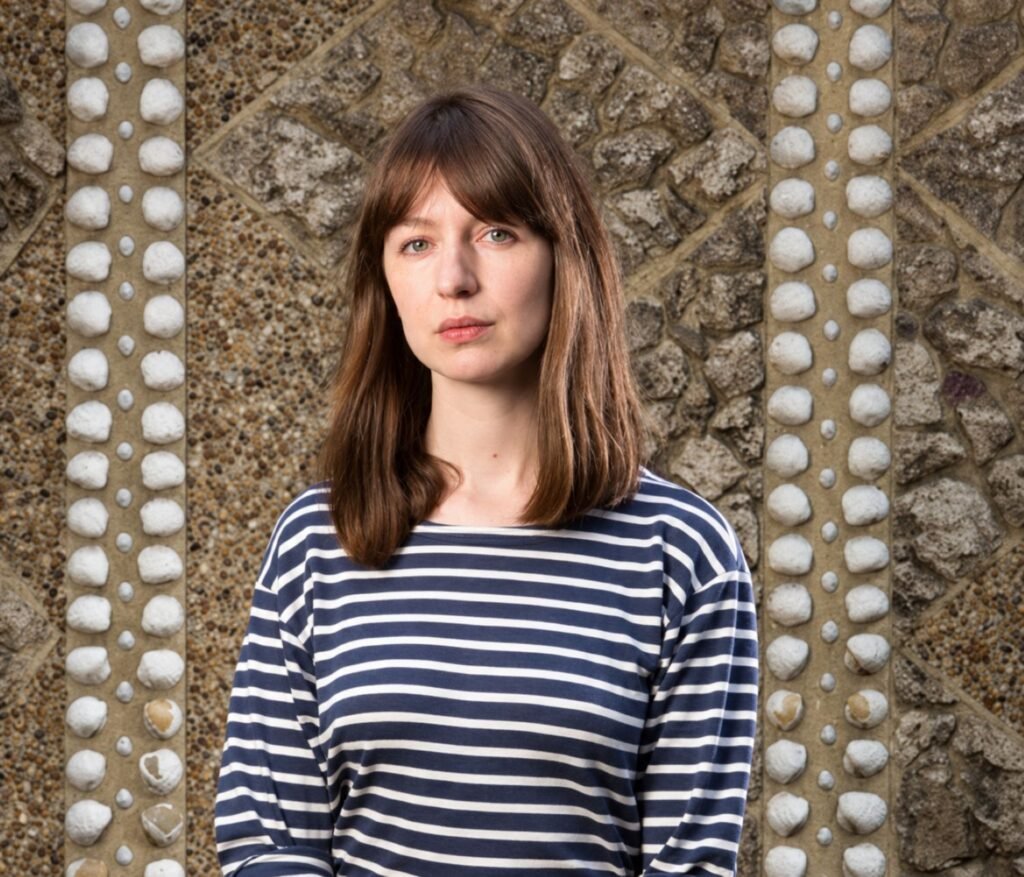
Before writing a line of published fiction, she won arguments. In 2013, she was the best speaker at the European Universities Debating Championships, and the essay she wrote about that experience was what secured her a literary agent. Four novels in seven years followed, along with more than six million copies sold and two television series. And in October 2026, because of a political decision she made and refused to reconsider, her books began to be withdrawn from sale in the United Kingdom.
Castlebar, Two Socialist Parents and an Arts Center
Her background explains more than usual in this case, because the home she grew up in contained the two things that would later shape her work.
She was born in Castlebar, a town in County Mayo in western Ireland, far from Dublin’s literary circuit. Her father worked at Telecom Éireann, the state telecommunications company, and her mother ran an arts center. Both were socialists, and she acknowledges that those values came from them. She has an older brother and a younger sister.
On one side, then, a childhood with access to the cultural life of a small town. On the other, a political education acquired around the family table rather than at university. Both appear later in her books: characters who read and argue a great deal, and a constant attention to the money each person has or lacks.
Europe’s Best Debater
Here lies the passion that gave her a craft, and it is a passion unlike writing.
She entered Trinity College Dublin to study English, held a scholarship and graduated in 2013. During those years, she devoted herself to competitive university debating, a demanding and fairly ruthless discipline: two teams receive a topic, are assigned a position that may not be their own, and must construct the strongest possible argument in a few minutes before judges who score its structure and the response to counterarguments.
In 2013, she was the best speaker at the European Universities Debating Championships. Not a finalist: the best on the continent.
What she did with that afterward is the move that defines her career. She wrote an essay about the experience, “Even If You Beat Me,” examining what competitive debating did to those who practiced it, herself included. In 2015, that text reached a literary agent, leading to the contract that resulted in her first novel.
The mechanism deserves attention because it is unusual. She was not discovered through a short story or a poem, although her earliest publications were poems in The Stinging Fly. She was discovered through a text in which she coolly analyzed the activity in which she had been a champion. She turned her own excellence into an object of study.
That approach later remained throughout her fiction. Rooney’s characters argue constantly, correct themselves and examine their motives halfway through a sentence. It is dialogue written by someone trained to detect the weak point in an argument.
Four Novels in Seven Years
Conversations with Friends appeared in 2017, published by Faber & Faber, and she wrote it while pursuing a master’s degree in American literature. That year, she won the Sunday Times Young Writer of the Year award.
Normal People, published in 2018, made her a phenomenon. It won the Costa Book Award and the Irish Book Award that year, followed by the Encore Award in 2019. Then came Beautiful World, Where Are You in 2021, and Intermezzo in September 2024, a novel about two brothers grieving their father’s death that earned her the Irish Book Awards’ Author of the Year prize and the Sky Arts literature award in 2025.
Together, the books surpassed six million copies and were translated into dozens of languages. In 2022, she entered the Time 100 list.
Television came quickly. Normal People premiered in 2020 as a BBC Three and Hulu co-production, with Rooney as an executive screenwriter, and received four Emmy nominations. Conversations with Friends followed in 2022.
Here comes the first decision that contradicts what might be expected of someone in that position: she turned down offers to adapt Beautiful World, Where Are You. With two successful series behind her and a market willing to pay, she said no.
The same applies to public exposure. She edited The Stinging Fly, the Irish literary magazine that had published her first poems, between 2017 and 2018, just as her career was taking off. She gives few interviews. And she lives in Castlebar, the town where she was born, married to a mathematics teacher.
The Publisher, Not the Language
Her political commitment is not a position merely proclaimed in interviews. It consists of a sequence of decisions with dates and costs.
In 2021, she refused to have Beautiful World, Where Are You translated into Hebrew by the Israeli publisher Modan, which she accused of publishing titles for that country’s Ministry of Defense. The decision formed part of her support for the BDS movement: boycott, divestment and sanctions. Several Israeli bookstore chains withdrew her books, and the Israeli government accused her of obstructing peace in the Middle East.
Another detail should be placed alongside that episode because it challenges the simplest reading of it. In May 2026, it was announced that Intermezzo would indeed be translated into Hebrew, published by publishers meeting the BDS movement’s own criteria. Her objection concerned the publisher, not the language or its readers.
In 2024, she signed an open letter committing not to work with Israeli cultural institutions, and that year she first used the word genocide to describe the military attacks in Gaza.
The Passion That Cost Her the British Market
The unfolding chapter is the most serious, and it deserves to be told with dates at hand because it is before the courts.
In June 2025, activists from the British group Palestine Action entered Brize Norton airbase and sprayed two military aircraft with red paint. In July 2025, the UK government added the group to its list of terrorist organizations.
Rooney publicly expressed support for the group and criticized the government’s decision in articles published in The Guardian and The Irish Times in August 2025. She also announced that she wanted to direct income from her book sales and royalties from the BBC television adaptations to the organization.
That is where the concrete problem arises. British counterterrorism legislation prohibits providing funds to a proscribed organization, with a potential prison sentence of up to fourteen years. This means Faber cannot transfer her UK royalties without committing an offense, and neither can the television production companies. Consequently, in October 2026, it was announced that her books would be withdrawn from sale in the country: copies already distributed would be sold until stocks ran out, while Faber would continue distributing her work elsewhere in the world.
The other consequences are equally concrete. Since the ban, she has been unable to give public talks in the United Kingdom, and for that reason she did not attend the Sky Arts award ceremony in person. In November 2025, she submitted a written statement to the court supporting the claimants challenging the proscription.
That litigation has not concluded and has taken several turns. In February 2026, the High Court declared the ban unlawful; in June 2026, that decision was reversed and the government’s action was deemed lawful; on July 30, 2026, the Supreme Court accepted the final appeal, with judgment expected on November 4 and 5, 2026. Meanwhile, around 2,500 individual charges relating to expressions of support for the group remain on hold pending that ruling.
Amnesty International UK warned that the situation could have a chilling effect on expression and dissent. The British government maintains its decision to proscribe the group. Rooney has not changed her position, and the consequence is that one of the bestselling novelists of her generation has become unavailable in one of the world’s largest publishing markets.
Castlebar Again
At just over thirty-five, with four novels, six million copies and two series, she lives in the western Irish town where she was born.
The consistency between the two passions structuring her biography is what stands out most. The young woman who won a European debating championship learned to maintain a position to the end, even when the judges disagreed; and the daughter of two socialists from Mayo turned that into a practice that makes no distinction between what is said and what is paid.
Her next appointment is not a book launch. It is a court ruling on November 4 and 5, in a country where, for now, she can neither speak publicly nor receive payment.