
Haley Bennett
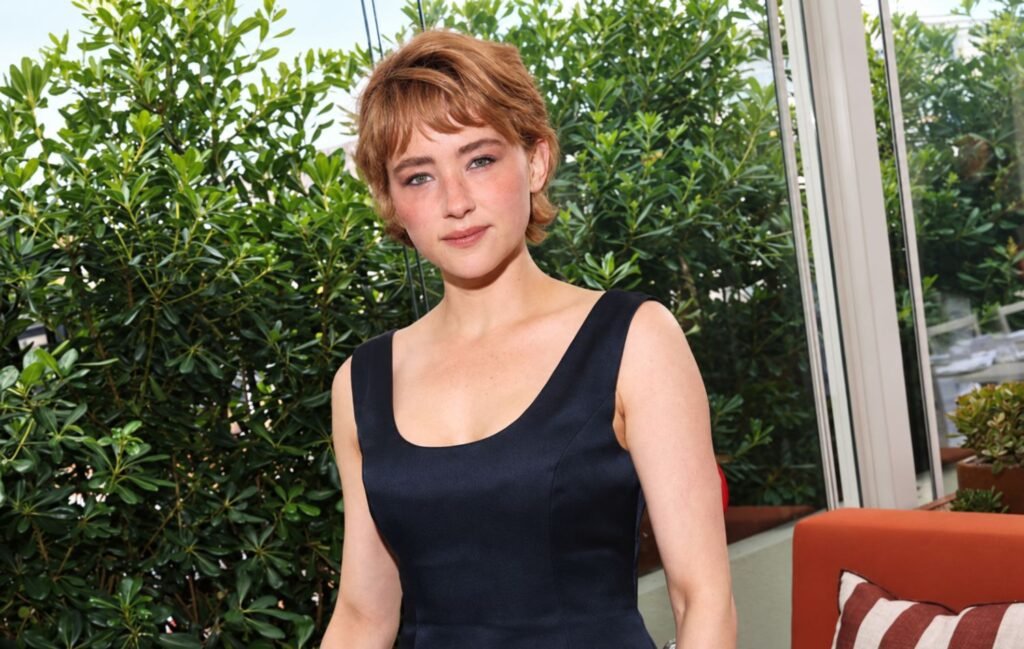
She sang in school choirs in an Ohio town, made her film debut at 19 playing a pop star and recorded an album that her label never released. Fourteen years later, she sang on screen again, in a musical with songs written by The National. In between, she learned something that changed her career: if the roles she wanted did not come her way, she had to produce them herself.
A Little Girl Who Was Always Moving
She was born in Fort Myers, Florida, on January 7, 1988, as Haley Loraine Keeling. Her parents separated when she was six, and she stayed with her father in Ohio, where they moved frequently. At ten, they settled in Stow, a town in the northeastern part of the state, and she attended high school there.
Those years reveal the two things that would later shape her life. One was the stage: she took part in school plays. The other was her voice: she sang in choirs.
At thirteen, she enrolled in a modeling school in Akron and began competing at industry conventions, in 2001 and again in 2006. None of it yet resembled a career. She was a girl from Ohio looking for a way in.
Three Months to Try
At eighteen, she persuaded her mother to take her to Los Angeles. The agreement was for three months.
She did not return with a role, but she returned with an agent, which at that age and without connections is considerably more than most people achieve. She also changed her surname: she adopted that of one of her mother’s partners and began calling herself Haley Bennett.
The first job she secured under that new name was the one that defines everything else. In Music and Lyrics (2007), alongside Hugh Grant and Drew Barrymore, she played Cora Corman, a pop star. She landed the role at her third audition.
The Album That Never Came Out
What made that debut distinctive was that it was not just an acting performance. Bennett sang several songs on the soundtrack.
And that was where passion met the industry. She signed with a record label and recorded an album. That album was never released.
It is worth pausing over that detail because it explains the following years. A nineteen-year-old making her debut in a Hollywood romantic comedy while singing, with a record deal signed, had everything laid out to become something else: an actress-singer on a label’s roster. The album fell through, and the easy path closed with it.
What followed was more than a decade of roles of different sizes in very different films. Horror in The Haunting of Molly Hartley (2008), a cameo in Marley & Me (2008), independent cinema with Kaboom (2010) and Kristy (2014), action alongside Denzel Washington in The Equalizer (2014), and formal experimentation in Hardcore Henry (2015), filmed entirely from a first-person perspective.
2016 was her year of greatest exposure: she appeared in The Magnificent Seven, The Girl on the Train and Rules Don’t Apply, all three released within a few months.
When She Stopped Waiting for the Call
The turning point came in 2019, and it was not only about acting.
Swallow is a psychological thriller about a woman with pica, a disorder that leads people to ingest nonfood objects. It is an extreme role, the kind that is not usually offered, and one that requires carrying the entire film. Bennett did not just star in it: she was an executive producer.
That decision brought her the greatest recognition of her career, the Best Actress award at the Tribeca Festival. And it established an approach she still follows: today, she stars in and produces the adaptation of Brood, Jackie Polzin’s novel.
The difference between waiting for a role and creating it is significant for an actress the industry had typecast early.
Singing Again, Fourteen Years Later
In 2021 came Cyrano, directed by Joe Wright, in which she played Roxanne alongside Peter Dinklage. It is a musical based on the stage production Erica Schmidt had premiered in 2018.
The songs were written by members of The National: the lyrics are by Carin Besser and Matt Berninger, and the music by brothers Aaron and Bryce Dessner. And the casting premise, according to Berninger, was precise: they were looking for actors who could sing, not singers who could act. They did not want operatic voices; they wanted people capable of embodying a character while singing.
For Bennett, it was less a challenge than a return. Her Roxanne sings in several scenes, including “Overcome,” the balcony number in which she converses with Cyrano, hidden in the shadows. The film was shot during the pandemic in Noto, Sicily, and part of the score was recorded there, with the town’s Baroque architecture serving as a reference for the orchestration.
Fourteen years after that album was left in a drawer, she sang on a cinema screen again. This time, it was released.
What Sustains the Rest
Her personal life intersected with her work in 2017, when she began a relationship with Wright, the English director of Atonement and Darkest Hour. They had a daughter on December 27, 2018, and settled in Bruton, a town in Somerset, England. He was the one who directed her in Cyrano.
Moving to an English town while her career unfolds in Los Angeles is not the obvious decision for an actress in her early thirties. Neither was producing a film about an eating disorder to secure the role she wanted.
Her current pace confirms it. In 2025, she released Magazine Dreams, filmed two years earlier, and starred in The Last Frontier for Apple TV. In 2026, she appears as Katherine Hilbery in Virginia Woolf’s Night and Day. Before that, she had worked in historical drama with Till (2022), about the murder of Emmett Till, and in Widow Clicquot (2023), in which she played the widow who turned a family winery into a champagne empire.
A thread runs through those very different roles: women who persist in something when everything around them says they should not. It is hard not to see in them the girl from Stow who sang in the choir, secured a record deal at nineteen, watched it disappear and kept singing anyway.