
Sandra Díaz
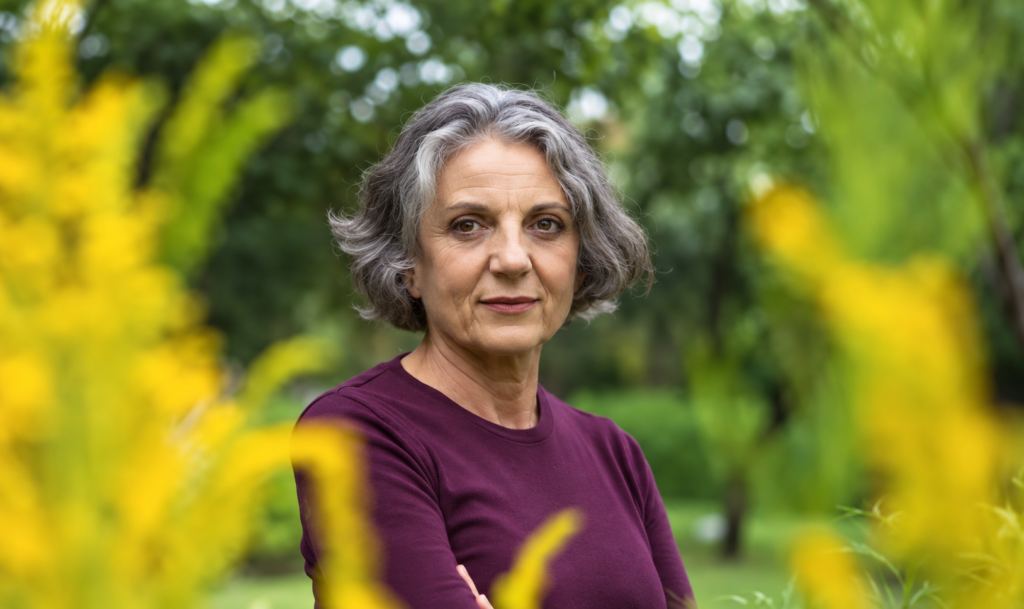
A good teacher does not simply know how many children are in the classroom: they understand what each one is like and what happens between them. The comparison comes from Elizabeth Maruma Mrema, the Tanzanian lawyer who wrote Sandra Díaz’s profile for Time magazine, and it accurately describes what Díaz did with the natural world. For forty years, this biologist born in Bell Ville shifted the focus of ecology: instead of simply counting how many species there are, she began measuring what each one does. That idea took her from the forests of Córdoba to co-chairing the United Nations’ global biodiversity assessment, membership in the Royal Society, the Princess of Asturias Award, the Tyler Prize —which in her field functions much like a Nobel— and Time‘s list of the one hundred most influential people in the world.
From Bell Ville to a doctorate at twenty-three
Díaz was born in 1961 in Bell Ville, a city in southeastern Córdoba that does not appear on any scientific map. She studied biology at the National University of Córdoba and had already completed her doctorate by 1984.
It is worth pausing for a moment on that date, because it explains quite a lot. At just twenty-three, while most people of her generation were still deciding what to do, she had already completed the entire formal stage of her training.
Work abroad followed, including a period at the University of Sheffield, and in 1993 she joined the Multidisciplinary Institute of Plant Biology, a joint initiative of CONICET and the University of Córdoba.
She is still there more than thirty years later. Today she is a senior researcher, the highest rank in the system, and teaches Community and Ecosystem Ecology at the university. She never left the country.
The question that changed an entire discipline
For much of the twentieth century, measuring biodiversity meant counting. How many species are in this forest, how many in this grassland, how many have been lost.
Díaz led a shift that seems obvious today but was not at the time: what matters is not only how many species there are, but what they do.
The discipline she helped advance is known as trait-based ecology. Instead of treating each plant as a label on a list, it measures its functional characteristics —how quickly it grows, what its leaves are like, how it uses water, how much carbon it fixes— and uses those traits to understand the role it plays within the ecosystem.
The conceptual shift has enormous practical consequences. It makes it possible to predict how an ecosystem will respond to climate change, design better conservation strategies and model what happens when one particular species disappears rather than another.
Together with French scientist Sandra Lavorel and Australian researcher Mark Westoby, she helped turn that approach into a standard. One milestone of that collaboration was a paper published in Nature in 2016 that, for the first time, organized the enormous variety of plant forms on Earth into a comprehensible framework.
For that to be possible, something else was needed: data. Díaz co-founded TRY, the global initiative that brings together information on plant functional traits from around the world in a common database, and founded the DiverSus research center in Córdoba, dedicated to diversity and sustainability.
Co-chairing the report that made governments uncomfortable
In 2019, the Intergovernmental Science-Policy Platform on Biodiversity and Ecosystem Services published its first Global Assessment. Díaz was one of its co-chairs.
To this day, that document remains the most comprehensive diagnosis of the state of life on Earth. And it made few people comfortable: it quantified the speed at which the planet’s biological fabric is unraveling and identified the dominant model of appropriating nature as a central cause.
Díaz often uses a textile image to explain it. Life on Earth works like a fabric, and that fabric is unraveling faster and faster.
Her public position on the environmental agenda has a nuance that distinguishes her and that she maintains even when it is unpopular: without denying the seriousness of climate change, she insists that the deeper crisis is biodiversity loss —the collapse of the network of plants, animals, soil and water that makes everything else possible. In a 2025 interview with Al Jazeera, she argued that reducing emissions is essential but insufficient, criticized governments for failing to meet the biodiversity targets they themselves had signed, and called for a reassessment of consumption-based lifestyles.
The large and the small on the same agenda
There is one feature of her career that is easily overlooked and that she herself emphasizes.
The same person who co-leads global United Nations assessments has worked on issues of local scale in her own province: the debate over Córdoba’s Forest Law and even the management of vegetation along roadsides.
These are not minor matters, however small they may seem. Road verges and highway edges function as biodiversity corridors and refuges in landscapes where agriculture has left little else. The fact that a scientist of her standing devotes time to them says a great deal about how she understands her profession.
Her work has also consistently crossed into the social sphere. She studies plant ecology, but also how different societies value, use and reshape ecosystems. That combination has allowed her to sit down with governments without ceasing to speak as a scientist.
An accumulation of awards that is becoming difficult to list
The list is long, and it helps to organize it according to what each distinction represents.
In 2009, she became the first Argentine woman elected to the U.S. National Academy of Sciences, a lifetime distinction that cannot be applied for: a candidate must be nominated by an existing member. She has said that the news took her completely by surprise.
In 2019, she was elected a foreign member of Britain’s Royal Society and received the Princess of Asturias Award for Technical and Scientific Research, shared with biologist Joanne Chory. That same year, she also received the Gunnerus Award in Sustainability Science and the Senckenberg Prize.
In 2020 came the Kew International Medal, awarded by one of the world’s most renowned botanical institutions. In 2021, she received the BBVA Foundation Frontiers of Knowledge Award. She has also received the Linnean Medal, the U.S. National Academy of Sciences’ Cozzarelli Prize, a Guggenheim Fellowship, the Zayed International Prize for the Environment and the Margalef Prize in Ecology.
In February 2025, she received the Tyler Prize, often described within the field as the Nobel Prize for the environment, shared with Brazilian scientist Eduardo Brondízio. Two months later, Time included her among the one hundred most influential people in the world, in the innovators category, describing her as a tireless diplomat confronting the triple crisis of climate change, biodiversity loss and pollution.
In Argentina, she received the Platinum Konex in 2013, the Bunge & Born Award in 2019 and the Diamond Konex in 2023.
She has accumulated more than three hundred scientific publications and ranks among the top one percent of the world’s most cited researchers.
What holds all of that together
It is difficult to find anything resembling a personal heroic narrative in her public statements. When Díaz talks about her career, she emphasizes above all the privilege of having worked in interdisciplinary teams and with people from different sectors, from specific problems in her province to issues at the global level.
That insistence on collective work is not false modesty. The databases she helped build, the report she co-chaired and the approach she advanced are all things that would have been impossible to produce alone. Her contribution was not an isolated discovery but a different way of looking at the world, one she then had to persuade thousands of colleagues across dozens of countries to adopt.
And there is something else that explains why her name circulates outside academic circles. Díaz did not stop at the scientific paper. She translated forty years of research into a message anyone can understand: if the fabric of life breaks down, reducing emissions alone will never be enough.
It is an uncomfortable idea, difficult to sell politically and far less photogenic than others. She has been repeating it, each time with new data, from a research institute in Córdoba.