
Leandro Erlich
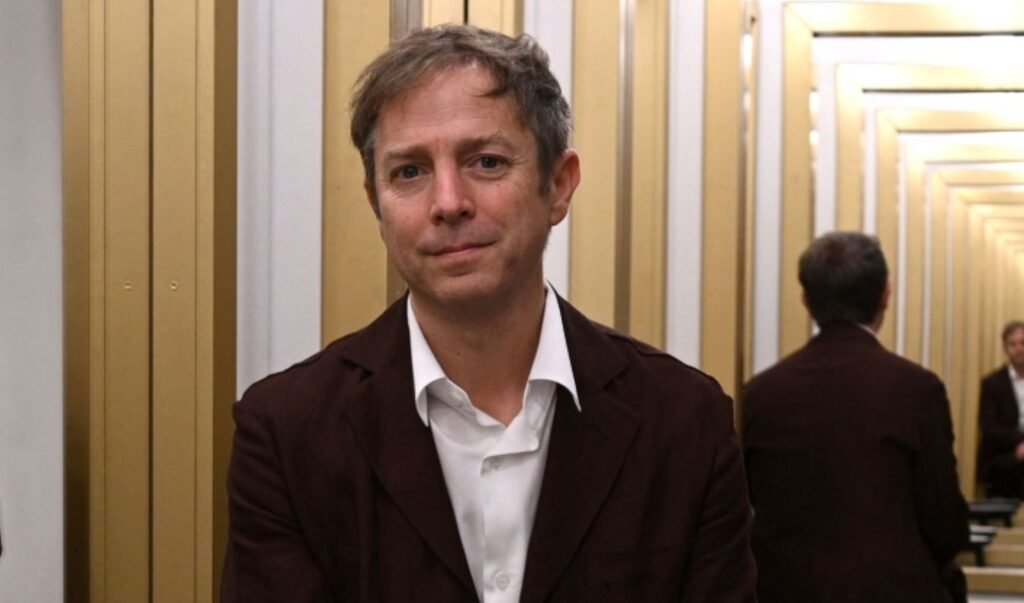
He held his first exhibition at 18, at 20 imagined building a replica of the Obelisk in La Boca, and at 28 represented Argentina at the Venice Biennale with a swimming pool that visitors could enter without getting wet. Leandro Erlich builds ordinary places —a living room, an elevator, a façade, a staircase— and alters them just enough to make visitors stop trusting what they see. His works are held by the Tate Modern and the Centre Pompidou, have traveled around the world through Tokyo, Miami, Shanghai and Wolfsburg, and in 2026 occupied the Grand Palais in Paris with the largest retrospective of his work ever held in Europe.
An impossible project at twenty
In 1993, Erlich proposed building a sixty-eight-meter replica of the Obelisk in the La Boca neighborhood. The work was never built, and could hardly have been, but it functions as a statement of principle: a twenty-year-old artist, in a country where resources tend to push toward the small and traditional, decided to think on an urban scale. Critic Rodrigo Alonso points out that Erlich’s most powerful tool in those years was neither technical nor even imaginative, but rather his willingness to enter territories larger than himself.
Two years later came a work born from reading the fine print. While applying for the Braque Prize, he discovered that the rules set a maximum size for objects: eighty by eighty by one hundred and eighty centimeters. He asked why and was told that those were the dimensions of the elevator through which the works would have to enter the building. His response was Elevator: a cabin with its interior and exterior reversed, where a play of mirrors creates a void extending toward infinity. It complied with the rule while exceeding it at the same time.
That same year he received a fellowship from Fundación Antorchas and shortly afterward entered the Core Program, the residency at the Museum of Fine Arts, Houston, where he received the Eliza Prize.
The mirror that reflects nothing
The Living Room, from 1998, marked a turning point. The installation presents an almost antiseptic bourgeois living room with a wall containing two openings: one is a mirror reflecting the room and the other is a window onto an identical but reversed room. The unsettling detail is that the visitor does not appear in the reflection.
The piece opened a line Erlich would develop for decades: the mirror as a threat. The absence of a reflection evokes Dracula, Narcissus, Freud’s unheimlich and Lacan’s mirror stage. Several essayists have read his work through a Borgesian lens, and Erlich himself acknowledges Borges, Cortázar and Bioy Casares among his references. Nicolas Bourriaud argues that his work cannot be understood outside an aesthetic made of labyrinths, duplications and revelations that never fully arrive.
The following year he created Swimming Pool, perhaps his most widely reproduced work. From above, viewers see fully dressed people walking along the bottom of a filled swimming pool. From below, the experience is one of entering a blue space crossed by filtered light and rippling reflections without a single drop of water touching them. The version presented at the Argentine pavilion of the 49th Venice Biennale in 2001 was later incorporated into the permanent collections of the contemporary art museum in Kanazawa, Japan, and Museum Voorlinden in the Netherlands.
He is not a magician, and he makes that clear
The difference between Erlich and an illusionist is deliberate, and he emphasizes it whenever he can: a magician needs you never to discover the trick, while his work is designed to be deciphered. The optical surprise is the starting point, not the goal. The moment the visitor understands the mechanism is when the work truly begins to function, because that is when an uncomfortable question opens up: if this can be manufactured, how solid is everything else?
He himself formulated the idea in a sentence that sums up his program: when the false passes for true, the true also becomes contaminated by falsehood.
That is why he distrusts push-button interactivity. In his words, there is nothing worse than a work that asks you to press something or put your head in a specific place. What he wants is for people to choose to remain involved, and he adds a subtle observation about his discipline: unlike cinema or theater, in the visual arts time belongs not to the work but to the viewer.
When the public completes the work
Tourism (2000), created with Judi Werthein for the Havana Biennale, set up a photographic studio with a snowy backdrop, sleds and artificial snow so that Cubans could take home a Polaroid as if they had been in the Alps. The staging was obvious from the beginning, yet the result ended up looking real, and the decisive contribution came from the public: people began arriving in warm clothes despite the November heat. One young man brought a sweater, and those who came afterward began borrowing it. Eventually even soldiers from the neighboring regiment borrowed it, including the officer who had initially gone there to stop the photographs and ended up posing with his daughters.
Bâtiment, created in 2004 for Paris’s Nuit Blanche, applied the same principle at street scale. A building façade is laid horizontally on the ground and a mirror tilted at 45 degrees returns it to an upright position, making people who lie down and hold onto balconies appear to be suspended in midair. The work was recreated in London, Shanghai and Buenos Aires, among other cities, and generated so many photographs taken by its own users that the artist eventually collected them and transformed some into independent works.
The same participatory logic appears in Le Cabinet du Psychanalyste (2005), where visitors occupy the empty spaces of a set behind reflective glass and become ghostly bodies within the scene.
The decapitated Obelisk and other urban interventions
In 2015, Erlich returned to the obsession of his youth with The Democracy of the Symbol: he made the tip of the Obelisk disappear from the view of Buenos Aires residents and installed a full-scale version of it inside MALBA. It was one of those operations of his that combine trompe-l’œil with commentary on a city’s identity.
His production does not end with surprise. The gallery representing him in Argentina notes that many of his works process emotional states connected with collective tragedies or social problems in the places where they are installed, to the point that critic Andrea Giunta considers them memorials. Window and Ladder – Too Late for Help, a window suspended in the air like the remains of a destroyed house, works in that register. So does Order of Importance, with cars made of sand trapped in a traffic jam on Miami Beach.
He has also worked with the inaccessible: clouds enclosed in museum display cases, windows simulating the view from an airplane, a harbor where glass boats float on water that does not exist.
Wolfsburg, Helsinki, Osaka and the leap to the Grand Palais
His international circulation has taken him through the Reina Sofía, MoMA PS1, the Centre Pompidou, the Barbican, Tokyo’s Mori Art Museum, New York’s Neuberger Museum, PAMM in Miami, Kew Gardens in London and the Banco do Brasil Cultural Centers.
In October 2024 came his first solo show in Germany: Weightless, at the Kunstmuseum Wolfsburg, conceived specifically for that space and with most of the works produced for the occasion. There, the suspension of physical laws became a way to address more urgent issues: fake news, the distortion of truth, migration and the growing power of manipulable images in the age of artificial intelligence. The exhibition remained open until July 2025. That year was followed by Amos Rex in Helsinki, Fundación MACRO in Buenos Aires and a participation in Expo Osaka.
The high point came in 2026. From June 2 to September 6, the Grand Palais devoted galleries 9 and 10 to what was presented as the largest retrospective of his work ever held in Europe: fourteen monumental installations at the intersection of installation art, sculpture and architecture.
The exhibition begins with Port of Reflections, in a dark room where at least six barges appear to float on water, although there is no water and there are only three boats. Then come the clouds of The Cloud and the voyeuristic gaze of The View, a video sculpture that allows visitors to spy on a dozen neighbors through their blinds. Even the building’s staircase was transformed by a sound installation. Upstairs, forty-one revisited works —models, photographs and unrealized projects such as Sablier and Lunas— reconstruct three decades of work, from 1994 to 2026. The final gallery brings together the most participatory pieces: Elevator Maze, where some of the cabin mirrors turn out to be empty frames; Infinite Staircase; and, to close, a monumental version of Bâtiment.
A quiet nonconformism
What holds the entire body of work together is not the effect but an insistence: questioning the nature, functioning and limits of things. His installations begin with the most ordinary places —a corridor, a hair salon, a glass shop, a changing room— because that is where the smallest alteration can produce the greatest disorientation. And because those are the spaces where visitors arrive with their guard down.
The result, as his gallery describes it, is a series of temporary microsocieties united by bewilderment or wonder: strangers who suddenly agree to sustain a fiction, help one another frame an impossible photograph or laugh together after realizing they have been fooled. That encounter between strangers, more than the trick itself, seems to be the material he works with.