
Mauricio Kartun
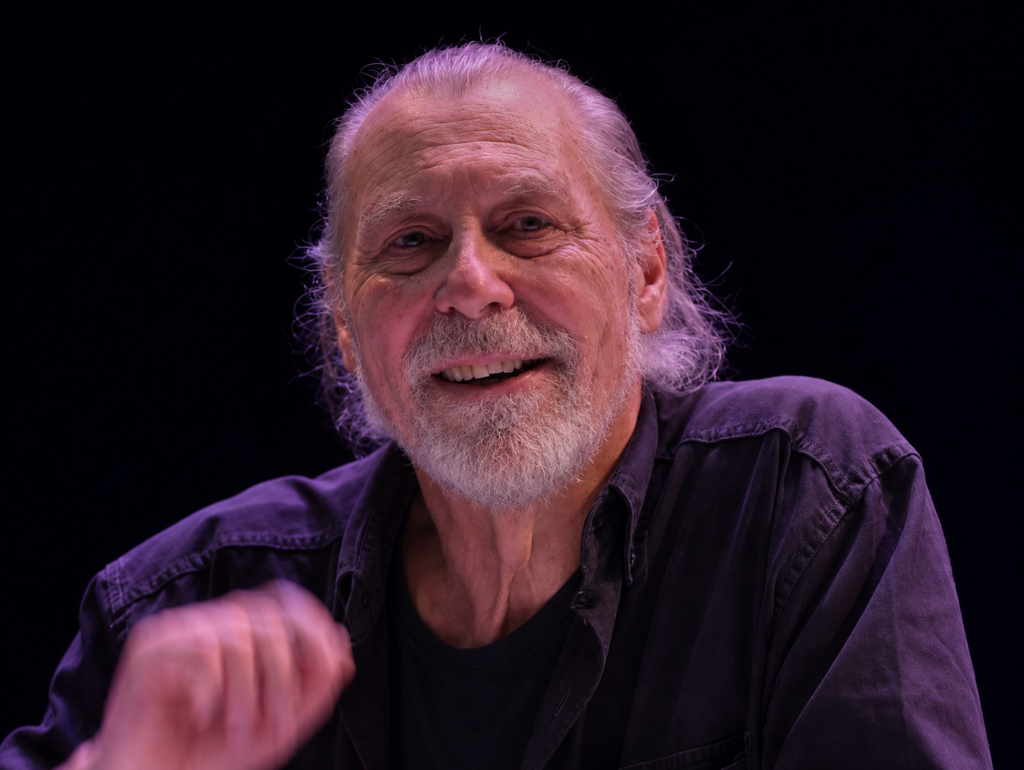
Some artists turn out work in quick succession. Others let each piece mature like wine. Mauricio Kartun belongs to the second group. He premieres a play in Buenos Aires roughly every three years, like clockwork, and audiences look forward to each one. A few weeks ago, the Spanish press described him as a guiding figure in Latin American theater after the loss of figures such as Augusto Boal. At 79, with more than thirty plays staged since 1973 and generations of playwrights trained in his workshop, Kartun has devoted his life to a single passion: telling stories onstage and teaching others how to tell them.
A kid from San Martín with notebooks full of images
Kartun was born in 1946 in San Martín, in Greater Buenos Aires, to a working-class family. He learned theater first as a craft. He studied directing with Jorge De La Chiessa and Oscar Fessler and began writing plays in the 1970s, when independent theater in Buenos Aires was both a school and a form of resistance. He was part of the Teatro Abierto generation, a collective act of cultural resistance during the dictatorship. He remained part of independent theater even when his plays reached publicly run venues.
One habit from those years still defines the way he works. In notebooks, he collects evocative images, phrases he overhears, and scenes he notices on the street. He describes it as being permanently on a fishing trip. You’re walking down the street and something turns up. You open a newspaper and something turns up. Someone tells you a story and something turns up. Terrenal, for example, began with a note about two men he once saw, which he kept for years until it found its form.
From Chau Misterix to Terrenal, a single body of work
His writing began in the 1970s and spans half a century. Kartun often says that after many years, a playwright discovers they have been writing one continuous work in which everything connects. Among its milestones are early works such as Chau Misterix and La Madonnita, followed by the trilogy known as the tríptico patronal: El niño argentino, Ala de criados, and Salomé de chacra. In those plays, he refined his signature approach. He set classical or biblical myths in the Argentine pampas and used a poetic language that draws on learned and local traditions to talk about class, power, and violence.
A high point came in 2014 with Terrenal. Pequeño misterio ácrata, his retelling of Cain and Abel on a suburban plot of land, which premiered at Teatro del Pueblo. The play became a phenomenon that lasted a decade, with sold-out runs and revivals and tours in Argentina and abroad. That year, Kartun also became the first playwright to win the Buenos Aires Book Fair critics’ award. Many audiences and critics came to regard Terrenal as one of the great Argentine plays of all time.
The teacher whose workshop shaped Argentine playwriting
His plays established him as a major writer, and his workshop made him an institution. For decades, Kartun trained playwrights in his courses and workshops, and many of the writers working in Argentine theater today studied with him. It is common to see his name in the acknowledgments for a Buenos Aires premiere as an adviser, teacher, or first reader. His teaching has the same voice as his plays. He distrusts formulas, defends intuition and the patient work of shaping images, and has favorite sayings his students can quote from memory. One of them is that an obedient actor is among the problems with bad theater.
His teaching extends beyond the classroom. His reflections on the craft appear in collections such as Escritos 1975-2015, edited by critic Jorge Dubatti, and in talks he gives around the world. In October 2026, the Ibero-American Theater Festival in Cádiz invited him to give a master class titled “Manual de supervivencia teatral,” on what makes theater a countercultural force in an age of screens.
A passion that extends beyond the stage
The same storytelling impulse that drives his plays has found new outlets in recent years. The short pieces he began publishing on social media came together in a novel, Salo solo. El patrullero del amor (2023), which sold out several editions. He went on to write short stories where the circus, the stages, and the characters of his theatrical imagination found a new form. That turn to fiction reveals how Kartun approaches writing. It is a state he never leaves.
His personal life and his work have always been intertwined. His roots in Greater Buenos Aires, his family’s trades, and its working-class memories are recurring material for his fiction. Even his artistic relationships function as an extended family. As he tells it, Baco Polaco came about in part because the cast of a revival of La Madonnita was reluctant to part ways at the end of the run. Few careers show as clearly how a passion can organize an entire life.
Baco Polaco and a playwright still at work
Kartun is still making new work. His latest play, Baco Polaco, moves Euripides’ The Bacchae to the Argentine pampas of the 1930s. It has filled Teatro Sarmiento, part of the Complejo Teatral de Buenos Aires, performance after performance since its 2025 premiere. In October 2026, he took it to the Gran Teatro Falla as part of Cádiz’s Ibero-American Theater Festival. The play reflects his idea that humor works in much the same way as poetry and his belief that popular celebrations can be spaces for justice and dissent.
His honors include the Argentores Grand Prize of Honor, the Platinum Konex Award, the Gold ACE Award, and an honorary professorship from the University of Buenos Aires. In 2025, he received a Martín Fierro award for lifetime achievement in theater and used the occasion to publicly defend the National Theater Institute in the face of cultural funding cuts. At 79, the kid from San Martín who jotted down images in notebooks is still doing what he did half a century ago: fishing for stories, bringing them to the stage, and teaching the next generation how it’s done.