
Wilma Mankiller
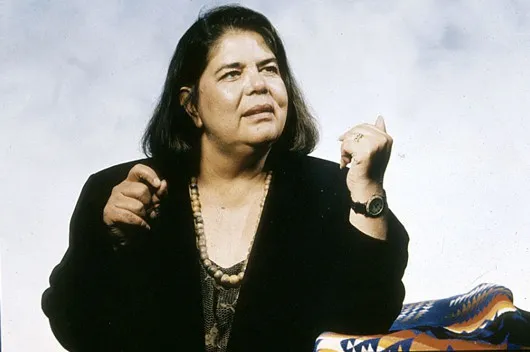
The trajectory of Wilma Mankiller is structured around sustained commitment to her community. Her leadership did not emerge from traditional power structures but from continuous collective participation. This orientation shaped both her public role and personal decisions, establishing a model in which cultural identity and institutional governance operated in an integrated manner.
Roots and formation of political awareness
Born in 1945 in Oklahoma, Mankiller grew up in a rural environment within the Cherokee Nation. Her family’s relocation to California, driven by federal policies, generated a cultural rupture that influenced her understanding of structural inequality. During her youth, exposure to civil rights movements reinforced a political consciousness centered on Indigenous self-determination.
From activism to governance
Her transition from activism to institutional management did not imply a shift in principles but an expansion of tools. In community-based projects such as infrastructure development in Bell, Oklahoma, she promoted cooperative models in which local populations actively participated in solving their own needs. This approach transformed isolated interventions into sustainable processes.
Institutional leadership in the Cherokee Nation
In 1985, she became principal chief of the Cherokee Nation, the first woman to hold that position in a major Native American tribe in the United States. During her administration, institutional structures expanded with improvements in healthcare, education, and housing. Her model combined strategic planning, reinvestment of resources, and community participation, strengthening the organizational capacity of the nation.
Personal dimension and resilience
Mankiller’s life included significant health challenges that required multiple medical interventions. Rather than interrupting her work, these experiences reinforced her understanding of leadership as a sustained process. Her ability to maintain public responsibilities under adverse conditions consolidated authority based on practice and consistency.
Community method: the principle of gadugi
The concept of gadugi, rooted in Cherokee culture, functioned as an operational foundation in her administration. It refers to collective work oriented toward the common good. Mankiller integrated this principle into public policy, promoting active community participation in planning and execution, strengthening autonomy and reducing external dependence.
Impact on Indigenous women’s leadership
Her leadership reshaped perceptions within Indigenous communities. By occupying a role historically dominated by men, she expanded access to decision-making spaces without breaking with cultural traditions. Her governance demonstrated that incorporating new perspectives could enhance, rather than weaken, institutional structures.
Legacy and projection
After leaving office in 1995, she remained involved in initiatives related to Indigenous leadership and community rights. Her approach redefined governance within the Cherokee Nation by prioritizing participatory structures over hierarchical models. National recognition, including the Presidential Medal of Freedom, reflected the broader impact of a leadership model that integrated cultural identity with public administration.