
Paul Van Haver
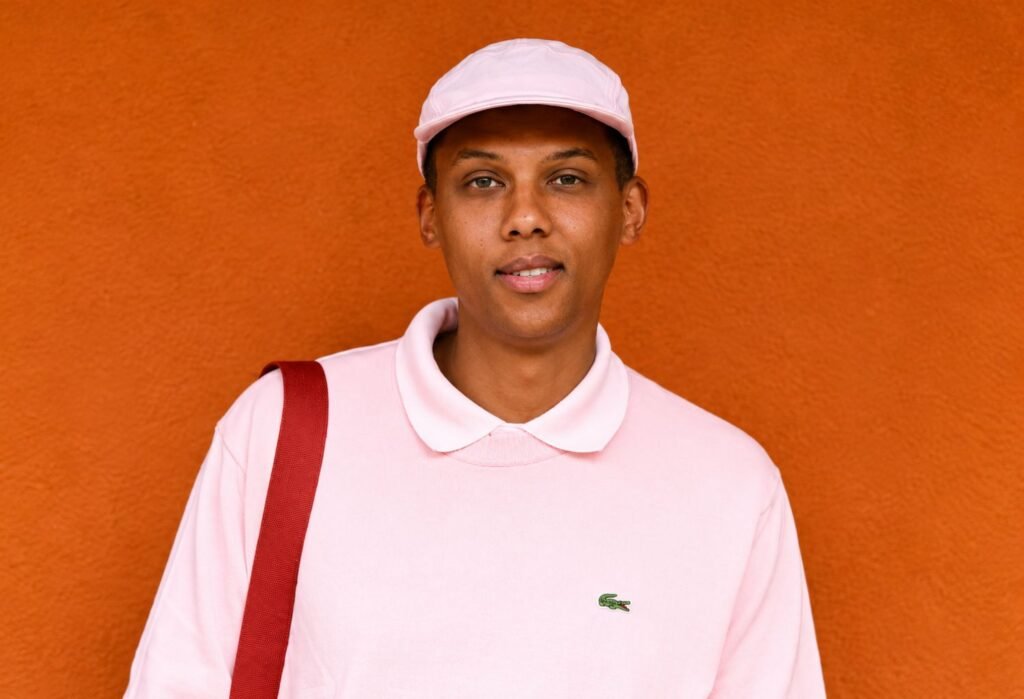
Behind the name Paul Van Haver is one of the most influential artists Europe has produced this century: Stromae. The Belgian who made the continent dance to the melancholy of Alors on danse built a distinctive body of work: dance-floor songs about absent fathers, cancer, alcoholism and suicidal thoughts, sung in French and turned into mainstream hits from Brussels to Paris and then around the world. His personal story—shaped by the Rwandan genocide, global stardom at 25 and a retreat at his peak to protect his mental health—explains that combination better than any press biography.
A Brussels boy marked by Rwanda
He was born on March 12, 1985, in Etterbeek and grew up in Laeken, a working-class neighborhood of Brussels. His Flemish mother, Miranda Van Haver, raised her children alone. His father, Pierre Rutare, a Tutsi architect whom Paul rarely saw, was murdered during the 1994 Rwandan genocide while visiting his family. That absence, which would later become the heart of Papaoutai, ran through a childhood of Jesuit schooling, academic setbacks and an emotional education shaped by Jacques Brel, Cuban son and Congolese rumba.
He began rapping around 2000 under the name Opsmaestro, performed as part of the duo Suspicion and eventually chose the name that would define him: Stromae, the verlan—the French practice of reversing syllables—version of “maestro.” He released his first EP while studying at INRACI, the Brussels film school, and signed with Because Music in 2008. He was 23, with a synthesizer full of sad ideas set to party rhythms.
From Alors on danse to Racine carrée: Europe at his feet
His breakthrough was swift. Released in 2009, Alors on danse climbed to number one across much of Europe with its mantra about work, debt and dancing as an anesthetic. Even Kanye West released his own remix in September 2010. His debut album, Cheese, released in June 2010, won Best Dance Album at the 2011 Victoires de la Musique.
What followed placed him in another league. Racine carrée, released on August 16, 2013, sold more than two million copies in France alone and delivered a succession of anthems: Papaoutai, the cry of a son asking where his father is, and Formidable, the monologue of a heartbroken drunk. Its music video was filmed with hidden cameras at a Brussels tram stop, with an apparently intoxicated Stromae becoming a viral news story before the scene was revealed to be a performance. In 2014, he performed at Sanremo, his song Ta fête became Belgium’s national team anthem for the World Cup in Brazil, and he contributed to The Hunger Games soundtrack alongside Lorde. At 28, the boy from Laeken was the biggest French-language star on the planet.
The price of reaching the top and an incomplete return
In 2015, during an African tour, everything broke down. Lariam, an antimalarial drug he was taking as a preventive measure, caused insomnia, hallucinations and anxiety attacks. He later said that without his brother’s support, he probably would have attempted to take his own life. He canceled concerts, withdrew from the stage and, in 2017, acknowledged that he was still experiencing panic attacks and did not know whether he would return to professional music. In between, there were occasional signs of activity: the single Défiler in 2018 and collaborations with Coldplay and Dua Lipa.
His formal return came with Santé in October 2021 and his third album, Multitude, on March 4, 2022. His performance of L’enfer—a song about suicidal thoughts, sung live during TF1’s television news broadcast and catching much of France off guard—set the tone for a comeback in which mental health stopped being a secret and became artistic material. History, however, repeated itself: between April and May 2023, he canceled several European dates and then the remainder of his world tour for health reasons. Since then, he has remained away from the stage.
Mosaert, family and an enduring influence
Music was never his only language. Through Mosaert—an anagram of Stromae—he built a creative label and a fashion brand with a retro-kitsch aesthetic that reached the windows of Colette and Le Bon Marché in Paris and collaborated with footwear house Repetto in 2020. Joining him in that venture is his wife, stylist Coralie Barbier, whom he married in secret in December 2015 in Mechelen and with whom he has a son born in 2018. His brother, Luc Junior Tam, completes the project’s core team.
Even while stepping back, his name continues to appear in notable projects: in November 2024, he joined Pomme on Ma meilleure ennemie for the series Arcane, and in July 2026, he appeared on My Sins Are My Savior, from Madonna’s album Confessions II. Each occasional collaboration nurtures the same hope among his followers: that the maestro will return to the classroom. Meanwhile, Paul Van Haver manages his talent according to the one rule his story has taught him: the work can wait; his health cannot.