
Joan Cwaik
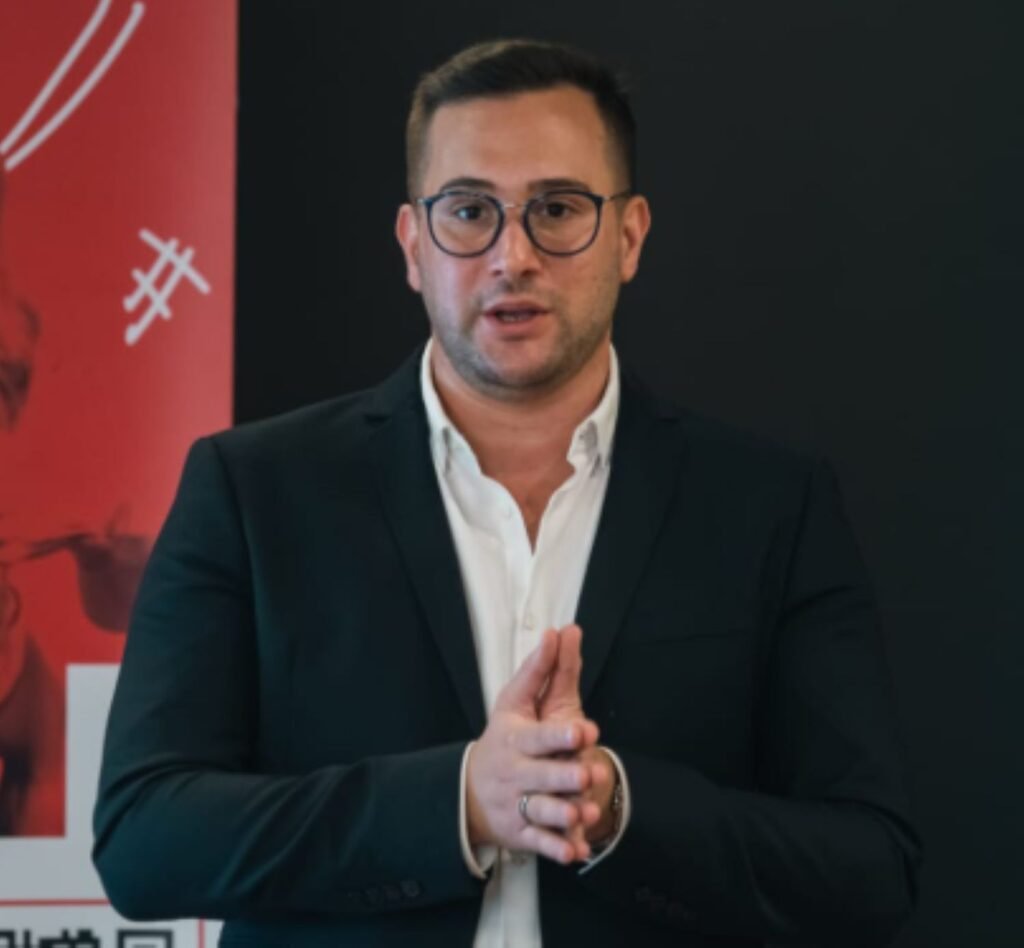
He began mining bitcoins with a computer assembled in his bedroom and eventually became a speaker who traveled to more than twenty countries. Joan Cwaik is the author of five books, a university professor, columnist and communicator specializing in emerging technologies and digital culture. His main subject is not the machine itself, but what happens to human beings when they live alongside it. This profile traces the origins of that interest and the way it shaped his career.
A computer that had to leave the house
At the age of 22, he became fascinated by Bitcoin and decided to understand it from the inside. He borrowed money from his father, bought the necessary components and assembled a computer for cryptocurrency mining in his bedroom.
The experiment did not last long. The heat generated by the graphics cards made the room almost uninhabitable, and his parents asked him to move the equipment out of the house. He remembers the episode as an early lesson in the costs involved in experimenting with something new.
Around the same period, he helped organize LABITCONF, the first major Latin American conference devoted to Bitcoin and blockchain technology. He identifies that experience as a turning point in his professional life.
A childhood divided between two countries
His personal history includes several moves. Cwaik began primary school at Colegio Delfín Jijena in the Buenos Aires neighborhood of Villa Crespo. At the age of nine, he moved with his family to Ra’anana, Israel, where he completed primary school and the first years of secondary education.
He later returned to Buenos Aires and finished school at Escuela Scholem Aleijem.
He has spoken about being bullied at school for being the unusual child in the classroom. Rather than presenting the experience as something that defined him permanently, he regards it as confirmation that his attention was already directed toward subjects that others had not yet begun to consider.
His first name was chosen in honor of Joan Manuel Serrat, one of his parents’ favorite musicians. His surname is a variation of Zweig, like that of the Austrian writer Stefan Zweig, and reflects a family history with Argentine and Russian-Polish branches.
From the classroom to international stages
Cwaik graduated from UADE in 2012 with a degree that combined media, entertainment, technology and management, three areas he would continue to connect throughout his career.
He later completed postgraduate studies in Multimedia Convergence at the Faculty of Architecture, Design and Urbanism of the University of Buenos Aires. He also earned an MBA from IAE Business School at Universidad Austral and participated in executive programs and professional training activities in Argentina and the United States.
He has taught since 2014. His academic career included positions at UADE’s School of Communication and ORT Argentina. Since 2023, he has coordinated the Emerging Technologies Program at the University of San Andrés, where he also teaches at its Business School and participates in postgraduate programs.
As a speaker, he has delivered more than 450 presentations in over twenty countries. His appearances have included TEDx events, Campus Party, eMerge Americas, Endeavor activities and the G20 Young Entrepreneurs’ Alliance. In 2018, he participated in the Argentine delegation to the G20 YEA, and in 2019 he received recognition among Argentina’s outstanding young people for his contribution to technology communication.
Five books and the same underlying question
In 2020, Cwaik published 7R: The Seven Technological Revolutions That Will Transform Our Lives through Conecta, part of Penguin Random House. The Argentine Chamber of Deputies declared the book of national interest.
A year later came The Human Dilemma: From Homo Sapiens to Homo Tech, published by Galerna. In 2024, he released Post-Technological: Skills to Recover What Makes Us Human, a book focused on the abilities people need to preserve in a world increasingly shaped by automation.
Two more titles appeared in 2025 through Planeta. The first was The Algorithm: Who Decides for Us?, an examination of the decisions people delegate to digital systems without always recognizing it. The second was The Fifth Power, written with Martín Yeza, about new forms of civic organization and the relationship between digital society and democracy.
The subjects change from one book to another, but the central question remains the same: how can people use technology without surrendering the qualities that make them human?
The ideas he keeps returning to
Two concepts appear repeatedly in his talks and writing.
The first is cognitive sedentarism, the mental inertia created by a world in which answers often arrive before questions have been fully formed. In his view, this convenience can gradually weaken creativity, curiosity and critical thinking.
The second is the idea of technology as an invisible sculptor. Digital systems shape personal relationships, employment, consumption and even the way people fall in love, often without their influence being clearly perceived.
His view of the labor market follows from this diagnosis. Tasks that are predictable and repetitive will increasingly be absorbed by automation. What will remain valuable are the capacities that cannot be programmed so easily, including empathy, improvisation, judgment, imagination and the ability to doubt.
In a 2025 interview published by the University of San Andrés, he argued that society has not yet learned to handle responsibly the power that technology places in human hands. His concern is less about whether technological change can be stopped than about whether people are prepared to understand and direct it.
His other professional role
Alongside his work as a writer, teacher and speaker, Cwaik leads marketing for Latin America at Maytronics, an Israeli company specializing in robotic pool-cleaning technology. His position gives him direct involvement in the commercial side of the technologies he analyzes in public.
He also writes columns and participates in Argentine and regional media, where he addresses artificial intelligence, algorithms, employment, education and digital culture.
Away from those activities, he lives in Pilar surrounded by plants, collects Pokémon cards through auctions and assembles playlists of Scottish and English rock.
There is a certain balance in that image. A communicator dedicated to explaining emerging technologies preserves a collection made from the printed cardboard of his childhood. The contrast is consistent with his central argument: the future becomes more useful when it does not force people to abandon everything that came before it.