
Diego Pol
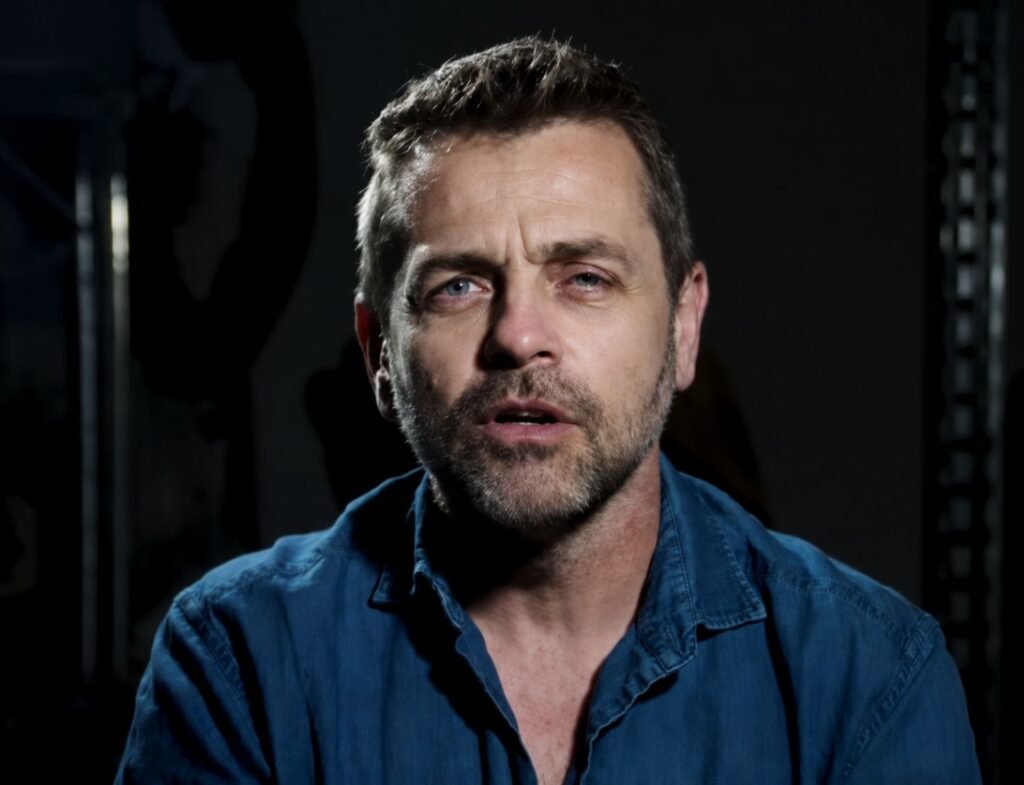
A man searching for sheep in the Chubut countryside noticed something unusual protruding from the ground. He thought they might be bones and alerted the museum. That report led to the discovery of the best-known giant dinosaur on the planet, and the person who went to investigate was a man who had spent thirty years waiting for exactly that kind of call.
A window into a world that no longer exists
Diego Pol was born in Rosario on June 23, 1974, and grew up in Buenos Aires. He says dinosaurs fascinated him as a child for a very specific reason: they were a window into a past world, unknown and mysterious, inhabited by creatures unlike anything that exists today.
What distinguishes that fascination from that of any other child with plastic toys is what he did with it. While attending secondary school at the Colegio Nacional de Buenos Aires, he went to the Natural Sciences Museum and offered to work as a volunteer. He was accepted and ended up helping with laboratory tasks involving the collection. Some time later, he was invited to take part in an excavation, where he discovered fieldwork. By the time he reached university, the matter had already been decided.
He graduated with a degree in Biological Sciences from the University of Buenos Aires in 1999 and moved to New York that same year to join the joint programme run by the American Museum of Natural History and Columbia University. His doctoral thesis, supervised by Mark Norell, examined the evolution of basal dinosaurs and Mesozoic crocodiles. In 2005, he completed postdoctoral research at the Mathematical Biosciences Institute at Ohio State University, working with Pablo Goloboff on methods for searching phylogenetic trees.
He could have stayed. Instead, he returned in 2006 to Trelew and joined the Egidio Feruglio Paleontological Museum to work in Patagonia, where rocks from the age of the dinosaurs lie exposed in the open air across a desert with almost no vegetation. In other words, he returned to the place where the fossils were.
Eighteen months, thirty people and a crane
The report from the rural resident led to the discovery of a femur protruding from the surface. What followed was an excavation fifty metres wide and ten metres deep that required more than a year and a half of fieldwork, teams of up to thirty people, the construction of a road so that trucks carrying cranes could reach the site, and each bone being wrapped in plaster before travelling to the laboratory.
More than 150 bones belonging to six individuals of the same species, all of which had died in the same place, were uncovered. That made Patagotitan mayorum—which measured up to forty metres in length—the best-documented giant in palaeontology, at a time when most other colossal species were known from only three or four isolated bones. It was presented to the public in 2014, formally described in 2017 and featured in a documentary with David Attenborough.
Pol describes his involvement in that project as one of the greatest privileges of his career. The choice of word is significant: someone driven by this passion does not speak of achievements, but of luck.
Eighty skeletons and more than one hundred eggs
The other fossil site that changed his career is located at El Tranquilo in Santa Cruz Province. There, his team found around eighty skeletons of Mussaurus patagonicus—ranging from embryos and hatchlings to adults—and more than one hundred eggs dating back approximately 193 million years. All the evidence pointed in the same direction: the shores of a dried-up lagoon had once been a breeding colony, a place where many adults gathered to lay eggs in nests. A drought killed them, and dust storms buried their remains. It provides the first concrete window into the social life of dinosaurs at the beginning of their evolutionary history.
Some of that material was prepared in Trelew and deposited at the Padre Molina Museum in Río Gallegos.
Searching for years for something that was never there
Those eggs produced the episode that best illustrates how he works. For years, his team studied them using traditional methods, searching for the calcium carbonate crystals that every eggshell was expected to contain. None appeared. They tested hypotheses involving recrystallisation and acid dissolution. Nothing worked.
They had been looking for a structure that had never existed: the eggs had soft shells. Confirmation arrived through a route that Pol himself describes without any solemnity. He was in New York visiting Norell for another project. After finishing their work, they spent three hours talking about sport and politics. At some point, they discussed what each of them was researching and discovered that they were facing the same problem with different eggs, one from Patagonia and the other from Mongolia. They brought in Yale chemist Jasmina Wiemann, who detected proteins in both samples. The result was published in Nature in 2020: during the first half of their evolutionary history, dinosaurs laid soft-shelled eggs. “Projects sometimes come together like that, by chance, during conversations outside their original context,” he explained.
What comes next, and what concerns him
Today, with support from National Geographic, he leads a project involving more than eighty scientists from different disciplines to understand how the age of the dinosaurs ended in Patagonia, a chapter that until now has been reconstructed almost exclusively from evidence found in North America.
His assessment of the present moment is optimistic. He argues that the systematic exploration of dinosaurs in South America began only in the 1970s and 1980s, that more palaeontologists are working today than throughout all previous history, and that we are entering “the golden age of palaeontology in South America.” Every expedition brings new species.
That enthusiasm coexists with a concern he expresses directly: the reduction in fellowships for young researchers beginning their careers threatens the next generation. As for why a science that does not manufacture products should matter, he has a brief answer: this natural heritage belongs to our region, and if we do not recover it ourselves, no one else will.