
Lionel Scaloni
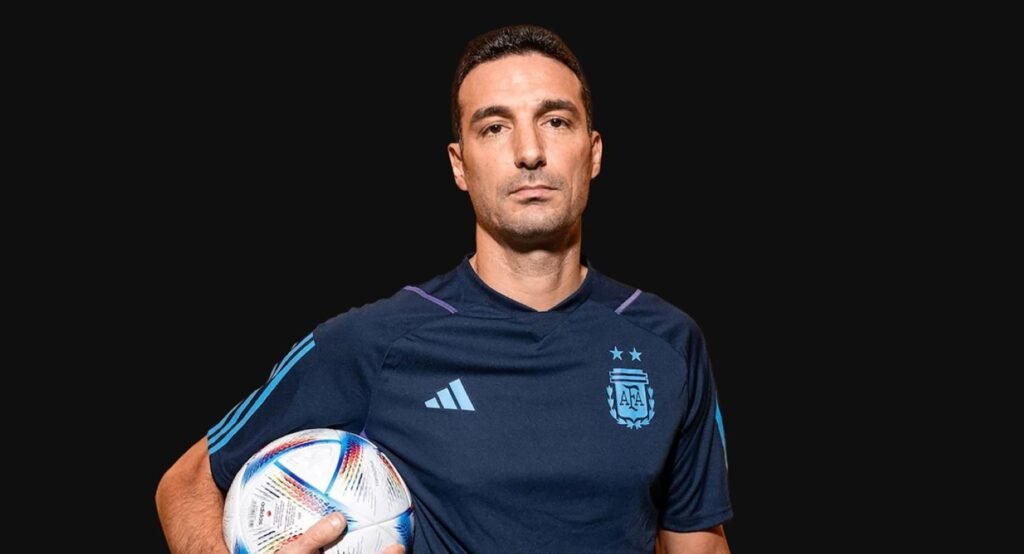
Lionel Scaloni turned his passion for football into a way of life. He first travelled the pitches as a player, always willing to adapt and take on different roles. He later became head coach of the Argentina national team, initially on an interim basis, and built one of the most successful periods in its history. His leadership is grounded in hard work, closeness with the players and a calmness that allows him to make decisions even under the greatest pressure.
A football childhood in Pujato
Scaloni was born on May 16, 1978, in Pujato, a town in the province of Santa Fe. He grew up in a family connected to football and showed a level of dedication from an early age that ultimately shaped his career.
He developed in the youth divisions of Newell’s Old Boys and made his professional debut for the club. He later played for Estudiantes de La Plata before beginning a long career in Europe.
Leaving home at an early age forced him to experience other cultures, adapt to new dressing rooms and understand different ways of living the sport. That experience would prove valuable years later, when he had to manage Argentine players developed in different leagues.
A career built on effort
In 1998, he joined Deportivo La Coruña, where he experienced one of the most important periods of his career. He was part of the team that won the Spanish league title, the Copa del Rey and the Spanish Super Cup.
Scaloni mainly played as a right-back, although he could also operate as a midfielder. His style was defined by intensity, energy and a willingness to contribute to the team. He was not tied to a single position and learned to respond to different needs.
He also played for West Ham, Racing de Santander, Lazio, Mallorca and Atalanta. He made seven appearances for the Argentina national team and was part of the squad that competed at the 2006 World Cup in Germany.
The beginning of an unexpected chapter
After retiring, Scaloni began preparing for a coaching career. He worked alongside Jorge Sampaoli at Sevilla and later joined his staff with the Argentina national team.
Following the 2018 World Cup in Russia, he took temporary charge alongside Pablo Aimar. The decision raised doubts because he had no previous experience as a head coach. Nevertheless, he began renewing the squad and succeeded in building a united group.
He called up new players, brought back others who had already represented the national team and established a direct relationship with Lionel Messi. At the end of 2018, he was confirmed in the role.
Passion transformed into a team
Scaloni’s main achievement was building a collective structure around individual talent. Argentina stopped depending exclusively on Messi and found players capable of supporting him, defending and taking responsibility.
His management combined closeness and authority. Scaloni listened to the players, strengthened the group’s internal relationships and prevented the dressing room from being dominated by rigid hierarchies. He also showed tactical flexibility, changing formations, names and positions according to the characteristics of each opponent.
His passion is reflected in match preparation and attention to detail. He analyses each player’s physical condition, protects the group’s overall functioning and communicates confidence without making himself the centre of the team.
The titles of the Scaloni era
The 2021 Copa América was the first major result of his project. Argentina defeated Brazil at the Maracanã Stadium and ended a 28-year wait for a major title.
In 2022, the team won the Finalissima against Italy and later reached the World Cup in Qatar. After losing to Saudi Arabia in the opening match, Scaloni made changes and maintained the squad’s confidence. Argentina recovered, reached the final and defeated France on penalties.
The 2024 Copa América extended that winning period. By then, Scaloni had already shown that his appointment had not been a temporary solution. His journey transformed passion for football into method, patience and leadership. The player who learned to adapt at every club ultimately built a national team recognised for its unity, character and ability to compete.