
Pedro Pascal
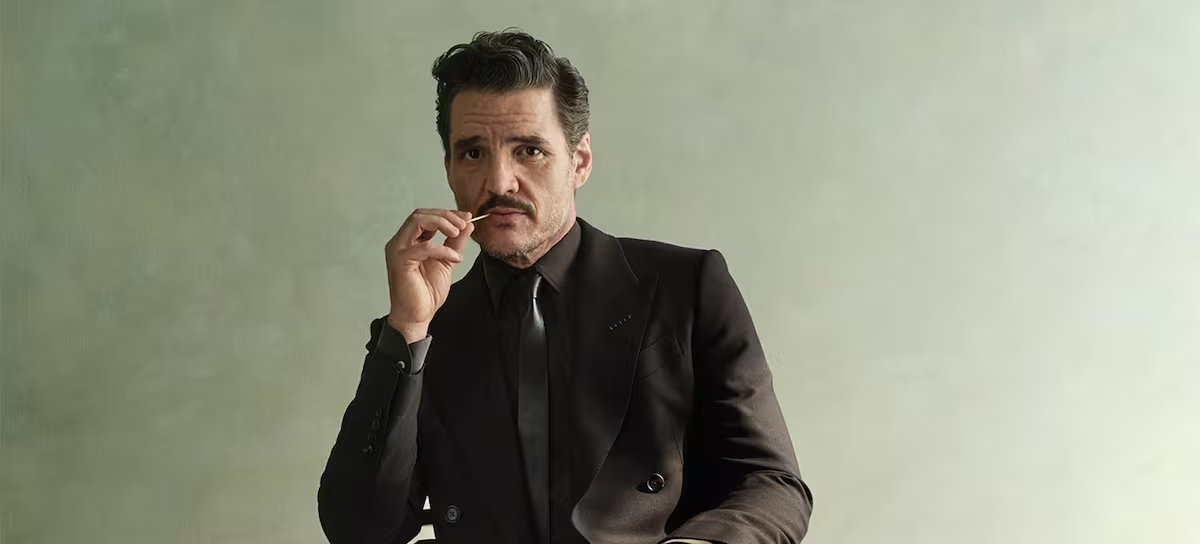
Pedro Pascal built a career shaped by persistence, acting training and a sensitivity connected to his family history. From his early work in theater and television to his consolidation in global series such as Game of Thrones, The Mandalorian and The Last of Us, his passion for acting translated into characters marked by loss, protection, humor and resistance.
Acting as a place of belonging
Pedro Pascal was born in Santiago, Chile, on April 2, 1975, under the name José Pedro Balmaceda Pascal. His childhood was shaped by family exile and adaptation to new environments, an experience that would later resonate with the way he interprets characters marked by displacement, survival and the search for bonds. Acting appeared in his life as a tool for expression, but also as a space where memory, accent, body and emotion could be transformed into stage presence.
A career built before fame
Before becoming an international figure, Pedro Pascal went through years of supporting roles, episodic appearances and sustained work in theater. That stage was decisive because it allowed him to develop technical resources away from mass recognition. His passion for acting was not expressed as anxiety for celebrity, but as discipline: studying scenes, sustaining auditions, observing human behavior and learning how to build characters with only a few minutes on screen. That patience explains the solidity of his later performances.
Oberyn Martell and the international leap
His appearance as Oberyn Martell in Game of Thrones marked a change of scale in his career. The character required a precise mixture of elegance, danger, family grief and political magnetism. Pascal did not interpret him as a decorative figure, but as a man driven by memory and the search for justice. Although his participation was brief, it left an intense mark on the audience. That role showed that he could dominate high-tension scenes without losing emotional nuance or physical presence.
Narcos and contained authority
In Narcos, Pedro Pascal consolidated a more sober side through Javier Peña, an agent marked by surveillance, exhaustion and coexistence with ambiguous power structures. His work relied on silences, glances and pauses, rather than major dramatic explosions. That expressive economy revealed mature acting dedication: the character conveyed fatigue, ethical pressure and determination without the need for overstatement. There, Pascal strengthened his image as a performer capable of sustaining tension through control.
The Mandalorian and the challenge of acting without a face
The Mandalorian presented him with a singular challenge: interpreting Din Djarin, a character often hidden behind a helmet and armor. Under those conditions, acting depends on voice, breathing, body rhythm and coordination with the visual language of the series. Pascal turned that limitation into a virtue. The bond between the Mandalorian and Grogu grew through minimal gestures, protective decisions and restrained affection, without falling into obvious sentimentality.
The Last of Us and emotional maturity
With The Last of Us, Pedro Pascal reached one of his most complex works. Joel is a survivor hardened by traumatic loss, forced to rebuild his capacity for affection in a devastated world. Pascal avoided exaggeration and chose a physical, dry and vulnerable performance. His character seemed to carry pain in his posture, in his low voice and in a persistent mistrust. That composition allowed him to connect with the audience through a fractured humanity, not through classic heroism.
Family history as artistic sensitivity
Pedro Pascal’s personal life is shaped by his Chilean origin, his family’s exile and an identity built between cultures. That biography does not fully explain his work, but it does help read certain patterns in his characters: displaced men, guardians, survivors or figures who learn to care in hostile contexts. His acting passion seems nourished by that sensitivity. On screen, he often works with characters who do not express everything they feel, but reveal their inner world through concrete actions.
A popularity sustained by craft
Pedro Pascal became a popular figure because of his public charisma, sense of humor and closeness with different audiences, but his permanence rests on something firmer: craft. His trajectory combines television, film, massive franchises and drama with strong emotional impact. That versatility allowed him to move from Game of Thrones to Narcos, from The Mandalorian to The Last of Us, without being reduced to a single type of character. His passion works as a method of professional continuity.
Reed Richards and a new stage
His incorporation as Reed Richards in The Fantastic Four: First Steps opened another area of his career. The character, associated with scientific intelligence, family leadership and collective responsibility, requires a different register from his more hardened figures. For Pascal, this type of role expands his expressive field: it is no longer only about portraying survivors or solitary protectors, but about working authority through reason, affection and the tension between knowledge and duty.
Passion as a form of resistance
Pedro Pascal’s career shows that artistic passion does not always appear as immediate impulse, but as prolonged resistance. His dedication can be seen in the years before recognition, in the ability to accept diverse characters and in the precision with which he transforms internal wounds into acting language. His work is crossed by tired bodies, protective bonds and restrained emotions. That combination turned his name into a central presence in contemporary film and television.