
Diego Rivera
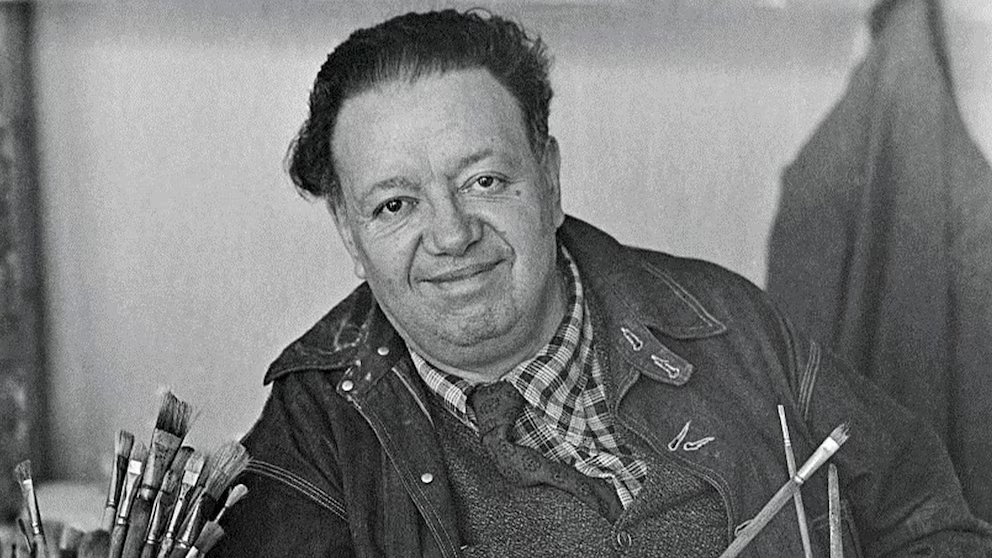
Diego Rivera structured his artistic production around a logic in which images function as a core element within social discourse. His work extends beyond formal criteria, aiming to construct accessible narratives about complex historical processes. Through muralism, he developed a visual system capable of integrating politics, identity, and collective memory within public space.
Training and exposure to avant-garde movements
Rivera’s early education at the Academia de San Carlos provided a classical technical foundation. This base was later reshaped during his time in Paris, where he engaged with movements such as Cubism. This experience transformed his understanding of pictorial space, allowing him to approach painting as an intellectual construction and later adapt these compositional frameworks to the Mexican context.
Muralism as cultural infrastructure
The emergence of muralism in Mexico is closely linked to post-revolutionary state policies aimed at consolidating national identity after the Mexican Revolution. Rivera, alongside José Clemente Orozco and David Alfaro Siqueiros, contributed to a model in which art became embedded within institutional spaces. Murals shifted from decorative elements to pedagogical tools designed for broad public engagement.
Technique, scale, and narrative construction
Rivera frequently employed the fresco technique, which involves applying pigments onto wet plaster. This method requires precise timing and structural planning. His compositions feature large-scale figures arranged in sequences that allow progressive interpretation. The use of color and volumetric forms enhances narrative clarity, enabling comprehension even within symbolically dense compositions.
Influence of pre-Hispanic traditions
His engagement with pre-Columbian art is reflected in the monumentality and formal simplification of his figures. Rather than replicating styles, Rivera reinterpreted visual codes to establish historical continuity. This approach integrates indigenous heritage into a modern framework, presenting national identity as a dynamic and evolving process.
Personal life and ideological framework
Rivera’s relationship with Frida Kahlo created a space of artistic and political exchange that influenced his work. Both shared a critical perspective on social structures and an adherence to Marxist thought. In Rivera’s case, this ideological dimension is expressed through works in which the artist positions himself as an მონაწილator within the conflicts he represents, rather than as a detached observer.
International projection and tensions
Rivera’s work in the United States revealed tensions between institutional commissions and ideological content. The controversy surrounding his mural at the Rockefeller Center, which included the figure of Lenin, exposed the limits of patronage when artistic content challenges economic interests. Rivera maintained his conceptual position, reinforcing his identity as a committed artist.
Legacy and contemporary relevance
Rivera’s impact redefined the role of art in public space, establishing a model in which imagery operates as a tool for social analysis. His work continues to influence multiple generations and disciplines, reinforcing the idea that artistic production can actively shape collective meaning. Muralism remains a reference point in ongoing discussions about culture, power, and representation.