
Pat Morita
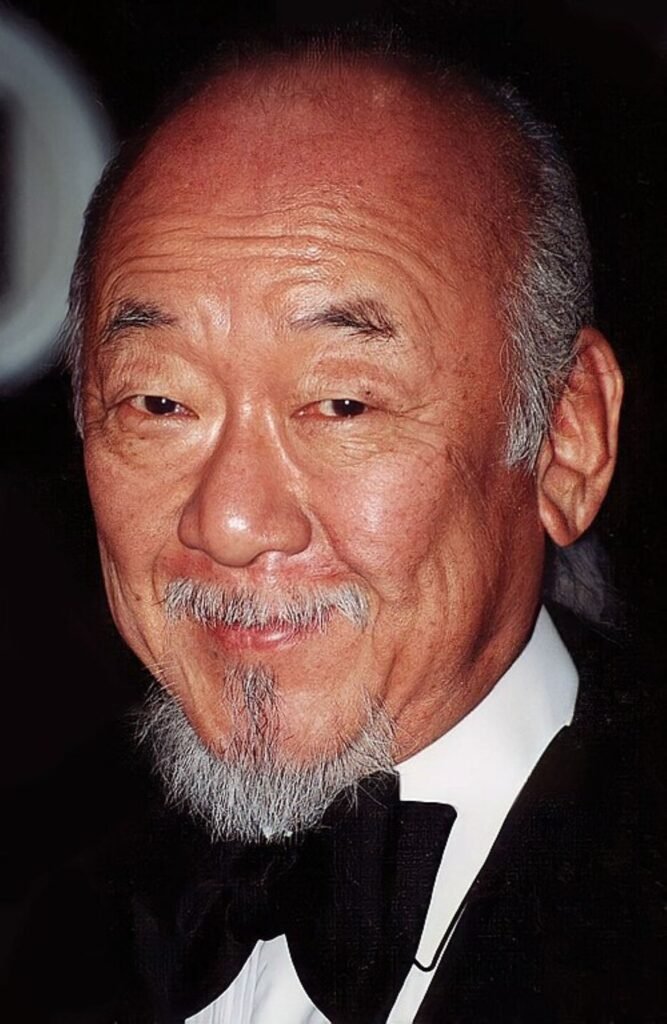
Pat Morita built a career defined by discipline, adaptability, and a technical relationship with acting. His trajectory does not follow a conventional progression, but rather a sequence of transitions shaped by health challenges, cultural context, and industry constraints. In his case, passion operates as persistence: maintaining professional continuity under adverse conditions.
Childhood and resilience formation
During his early years, Morita suffered from spinal tuberculosis, a condition that required long-term hospitalization and multiple surgeries. Recovery involved relearning basic motor functions, establishing a strong connection to physical and mental discipline. At the same time, his family was affected by the Internment of Japanese Americans, reinforcing a formative context marked by displacement and adaptation.
Comedy as a technical foundation
Before transitioning into acting, Morita developed his career in stand-up comedy. This format demands control over timing, audience perception, and expressive economy. These skills became transferable assets when he entered television. In Happy Days, his character relied on measured gestures and controlled delivery, translating stand-up techniques into serialized narrative performance.
Cinematic turning point
His role as Mr. Miyagi in The Karate Kid marked a structural shift. The performance is built on restraint, using silence and minimal gesture to convey emotional depth. This approach diverges from overt comedic expression and integrates personal experience with refined acting technique. His nomination for the Academy Awards in 1985 reflects recognition of this transformation.
Identity and cultural representation
Morita’s career unfolded within an industry that often limited roles for Asian-American actors. His work introduced variation within these constraints, constructing characters with greater narrative depth. Mr. Miyagi, for example, is defined not solely by cultural identity but by personal history and ethical framework, contributing to a gradual expansion of representation in mainstream media.
Personal tensions and professional continuity
Throughout his life, Morita faced challenges related to alcohol use, which affected aspects of his professional trajectory. These difficulties highlight structural pressures within the entertainment industry. Despite this, he maintained continuity in film and television, returning to work and adapting to changing conditions while preserving relevance.
Legacy and symbolic construction
Morita’s legacy is closely associated with mentorship as a structured process of repetition and gradual learning. In The Karate Kid, simple tasks are used to develop complex skills, reflecting a methodology aligned with his own career path. His trajectory emphasizes accumulated experience over episodic visibility, positioning his work as an example of sustained practice over time.