
Yuko Yamaguchi
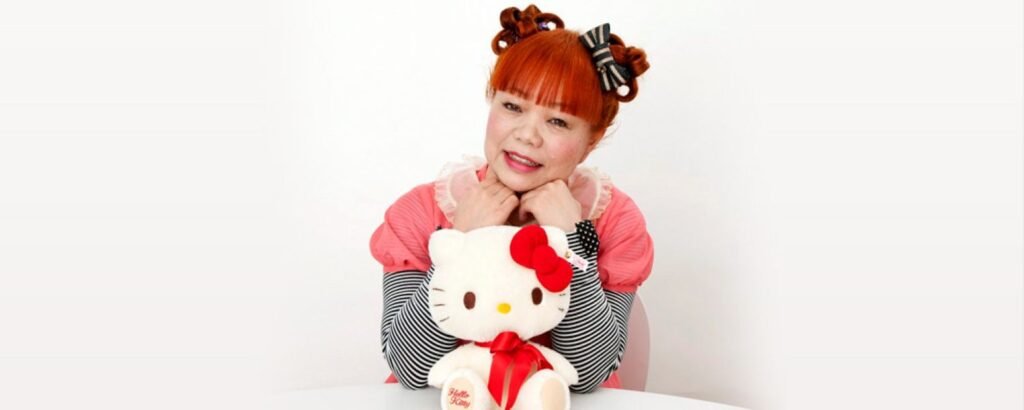
Yuko Yamaguchi is a Japanese designer born on October 24, 1955, in Kōchi. She joined Sanrio in 1978 and, in 1980, assumed creative responsibility for Hello Kitty, becoming the character’s third designer. For more than four decades she preserved its visual identity while guiding its global expansion, transforming a simple figure into a cultural symbol with international reach.
Education and industrial perspective
A graduate in industrial design from Joshibi University of Art and Design, Yamaguchi introduced structural logic into character creation. Her training extended beyond illustration to encompass object design, repetition and application. This foundation enabled Hello Kitty to maintain coherence across thousands of products, from school supplies to collaborations with international brands, ensuring adaptability without losing recognizability.
The contest that shaped her path
In 1980 she won an internal Sanrio contest with an illustration of Hello Kitty playing the piano. That design led her to take creative direction at a moment when the brand sought revitalization. The responsibility was not to reinvent the character, but to refine proportions, wardrobe and context while preserving the immediate recognition already established among audiences.
Design as continuity
Yamaguchi’s dedication was expressed through consistency. Keeping a character relevant requires updating details without altering its essence. She worked on thematic variations, cultural celebrations and seasonal adaptations that allowed the figure to accompany successive generations. Her role involved managing visual identity with precision and sustained discipline over time.
The expressive decision of the face
One of Hello Kitty’s most discussed traits is the absence of a mouth. This feature allowed the character to function as an emotional projection surface. Rather than fixing a specific expression, the design enables each viewer to interpret mood according to personal experience. The choice transformed a graphic limitation into a tool of cultural empathy.
Global expansion and licensing
Hello Kitty’s international growth required negotiating standards, adapting products and maintaining coherence across diverse markets. Yamaguchi was active during the period when the character evolved from a local icon to a global phenomenon. Graphic consistency proved essential for collaborations in fashion, technology and entertainment, supporting brand integrity at scale.
Other creative projects
Beyond Hello Kitty, Yamaguchi contributed to developments within the Sanrio universe such as Jewelpet and collaborations with TV Asahi’s mascot Go-chan. These projects reflect continuity in her approach: characters defined by formal simplicity and strong emotional identification. Although Hello Kitty became the most visible emblem, her career extended beyond a single icon.
Cultural debate and redefinition
At different moments, public discussions emerged regarding the character’s identity, particularly the clarification that Hello Kitty is portrayed as a “girl” rather than a “cat.” Rather than weakening the brand, these debates reinforced its symbolic dimension. The narrative construction surrounding the character demonstrates how visual identity is complemented by story and universe.
Conclusion of a stage and legacy
After more than 45 years associated with Hello Kitty, Yamaguchi announced her retirement in 2026. Her trajectory illustrates a distinctive form of dedication: sustaining a global character through continuous refinement and attentive cultural reading. Her legacy extends beyond a recognizable image to a design methodology that combines aesthetic sensitivity with industrial structure.